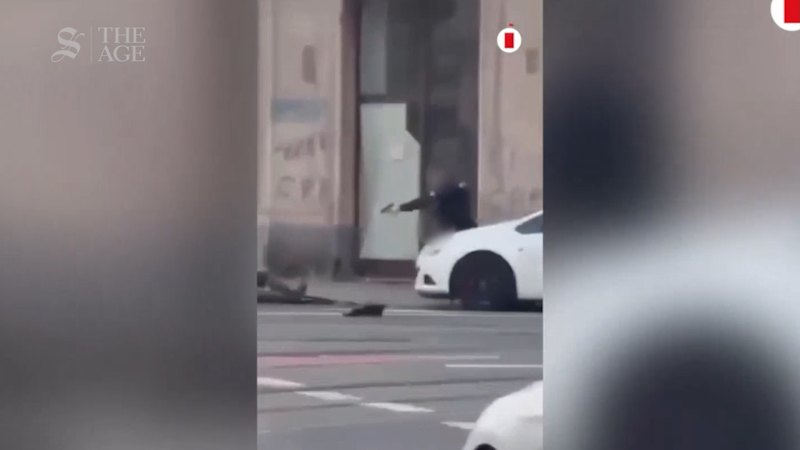
Every time a firearm discharges in a European tourist hub, the coverage follows a predictable, breathless script. A headline flashes across your feed: Polish gunman opens fire in Krakow's main square. Within minutes, cable news panels and viral threads transform a localized criminal incident into an existential referendum on European gun laws, border security, or the sudden collapse of civil order.
That narrative is lazy, factually distorted, and dangerous. If you found value in this piece, you should check out: this related article.
Having spent over fifteen years analyzing European urban security, municipal threat assessments, and crime data across Central and Eastern Europe, I have watched newsrooms and municipal leaders make the exact same mistake after every high-profile incident. They mistake visibility for statistical reality. They treat a rare anomaly in Rynek Główny as proof of a systemic breakdown, while ignoring the actual operational failures that turn crowded historic plazas into soft targets.
If you want to understand what really happened when shots rang out in Krakow—and why the standard media autopsy gets almost everything backward—you have to strip away the sensationalism and look at the mechanics of Central European crime, Polish firearm legislation, and the illusion of tourist-zone invulnerability. For another angle on this development, refer to the latest coverage from The Washington Post.
The Myth of the Gun-Free European Utopia vs. The Reality of Poland
The first lazy consensus in Western coverage of Polish gun violence is rooted in total ignorance of Polish law. When an incident occurs in Warsaw, Gdańsk, or Krakow, international commentators immediately frame it as an impossible breach of a continent-wide gun ban.
That premise is false. Poland does not have a blanket gun ban, nor is it experiencing an American-style wave of mass shootings. Under the Polish Act on Weapons and Ammunition (Ustawa o broni i amunicji), civilians can legally obtain permits for sporting, hunting, collecting, and personal protection—provided they pass rigorous psychological evaluations, background checks, and practical exams. Following Russia's full-scale invasion of Ukraine in 2022, legal gun ownership in Poland surged, with hundreds of thousands of permits now active across the country.
Yet despite that surge in legal ownership, Poland remains one of the safest countries in the European Union regarding firearm homicides. According to Eurostat and Polish Police (Policja) annual crime statistics, gun-related violent crime in Poland sits near the bottom of global rankings.
When a gunman opens fire in Krakow, the media immediately asks: How did he get a gun in a country with strict laws?
They are asking the wrong question. In almost every non-terrorist shooting in Poland over the last decade—from targeted organized crime hits in Wrocław to isolated domestic or personal disputes in Poznań—the weapon used was either an illicitly trafficked firearm from Balkan or post-Soviet black markets, a modified blank-firing alarm gun (bron alarmowa), or an illegally held antique/black-powder weapon.
Focusing on broad national gun control debates after a Krakow square incident is pure theater. It allows pundits to recycle pre-written talking points without examining the actual supply chain of black-market conversions or the specific behavioral red flags that preceded the attack.
Why Rynek Główny Creates an Illusion of Security
Krakow’s Main Market Square (Rynek Główny) is the largest medieval town square in Europe. On any given afternoon, tens of thousands of tourists, street performers, hospitality workers, and locals pack its cobblestones. Because the square is saturated with municipal guards (Straż Miejska), national police patrols, and high-definition CCTV networks, visitors assume it is an impenetrable fortress.
That assumption is an operational liability.
In urban security consulting, we call this the visibility paradox. High-density tourist zones deploy uniform patrols designed primarily for visible deterrence and low-level public order offenses—pickpocketing, public intoxication, unlicensed street vending, and rowdy stag parties.
Visible deterrence works brilliantly against opportunistic thieves. It does almost nothing against an acutely unstable individual, a targeted criminal assailant, or someone experiencing a violent psychotic break.
Here is the uncomfortable truth that city tourism boards hate admitting:
- Crowd density slows tactical response. A patrol officer 150 meters away across a packed square cannot sprint in a straight line when 5,000 panicked pedestrians suddenly surge toward narrow medieval exit streets like Floriańska or Grodzka.
- Acoustic distortion delays recognition. Surrounded by stone facades, church bells, and outdoor restaurant chatter, the initial crack of a small-caliber handgun or converted alarm pistol rarely registers immediately as gunfire. Bystanders freeze, assuming it is firecrackers or a dropped metal tray, costing critical seconds.
- Bottleneck architecture traps civilians. Medieval squares were built for commerce and defense against cavalry, not rapid emergency dispersal. Narrow alleyways create immediate crush hazards the moment panic sets in.
I have walked municipal officials through post-incident video reviews across European capitals where police response times were under ninety seconds—an extraordinary metric on paper—yet the perpetrator still fired multiple rounds and fled before officers could establish a clean line of sight. Celebrating fast police arrival while ignoring acoustic blind spots and crowd-crush bottlenecks is how cities guarantee they will be caught off guard again.
Dismantling the Media's Favorite Questions
Whenever a shooting hits a major European destination, search engines flood with predictable queries. Let's look at the standard questions people ask—and expose why the conventional answers are useless.
Is Krakow safe for tourists right now?
Asking whether an entire city of 800,000 people is "safe" based on a single shooting is statistically illiterate. You are vastly more likely to be injured by an intoxicated driver, a cobblestone fall, or a bar scam in Krakow than by gunfire. The real safety question for travelers isn't about crime rates; it is about situational awareness in high-density nightlife zones after midnight, where alcohol-fueled escalations actually happen.
Are gun violence incidents rising across Central Europe?
No. Violent crime across Poland, the Czech Republic, and Slovakia has trended downward over a twenty-year horizon. What has risen is instant smartphone documentation and algorithmic amplification. Ten years ago, a localized shooting between two criminals in a European city square produced a three-paragraph wire brief. Today, thirty-seven vertical videos hit X and TikTok before the ambulance arrives, creating the visceral illusion of a continent-wide epidemic.
Should European cities deploy armed tactical units permanently in tourist squares?
Putting assault-rifle-toting soldiers on every corner of Rynek Główny is security theater at its worst. Heavy militarization degrades the open civic atmosphere that makes European cities livable, habituates the public to armed patrols, and rarely stops a spontaneous close-range shooting before the first shots are fired.
The Real Blind Spot: Blank-Firing Conversions and Unmonitored Fringe Threats
If policymakers and journalists actually wanted to prevent the next incident in a European square, they would stop debating American politics and look at two concrete, verifiable vulnerabilities inside Europe right now.
First is the black-market conversion pipeline. Across the European Union, alarm and signal weapons—gas pistols and blank-firers—have historically been far easier to purchase than live firearms. Criminal workshops across Eastern and Southeastern Europe routinely bore out barrels and replace weak alloys to convert cheap blank-firers into lethal 9mm or .380 ACP handguns. Even after EU Directive 2019/69 tightened technical specifications on alarm weapons, hundreds of thousands of older, easily convertible models remain in circulation.
Second is the gap between psychiatric intervention and criminal flagging. Across Central Europe, chronic underfunding of community mental health services means individuals exhibiting severe paranoid delusions or escalating violent fixation routinely slip through the cracks until they acquire an illicit weapon or improvise a blade or vehicle attack. Police databases track known gang affiliates; they rarely integrate early-stage behavioral threat assessments unless a prior violent felony has already occurred.
Imagine a scenario where a municipality pours two million euros into adding forty new 4K surveillance cameras around its historic center, while leaving its regional crisis-intervention psychiatric unit understaffed by half and ignoring illegal online marketplaces selling converted blank pistols. When an attack inevitably happens, the city gets crisp, high-resolution footage of a tragedy it failed to interrupt upstream.
That is not security. That is forensic archiving.
The Downside of Telling the Truth About Urban Risk
Taking this contrarian stance—insisting that a shooting in Krakow is neither an apocalypse nor proof that current security models work—alienates everyone.
Tourism boards and city boosters hate it because pointing out medieval bottleneck risks and acoustic delays disrupts their immaculate "safest city in Europe" marketing brochures. Meanwhile, panic-peddling media outlets hate it because refusing to frame the incident as a sweeping ideological crisis kills their click-through rates.
There is also a genuine operational tension in my own argument: you cannot design a historic medieval square for maximum tactical dispersal without destroying its architectural heritage. Rynek Główny will never have wide modern boulevards, and turning historic centers into sterile, heavily barricaded fortresses ruins the very reason people live in and visit them. Accepting open public space means accepting a non-zero baseline of unpredictable human violence.
What Actually Makes Public Spaces Safer
If you manage urban venues, oversee municipal safety, or simply refuse to outsource your personal safety to wishful thinking, stop relying on visible police patrols as a magic shield. Effective risk reduction in dense European plazas requires specific, unglamorous adjustments:
- Deploy acoustic gunshot detection tied directly to CCTV slewing. Modern acoustic sensors distinguish between firecrackers, exhaust backfires, and muzzle blasts in milliseconds, automatically rotating nearby cameras to the exact coordinates before a single bystander dials 112.
- Train hospitality and street-level staff in immediate shelter-in-place protocols. Waiters, cafe managers, and municipal cleaners are the true first responders in a town square. Teaching them to lock heavy timber doors and move patrons away from glass storefronts saves more lives than adding another foot patrol three blocks away.
- Target illicit firearm conversion networks aggressively. Customs and national police task forces must treat converted blank-firing pistols with the same investigative priority as military-grade contraband, shutting down the cross-border parcel routes used to ship components.
- Practice basic spatial discipline as a civilian. When you sit in a crowded European square, note two exits that do not funnel into the main tourist bottleneck, avoid lingering in dense crowd surges when loud bangs occur, and never pull out your phone to film chaos instead of putting solid masonry between yourself and the noise.
Stop letting sensationalist headlines trick you into believing either that Europe is descending into lawless chaos or that a few extra police cruisers in a town square guarantee your safety. Look at the architecture, understand the real mechanics of illicit weapons, and keep your eyes open when the crowd stops moving.



