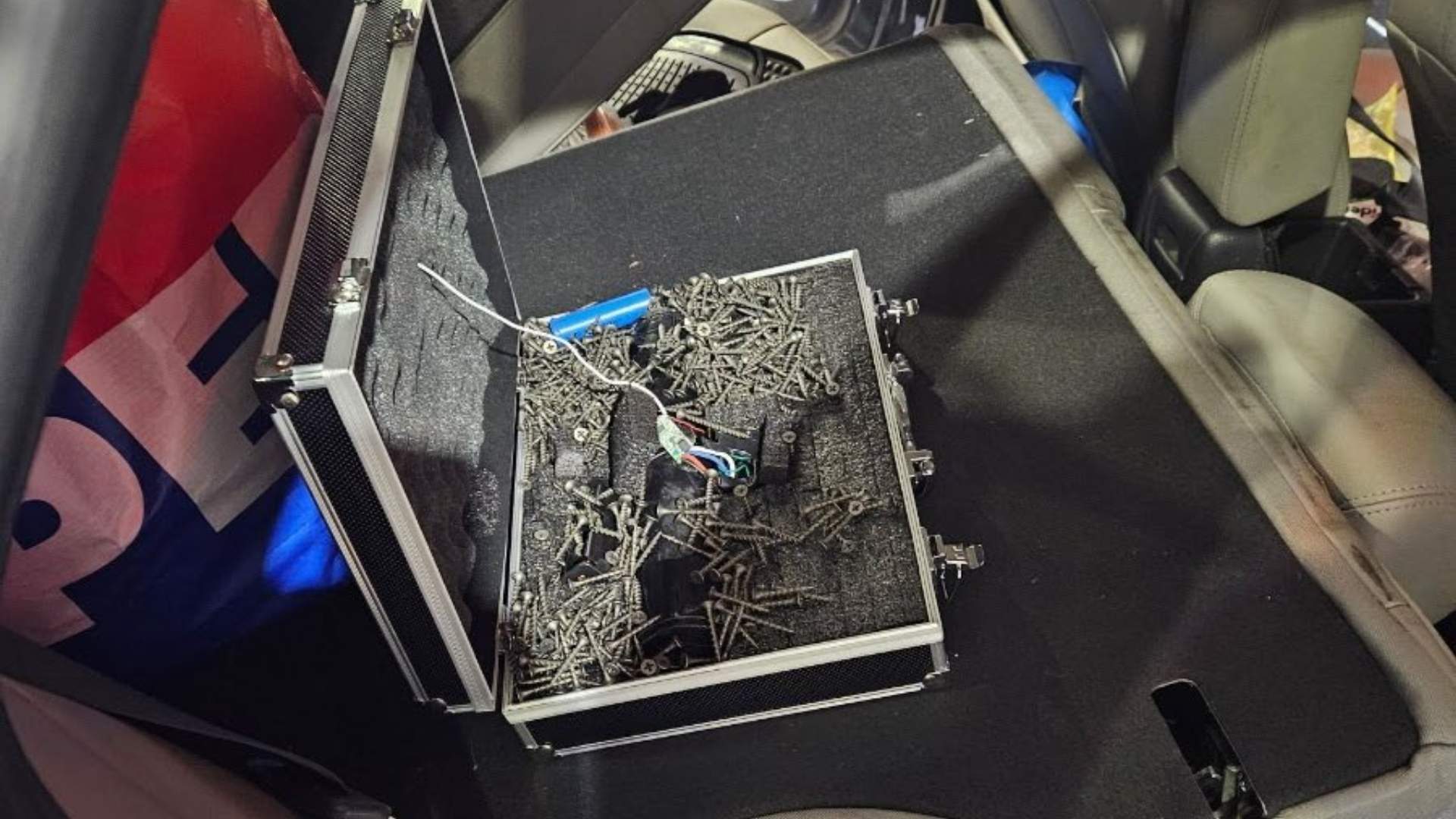
The morning of November 6, 2018, began with the kind of mundane rhythm that defines life in a bedroom community. In Sherwood Park, the air was crisp, tasting of the early winter chill that settles over Alberta like a heavy wool blanket. People were doing what they always do—scraping frost off windshields, balancing lukewarm coffees, and thinking about the evening’s hockey practice or the grocery list sitting on the kitchen counter.
But beneath the concrete skin of the Strathcona County Community Centre, something was waiting. It wasn't a mechanical failure or a structural crack. It was an Improvised Explosive Device (IED).
To the average passerby, the word "bomb" evokes Hollywood imagery: red wires, ticking clocks, a dramatic countdown. Real life is far more clinical. Real life is a car parked in a garage, packed with the intent to shred human beings.
The Anatomy of Lethality
When a veteran explosives expert looks at a device like the one found in that Sherwood Park parkade, they don't see a "weapon." They see a calculation. They see physics applied to flesh.
The car wasn't just a vehicle anymore; it had been transformed into a pressure vessel. Think of a pressure cooker on a kitchen stove. If the valve fails, the steam builds until the metal can no longer hold the energy. Now, replace that steam with a high-velocity chemical reaction and replace the pot with several tons of steel, glass, and plastic.
A former Mountie, one who spent years staring down the barrel of domestic threats, recently reflected on the sheer scale of the intent behind that device. His assessment was chilling. This wasn't a cry for help or a symbolic gesture. It was designed to kill many people. Many.
The word "many" is doing a lot of heavy lifting there. It accounts for the school children in the library upstairs. It accounts for the municipal workers at their desks. It accounts for the parents picking up their kids from the pre-school programs.
In explosives work, we talk about the "kill radius" and the "injury radius." The kill radius is the zone where the overpressure of the blast—the invisible wall of air moving faster than sound—literally crushes the internal organs. The injury radius is wider. That is where the shrapnel lives. In a car bomb, the car itself becomes the shrapnel. Door handles, engine bolts, and window glass become supersonic needles.
The Psychology of the Hidden Threat
Why does a quiet suburb become a target? It’s a question that haunts the edges of our collective security. We tend to think of danger as something that happens "over there"—in war zones or massive metropolitan hubs. But the choice of a community centre is a choice of intimacy.
It strikes at the heart of the social contract.
We park our cars, we walk into public buildings, and we assume the floor will hold. We assume the person in the next stall over is just another neighbor. When that trust is weaponized, the damage lingers long after the glass is swept up.
Consider the hypothetical family—let's call them the Millers. They are walking toward the elevator, the toddler is complaining about his boots being too tight, and the mother is checking her watch. They are ten feet away from a trunk full of carefully arranged destruction. They don't know it. The air is silent. The world is normal.
That gap between the mundane and the catastrophic is where the horror lives. The "former Mountie" mentioned in the briefings isn't just offering a technical opinion; he is highlighting the bridge between "it could have happened" and "it almost did."
The Invisible Shield
We rarely think about the people who walk toward the sound of a silent threat. When the first explosion occurred that Tuesday evening—a smaller blast that served as a grim precursor—the evacuation began.
Imagine being a first responder entering that parkade. You are walking into a concrete box. You know there has already been one detonation. You know the air is thick with the smell of burnt ammonium and scorched rubber. Your lizard brain is screaming at you to run the other direction.
Instead, you look for the source.
The discovery of the second, much larger device changed the narrative from a localized accident to an attempted massacre. The sheer volume of explosives involved meant that if the primary device had functioned as intended, the Community Centre wouldn't just have been damaged. It would have been a tomb.
The technical skill required to build a device capable of such mass casualty is significant. It requires a specific kind of dark patience. You have to source the components, often hiding them in plain sight. You have to understand the chemistry of ignition. You have to be willing to sit in a garage and assemble a puzzle where the final picture is blood.
The Lingering Echo
The suspect in the Sherwood Park case, a 21-year-old man, died from a self-inflicted gunshot wound shortly after the incident. This left a void where an explanation should be. Without a trial, without a manifesto, the community was left to stare at the "why" and find nothing but their own reflections.
This is the cruelty of domestic terror. It provides no closure, only a heightened sense of vigilance that borders on Paranoia.
For months afterward, people in Strathcona County looked at parked cars differently. They noticed the unattended bag. They felt a slight prickle of heat on the back of their necks when they entered a crowded room. That is the secondary blast of an IED—the one that happens in the mind.
The expert’s testimony serves as a cold reminder: security is an illusion we all agree to maintain. We rely on the fact that most people are good, or at least, not actively murderous. But when one person decides to break that agreement, the response must be absolute.
The former Mountie’s words weren't meant to scare. They were meant to respect the reality of what was stopped. We often celebrate the heroes who save lives from burning buildings or sinking ships. It is harder to celebrate the "non-event"—the bomb that didn't go off, the massacre that stayed in the realm of the theoretical.
But we must.
We have to recognize that the difference between a Tuesday night dinner and a national day of mourning was a matter of a few failed circuits and the rapid intervention of people who knew exactly what they were looking at.
The metal under the floorboards was meant to change Sherwood Park forever. It was meant to be a landmark of grief. Instead, it became a testament to the fragile, invisible lines that hold a community together.
The car was a coffin that stayed closed. The children in the library went home. The grocery lists were finished.
Sometimes, the most important story is the one that never got the chance to finish its final act.
The silence in that parkade after the technicians finished their work wasn't just the absence of sound. It was the weight of every life that was still allowed to breathe, unaware of how close they had come to the heat.


