Everyone in Washington is popping champagne over the wrong funeral.
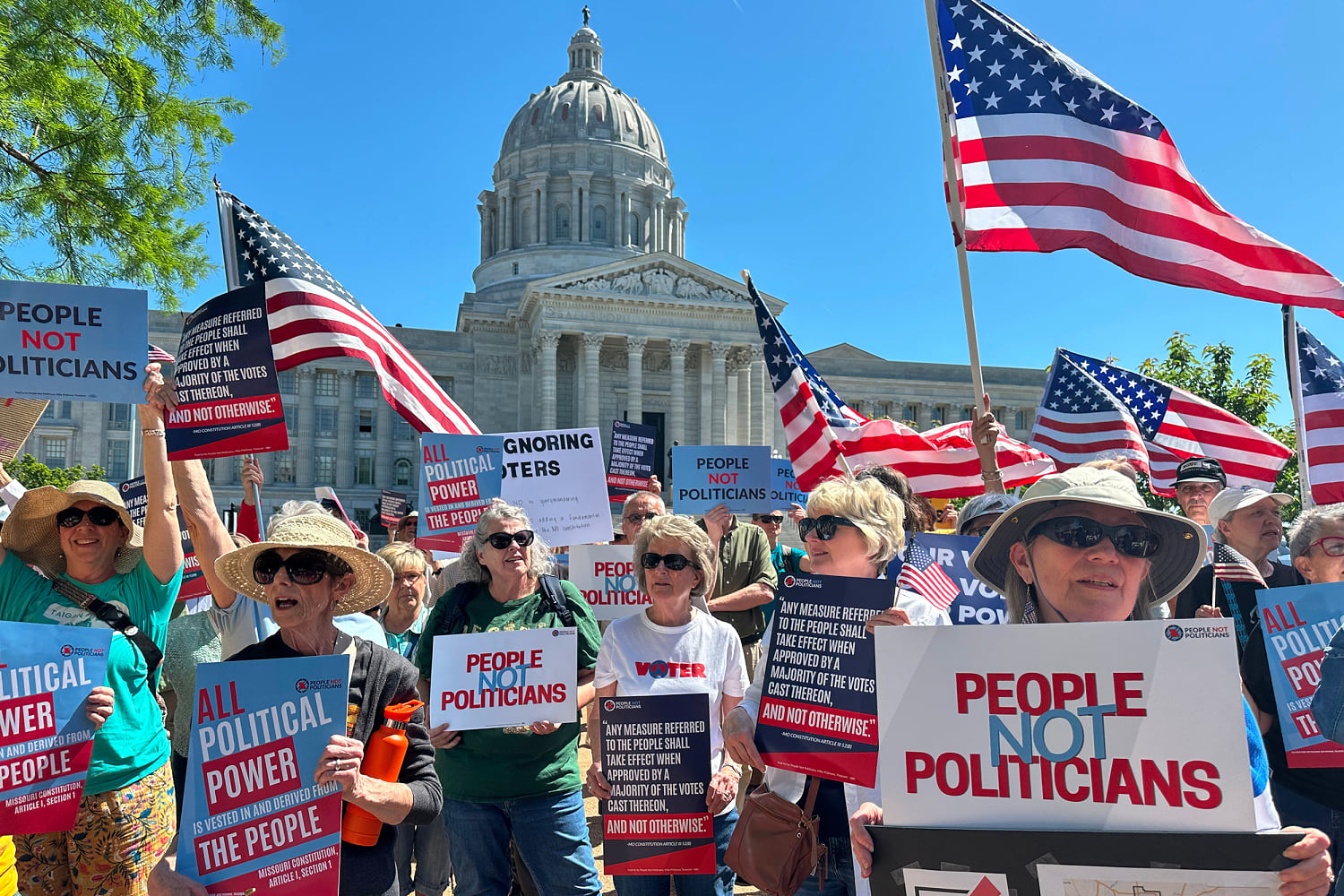
Political pundits are framing the rejection of Missouri’s Republican-drawn congressional map as a massive populist triumph. They want you to believe grassroots organizers just dealt a death blow to partisan gerrymandering in the Show-Me State. They are wrong. Dead wrong.
If you actually understand how map-drawing mechanics work in deep-red states, Missouri voters didn't just save democracy. They accidentally rescued the Missouri GOP from a catastrophic self-inflicted wound, while handing Democrats a pyrrhic victory that changes almost nothing on the ground in Washington.
Let’s look past the victory laps and examine the cold, hard math of Missouri redistricting.
The Lazy Consensus About "Fair Maps"
The mainstream coverage of Missouri’s redistricting battle relies on a comforting fairy tale. The story goes like this: greedy Republican legislators tried to carve up the state to cement a 7-1 congressional delegation, and heroic voters stepped in via the referendum process to stop a partisan power grab.
That narrative sells subscriptions. It also ignores basic political geography.
Missouri is not a swing state anymore. Barack Obama lost it by less than 4,000 votes in 2008; Donald Trump won it by over 15 points in 2020 and nearly 19 points in 2024. When a state tilts that heavily toward one party, you don't need a dark-room conspiracy to produce a lopsided congressional delegation. Geography does the heavy lifting for you.
Democratic voters in Missouri are overwhelmingly packed into two dense urban cores: St. Louis and Kansas City. Everywhere else—from the Bootheel to the Ozarks to the northern plains—is bright red. In political science, this is known as unintentional gerrymandering or natural packing, a phenomenon extensively documented by researchers like Jowei Chen and Jonathan Rodden.
Even if you locked a nonpartisan algorithm in a room with zero partisan data and told it to draw compact, contiguous districts that respect county lines, Missouri would still naturally produce a 6-2 Republican map almost every single time.
So when voters block a Republican-drawn map, what are they actually blocking? They aren't stopping a wave of blue seats from emerging. They are merely forcing the state back to a baseline that already favors the GOP by a three-to-one margin.
How the "7-1 Map" Was a Trap for the GOP
Here is the secret Republican strategists in Jefferson City won't say out loud: the aggressive 7-1 map was a ticking time bomb for their own incumbents.
To squeeze a seventh Republican seat out of Missouri, mapmakers had to crack Kansas City—specifically Emanuel Cleaver’s 5th District—and dilute Democratic voters across sprawling suburban and rural districts. On paper, in a neutral election year, this turns six safe GOP seats and two safe Democratic seats into seven lean-Republican seats and one safe Democratic seat.
In practice, it violates the first rule of gerrymandering: never sacrifice your floor to raise your ceiling.
I have watched state parties blow millions of dollars defending "dummymanders"—maps stretched so thin to maximize seat counts that a modest wave election wipes out half the delegation. When you take reliable Republican voters out of safe districts like the 2nd (St. Louis suburbs) or the 4th to prop up a newly drawn district in Jackson County, you turn +15 Republican seats into +6 or +7 seats.
If a national wave hits in a midterm cycle—a 6- or 7-point swing toward Democrats—that greedy 7-1 map doesn't hold. It collapses. Suddenly, Republicans aren't gaining a seat in Kansas City; they are losing Ann Wagner’s seat in St. Louis County and failing to hold the cracked Kansas City seat, ending up with a 5-3 delegation instead of the 6-2 lock they started with.
By rejecting the overreaching map, Missouri voters forced the GOP back into a fortress. A 6-2 map makes those six Republican seats virtually indestructible, even in a historic blue tsunami. Voters thought they were clipping the GOP's wings. They actually put them back in armor.
The Illusion of the Referendum Veto
There is a second, deeper delusion running through the commentary on Missouri: the idea that citizen-led ballot measures are a silver bullet against partisan mapmaking.
We have seen this movie before. In 2018, Missouri voters overwhelmingly passed Amendment 1, known as "Clean Missouri," which created a nonpartisan state demographer to draw legislative lines based on partisan fairness. Two years later, in 2020, the Republican-controlled legislature put Amendment 3 on the ballot—packed with confusing language about lobbyist gifts—and voters repealed their own reform.
Direct democracy is a blunt instrument, and legislatures hold the scalpels.
Even when voters successfully block a congressional map via referendum or constitutional amendment, the process triggers a chaotic sequence of court battles, special masters, and remedial maps. And who appoints the judges on the Missouri Supreme Court? Every single justice on the state’s highest court was appointed by a Republican governor, thanks to Missouri’s nonpartisan court plan—which still relies on the governor making the final pick from a three-person panel.
Imagine a scenario where a rejected map gets kicked to the courts or back to the General Assembly under a tight filing deadline. The legislature stalls, forces a constitutional crisis over candidate filing dates, and either passes a slightly tweaked version of the exact same map or watches a conservative judiciary adopt a status-quo 6-2 map that locks in GOP dominance for the rest of the decade.
Voters get the emotional satisfaction of saying "no." The party in power keeps the structural advantage.
Answering the Wrong Question About Redistricting
If you look at what people actually search for when news like this breaks, the questions reveal how thoroughly the public misunderstands the mechanics of representation:
- "Does blocking the GOP map mean Democrats will gain seats in Missouri?" No. Unless a court draws an aggressive racial-packing or partisan-fairness map that deliberately snakes urban voters into rural counties, Democrats are capped at two seats in Missouri. Blocking the map preserves the status quo; it does not flip seats.
- "Why didn't the independent commission fix this?" Missouri uses bipartisan commissions for state legislative districts, not congressional ones. Congressional maps are passed like regular bills by the legislature and signed by the governor—which is precisely why they are vulnerable to the state's referendum process, unlike in states where governors have no veto power over maps.
- "Is gerrymandering illegal if voters reject the map?" Not even close. The U.S. Supreme Court ruled in Rucho v. Common Cause (2019) that partisan gerrymandering claims are nonjusticiable in federal court. Unless a map violates the Voting Rights Act on racial grounds or violates a specific provision of a state constitution, state legislatures have near-total authority to draw lines for partisan gain.
Everyone is obsessed with who draws the lines. Almost nobody is paying attention to how primaries actually dictate policy.
The Real Damage Happening in Safe Districts
Whether Missouri runs on a 6-2 map or a 7-1 map, the real distortion of American democracy isn't happening in the general election. It is happening in the August primaries.
When you preserve a 6-2 map with six hyper-safe Republican seats and two hyper-safe Democratic seats, general elections become pure theater. The winner is decided months earlier, in low-turnout party primaries dominated by the most ideologically rigid 10 percent of the electorate.
I have sat in strategy rooms with congressional incumbents who never once mentioned their general election opponent. Not once. Every dollar they raised, every press release they issued, and every floor vote they took was calculated around one terrifying metric: surviving a primary challenge from their own flank.
A 6-2 map guarantees that six Missouri Republicans never have to appeal to a swing voter in their lives. Meanwhile, the two Democrats in St. Louis and Kansas City face the exact same incentive structure in reverse. Neither side pays a political price for refusing to compromise, because neither side faces a competitive general election.
Paradoxically, the "unfair" 7-1 map that voters rejected would have forced at least two or three Missouri Republicans to actually campaign for moderate, suburban voters in order to survive. By killing it, voters inadvertently reinforced the exact partisan echo chambers they claim to hate.
The Downside of My Own Argument
Let’s be honest about the flaw in this contrarian take: principles matter, even when the math doesn't change.
If you let a state legislature ignore public backlash and steamroll an unpopular map through without consequences, you erode public trust in the legitimacy of elections. Even if a 6-2 map and a 7-1 map both leave Republicans with a commanding majority, the process of voters exercising their constitutional right to check the legislature is not meaningless. It forces politicians to remember that their power is borrowed, not owned.
Furthermore, a single seat in the U.S. House of Representatives is no longer a rounding error. With House majorities routinely hinging on three to five seats, denying the GOP a single pickup opportunity in Kansas City can literally determine who holds the Speaker’s gavel and controls committee subpoenas.
What Reformers Should Actually Do Instead
If voting rights advocates and frustrated citizens want to actually change the incentives in states like Missouri, celebrating a blocked map is a waste of energy. The playbook needs a complete overhaul:
- Stop fighting over maps and start targeting primary rules. Passing Top-Four or Top-Five open primaries with ranked-choice voting—the model Alaska adopted—does more to moderate politicians in a single cycle than ten years of redistricting lawsuits. When a Republican in rural Missouri has to worry about winning second-choice votes from independents and moderate Democrats, their behavior in Washington changes overnight.
- Ditch the "nonpartisan commission" obsession. Independent commissions sound great in theory, but in practice, they get bogged down in endless litigation, partisan infiltration of the selection pools, and paralysis. Look at how California’s commission was quietly gamed by savvy operatives posing as regular citizens during the public comment phase. Transparent, mathematical rules—strictly enforcing compactness and banning the splitting of municipalities—are harder to manipulate than a room full of "independent" appointees.
- Focus on state legislative maps, not Congress. Congressional districts get the cable news coverage, but state house and senate maps determine who controls the redistricting pen, election administration, and ballot access laws for the next ten years. You cannot fix the top of the ticket while ignoring the foundation.
Missouri voters proved they still have the muscle to pull the emergency brake when politicians get greedy. Now they need to realize that pulling the brake doesn't steer the car.


