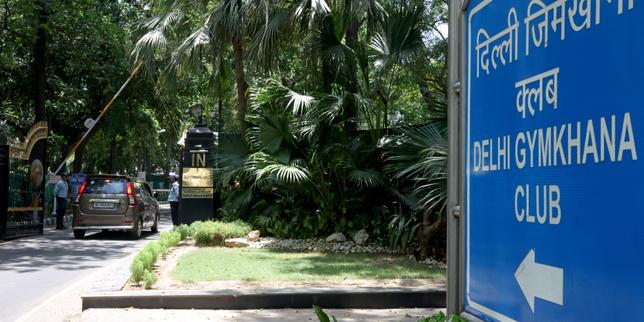
The recent government order directing the Delhi Gymkhana Club to vacate its massive 27.3-acre property in the most heavily guarded square kilometer of New Delhi has been framed by many as a populist war on entrenched privilege. To see this simply as Narendra Modi fighting a Lutyens' Delhi elite is to miss the real mechanics of Indian state power. The state-led push to reclaim this ultra-exclusive colonial-era institution reveals a much deeper shift in how public land, national security, and institutional control are managed in India today.
Founded in 1913 as the Imperial Delhi Gymkhana Club, the institution has long functioned as a premier watering hole and social network for top civil servants, military brass, and old-money families. For decades, a non-government applicant could expect to languish on the membership waiting list for up to 40 years. Yet, the current standoff is no longer just a cultural debate about colonial legacies. It is a high-stakes legal and political battle involving federal ministries, forensic financial audits, and sudden eviction notices based on national security.
The National Security Pretext Next to the Prime Minister Residence
The Ministry of Housing and Urban Affairs served an eviction notice with an initial June 5 deadline, though subsequent legal challenges extended that timeline while the Delhi High Court deliberated. The official reason provided by the state is the need for "strengthening and securing defence infrastructure" and other public security purposes.
Given that the club shares a direct boundary wall with the Prime Minister's official residence on Safdarjung Road, security arguments carry significant political weight. The club has faced intense scrutiny over specific lapses. Internal records and investigative findings highlighted a bizarre incident involving an unauthorized drone flown during a political rally organized right inside the club premises. For a high-security VIP zone, an unregulated drone flight is a major red flag, and the government used these operational vulnerabilities to build its case for reclaiming the land.
Critics and club defenders argue that the national security angle is a convenient cover. They point out that New Delhi navigated much higher periods of active domestic terror threat throughout the 1980s and 1990s without the club ever presenting a physical danger to the leadership. However, the state's legal position relies on the absolute authority of the lessor. Union Housing and Urban Affairs Minister Manohar Lal explicitly stated that the government retains the legal right to take back leased public land for development or national security whenever required, regardless of whether the lease has expired.
When the Cleanup Crew Leaves a Worse Mess
This confrontation didn't happen overnight. The state actually took functional control of the club back in April 2022. Following years of complaints regarding membership irregularities, nepotism, and lease violations, the National Company Law Tribunal (NCLT) suspended the club's elected general committee. The Ministry of Corporate Affairs (MCA) then stepped in, appointing a six-member board of administrators to clean up the club's financial management and eliminate insider corruption.
Instead of a smooth institutional overhaul, the government-appointed management presided over an era of internal chaos. A review of internal records and forensic audits conducted by firms like Baker Tilly reveals a series of striking red flags that continued well into 2024 and 2026:
- Unapproved Accounts: Club members openly revolted during recent Annual General Meetings, refusing to pass the audited accounts presented by the government-backed administrators.
- The Sealed Audit: The administration commissioned a comprehensive forensic audit shortly after taking over in 2022, yet they kept the final report under wraps, refusing to share it even with the club's own internal auditors.
- Phantom Expenses: Draft versions of financial audits flagged systemic accounting failures, including expenses billed to the accounts of deceased members who were still somehow "dining" at the club.
- Surging Litigation Costs: Despite a stated goal to reduce waste, legal expenses spiked significantly. The club spent over 8 crore rupees on continuous litigation within a five-year window, paying massive fees to top-tier lawyers while internal financial reporting grew increasingly opaque.
Frustrated by the lack of internal control and missing records, the club's long-standing auditing firm, Khanna and Anandhanam, abruptly resigned. The subsequent auditors, AVA & Associates, similarly noted in their reports that they were completely denied access to vital financial files.
The Broader Threat of Executive Overreach
The legal battle over the Delhi Gymkhana Club has triggered panic across thousands of educational, cultural, and charitable organizations throughout India that operate on public land leases. If the central government can summarily evict an incredibly well-connected club worth an estimated 10,000 crore rupees by citing vague defense needs, it sets a highly volatile legal precedent.
Every single school, sports complex, and historical society operating on a government lease now faces structural uncertainty. The lease agreement, meant to provide long-term stability, effectively converts into a fragile arrangement vulnerable to shifting political calculations. This centralized reclamation policy signals a fundamental change in how the current administration views autonomous social institutions.
For the general public, the debate remains split. One side sees the dismantling of an obsolete, exclusionary playground where elites paid nominal annual rents for prime real estate. The other side sees the destruction of a unique heritage space, historic library, and vital urban green expanse to make way for concrete state infrastructure.
Real Next Steps for Institutional Leadership
If you run or sit on the board of a leased institutional space in India, you cannot afford to treat the Gymkhana crisis as an isolated incident. The state is systematically auditing land use and compliance across the country. To insulate your organization from sudden regulatory actions, implement these operational steps immediately:
- Conduct a Rigorous Lease Compliance Audit: Do not wait for a government notice. Hire independent legal counsel to review your original land grant conditions, construction permissions, and sub-leasing terms to ensure zero technical violations.
- Modernize Financial Reporting: The Gymkhana administration fell apart because of manual accounting mismatches and undisclosed vendor relationships. Transition your institution to transparent, digital accounting frameworks with strict, independent internal controls.
- Resolve Member Misconduct Proactively: If your organization has legacy issues regarding nepotistic membership tracks or unvetted financial perks, address them internally through transparent policy changes before regulatory bodies use them as a pretext for an institutional takeover.
The era of relying on old-boy networks and political connections to protect premium institutional land is officially over. Total compliance and bulletproof financial transparency are now your only real defense.
To better understand the scale of the public land and elitism debate surrounding this historic transition, watch this detailed broadcast on the Delhi Gymkhana Club Takeover. This discussion features key insights into how the balance between heritage preservation and state authority is playing out on the ground in New Delhi.