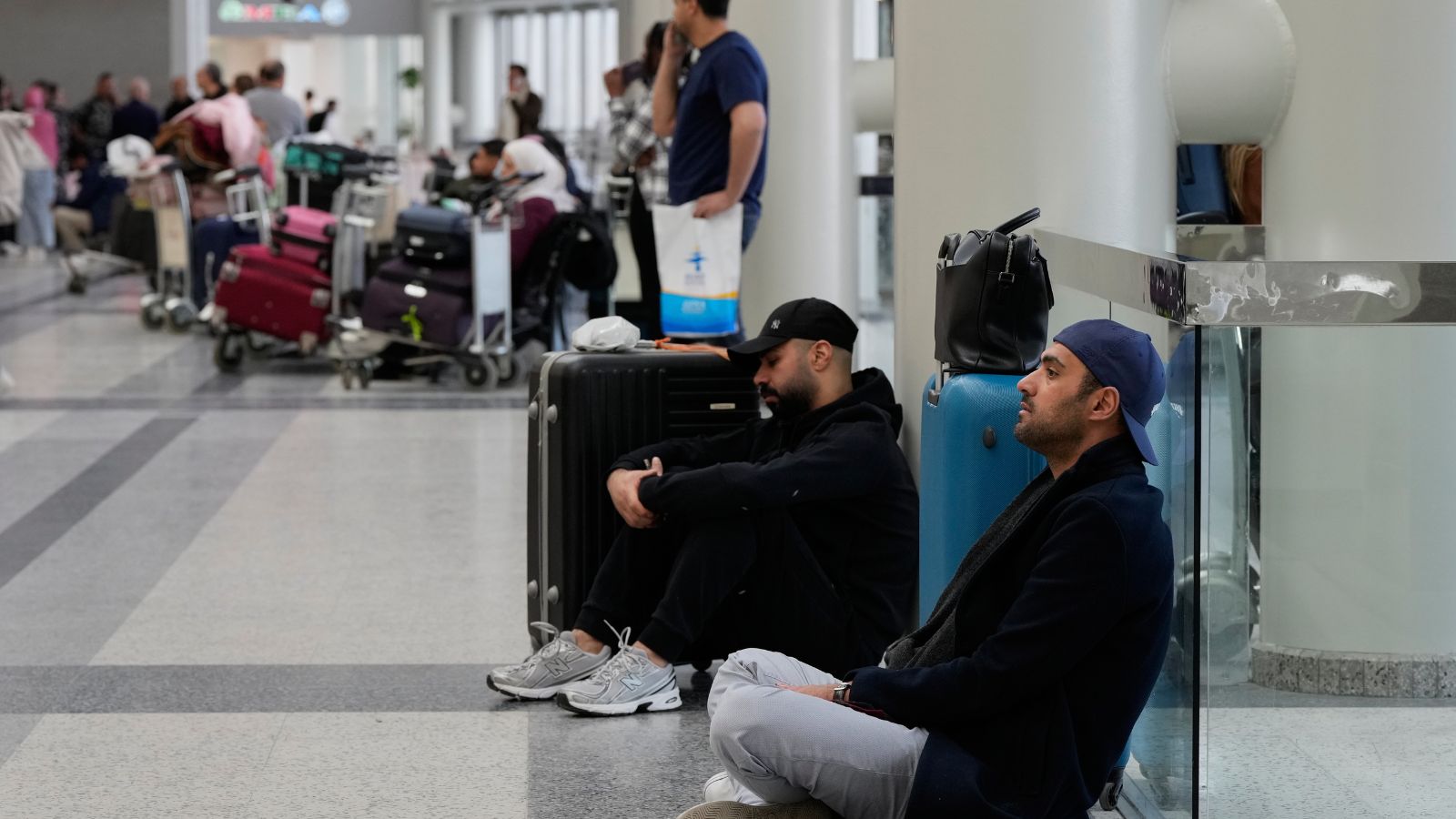
The air inside Terminal 3 of Dubai International Airport usually smells like a blend of expensive oud, roasted Arabica, and the sterile, pressurized promise of somewhere else. It is a cathedral of kinetic energy. On a typical Tuesday, sixty thousand souls drift through these corridors, their minds already orbiting London, Tokyo, or New York. We treat airports like non-places—liminal zones where the laws of physics and the fragility of the human body are temporarily suspended by the sheer industrial might of global transit.
Then, the sound changed.
It wasn't the roar of a GE90 engine or the rhythmic chime of a boarding announcement. It was the sharp, discordant crack of reality breaking through the polished veneer of the world’s busiest international hub. In an instant, the seamless choreography of flight schedules and duty-free shopping collapsed. Four people, individuals who had likely spent their morning worrying about seat assignments or carry-on weight, suddenly found themselves at the center of a different kind of calculation: the triage of an "incident."
The Dubai Media Office is notoriously concise. Their reports are masterpieces of linguistic economy. When they announced that four people were injured following an incident at the airport, they provided the "what" but meticulously scrubbed away the "how" it felt. To the official record, it is a statistic to be managed. To the person standing five feet away from the impact, it is a haunting.
Imagine a traveler—we will call her Sarah. She is a consultant, the kind of person who can navigate DXB blindfolded. She is checking her watch, calculating if she has time for a quick espresso before the trek to the gate. To Sarah, the airport is a machine. It is a reliable, high-performance engine designed to propel her through life. When that machine stutters, the psychological fallout is more than just a delay. It is a visceral reminder that our modern safety is a thin membrane.
The injury of four people in such a controlled environment acts as a glitch in the simulation. We don’t go to airports expecting the ground to give way or the infrastructure to fail. We go there to be processed. When the process bleeds, the silence that follows is heavier than any jet engine’s drone.
The logistical aftermath of such a moment is a frantic, invisible ballet. While the headlines focus on the number of casualties, a city within a city springs into action. Medics move through the sea of rolling suitcases. Security cordons off the scent of burnt rubber or shattered glass. Behind the scenes, the Dubai Media Office coordinates with airport authorities to ensure the flow of "business as usual" isn't interrupted for too long.
There is a cold brilliance to how DXB handles crisis. Within an hour, the debris is often cleared, the yellow tape is gone, and the next wave of passengers walks over the same floorboards, oblivious to the fact that someone’s life changed there sixty minutes prior.
But the real problem lies elsewhere. We have become so accustomed to the perfection of these transit hubs that we’ve lost our respect for the sheer scale of the forces at play. An airport is not a shopping mall with wings. It is a high-pressure environment where thousands of tons of steel, millions of gallons of fuel, and complex mechanical systems converge.
Consider the mechanics of a simple luggage belt or a motorized walkway. To a child, it's a toy; to an engineer, it's a series of torque calculations and potential failure points. When we hear "four injured," our minds search for a villain—a terrorist, a rogue pilot, a catastrophic fire. But often, the truth is more mundane and, in some ways, more terrifying. It is a mechanical slip. A structural hiccup. A human error in a system that demands 100% uptime.
Safety isn't a static state; it's a constant, exhausting performance.
When the news cycle moves on—which it does in Dubai with a ruthless efficiency—the four people involved remain. For them, the airport is no longer a non-place. It is the site of a trauma. It is the place where a vacation ended before it began, or where a business trip turned into a hospital stay. While the Media Office confirms they are receiving "necessary medical care," that phrase acts as a curtain drawn over a private struggle.
The invisible stakes of our travel-obsessed culture are rarely discussed. We trade our vulnerability for speed. We step onto those moving walkways and trust that the teeth of the machine won't bite. We walk under massive architectural overhangs and trust the bolts will hold. Most of the time, they do. But when they don't, the shock is as much about the betrayal of that trust as it is about the physical pain.
Dubai is a city built on the defiance of limits. It is a desert that became a forest of glass. Its airport is the crown jewel of that ambition, a place where the sun never sets on the arrivals board. To admit to an "incident" is to admit to a crack in the armor.
The four people in that ward tonight are the human cost of a system that rarely pauses. They are the friction in a world that demands to be frictionless. As the A380s continue to lift off into the humid Arabian night, their shadows stretching over the sand, the airport continues its song. The coffee is poured. The perfumes are sprayed. The boarding calls resume.
The world moves on because it has to. But for a few minutes on a Tuesday, the machine stopped, and we were forced to look at the ghosts in the gears.
A single shoe left on a polished floor tells a story that a press release never will.