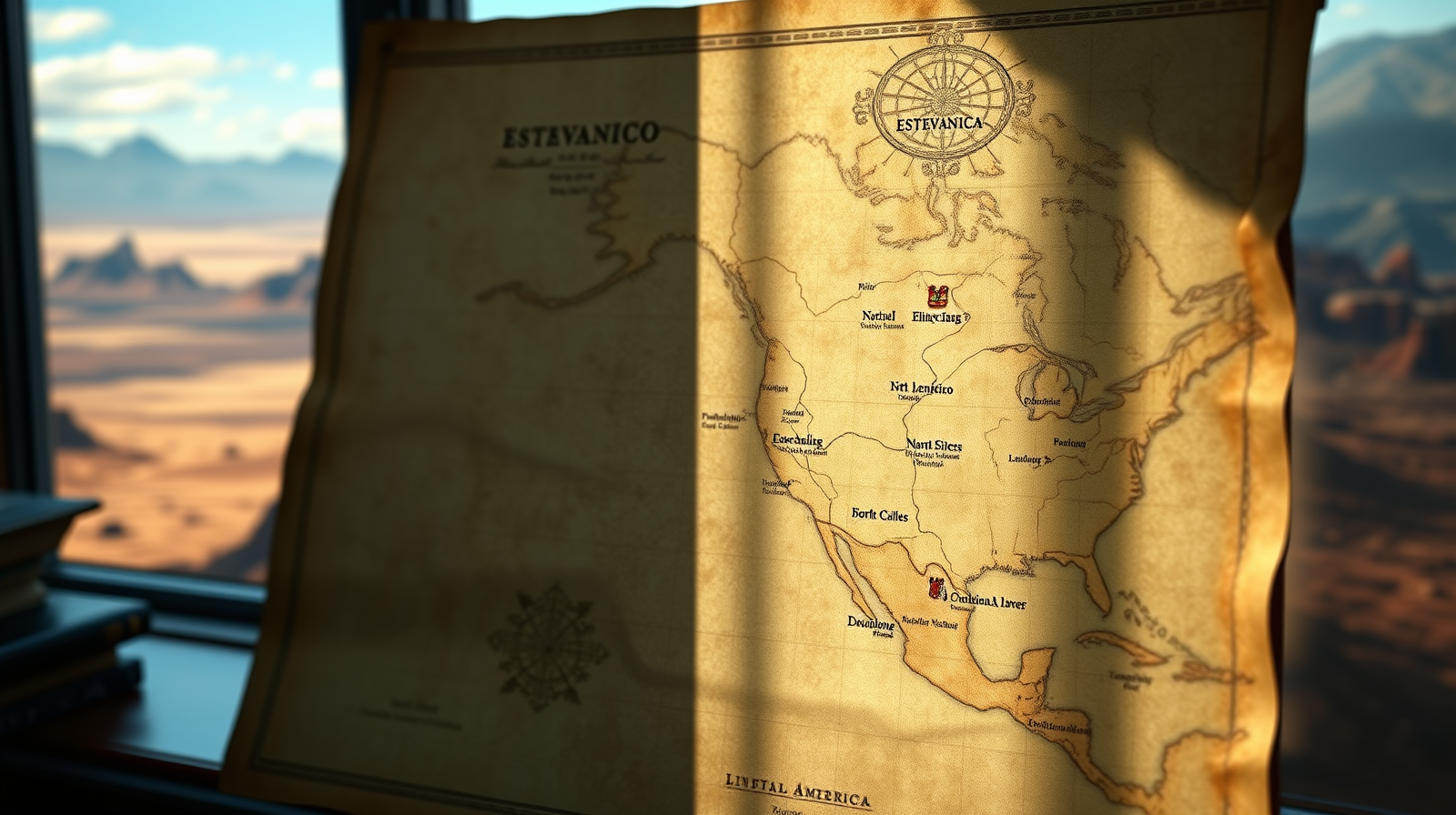
History books love to credit iron-clad Spanish conquistadors with mapping the rugged expanses of the New World. They tell grand stories of Hernán Cortés and Francisco Vázquez de Coronado. But the most remarkable feat of survival and exploration in early American history didn't belong to a Spanish noble. It belonged to a Moroccan man sold into slavery, forced onto a doomed expedition, who somehow transformed himself into a revered tribal medicine man and the primary scout of the American West.
His name was Mustafa al-Zemmouri, though the Spanish scribes minimized him in their journals as Estevanico, or "Little Stephen".
Long before the United States existed, this Arabic-speaking North African walked across thousands of miles of unexplored terrain. He crossed Florida, the Texas coast, New Mexico, and Arizona. He saw the Mississippi River and encountered the Pueblo civilizations well before any white European.
The real story of Mustafa al-Zemmouri isn't just a tale of survival. It's a masterclass in psychological adaptability and cultural reinvention under the harshest conditions imaginable.
From Moroccan Captive to the Florida Disasters
Mustafa was born around the turn of the 16th century in Azemmour, a fortified coastal town in Morocco. During a period of intense drought and Portuguese colonial aggression in the 1520s, he was captured and sold into European slave markets. A Spanish nobleman named Andrés Dorantes de Carranza bought him, forced a Christian baptism upon him, and renamed him Esteban.
In 1527, Dorantes took Mustafa along on the Pánfilo de Narváez expedition. It was a massive, expensive colonial effort. Five ships and 600 men set out from Spain to conquer and settle Florida.
It went wrong almost immediately.
Bad navigation, crippling diseases, and fierce resistance from Indigenous tribes like the Apalachee decimated the force. Stranded on the Florida panhandle without their ships, the remaining men slaughtered their own horses for food and melted down their stirrups and spurs to forge crude nails. They built five flimsy rafts, hoping to skim the Gulf Coast to reach Spanish outposts in Mexico.
Hurricanes and starvation wiped out almost everyone, including Narváez himself. Mustafa’s raft washed ashore near Galveston Island, Texas, in late 1528. Within months, a handful of survivors dwindled to just four: Mustafa, his owner Dorantes, Alonso Castillo Maldonado, and Álvar Núñez Cabeza de Vaca.
The Great Reversal of Power
For the next several years, the local Karankawa and Coahuiltecan tribes enslaved the four survivors. Here, the rigid hierarchy of the Spanish Empire completely collapsed.
In the Texas brush, nobility meant nothing. Survival required skills the Spanish elite simply lacked. Mustafa possessed an uncanny gift for linguistics and cultural diplomacy. While the Spaniards struggled to adapt, Mustafa quickly mastered multiple Indigenous languages and picked up complex sign languages used for trade across the plains.
By the time the four men escaped their captors in 1534, Mustafa had effectively become the de facto leader of the group.
They began traveling west, adopting the roles of wandering faith healers and medicine men. They called themselves "Sons of the Sun". Mustafa marched ahead, carrying a sacred gourd rattle adorned with bells and feathers—a powerful symbol of spiritual authority across the region.
Tens of thousands of Indigenous people followed them from village to village, treating Mustafa with immense reverence. He handled the critical negotiations, secured food, and scouted the trails. The three Spaniards relied entirely on his tongue and eyes to keep them alive. When they finally stumbled into a Spanish outpost in Sinaloa, Mexico, in 1536, they had walked nearly 2,000 miles across the American continent.
The First to Enter the American Southwest
You'd think reaching Spanish civilization would mean freedom. It didn't.
While Cabeza de Vaca returned to Europe to write his famous memoirs, Mustafa was pulled right back into the machinery of slavery. The Spanish Viceroy in Mexico City, Antonio de Mendoza, grew obsessed with stories of wealthy northern cities, the mythical Seven Cities of Cibola. He needed experienced scouts to find them. The Spaniards refused to go back, so Mendoza bought Mustafa to lead a new reconnaissance mission.
In 1539, Mustafa was sent north alongside a Franciscan friar named Marcos de Niza.
The dynamic was broken from the start. Mustafa, having tasted absolute freedom and status in the interior, refused to play the submissive servant to a slow-moving priest. He surged ahead as an advance scout.
He worked out a code with Niza using wooden crosses. If he found a minor settlement, he’d send back a small cross. If he found something massive, he’d send a large one. Within days, Native messengers returned to the friar carrying a cross the size of a man. Mustafa had reached the complex stone pueblos of the Zuni people at Hawikuh, in modern-day New Mexico.
The Final Mystery at Hawikuh
Mustafa arrived at the Zuni pueblo wearing bells on his ankles and wrists, accompanied by a large following of indigenous allies. He demanded gifts, women, and entry into the town. But his luck finally ran out.
The Zuni elders grew deeply suspicious of his sacred gourd rattle, which belonged to a rival tribe, and they found it bizarre that a black man claimed to represent white gods. They blocked him from entering and confined him to a building outside the village. The next morning, when Mustafa tried to approach again, the Zuni attacked. He was cut down by a volley of arrows.
Or was he?
Because historians rely almost entirely on the secondhand reports of a panicked Friar Niza—who fled back to Mexico City without ever setting foot in the village—the exact truth remains a mystery. Some modern scholars and indigenous oral traditions suggest Mustafa might have faked his death with the help of the Zuni to escape Spanish custody permanently. It was the perfect exit strategy for a man who spent his life mastering the art of reinvention.
Why Mustafa’s Legacy Was Erased
If you want to understand how history gets distorted, look at the official Spanish records of the era. Mustafa was the first non-native person to explore Arizona and New Mexico, yet his achievements were instantly co-opted by the empire.
Spanish writers frequently minimized his intellect, framing his navigational genius as mere physical endurance. They focused heavily on his flaws or labeled him a simple servant. He couldn't legally document his own journey, so his story was filtered through the fragile egos of the men who owned him.
If you want to dig deeper into this incredible history, don't stop here. Pick up a copy of La Relación, the actual survival chronicle written by Cabeza de Vaca, or read The Moor's Account by Laila Lalami, a brilliant historical fiction novel that reconstructs the expedition entirely from Mustafa’s perspective. Stop looking at early American exploration as a purely European enterprise. The real history is far more complex, diverse, and fascinating than the standard textbook narrative admits.
:max_bytes(150000):strip_icc():focal(749x0:751x2)/auschwitz-2-691cb034ee9e43cfa45a0969012c6337.jpg)