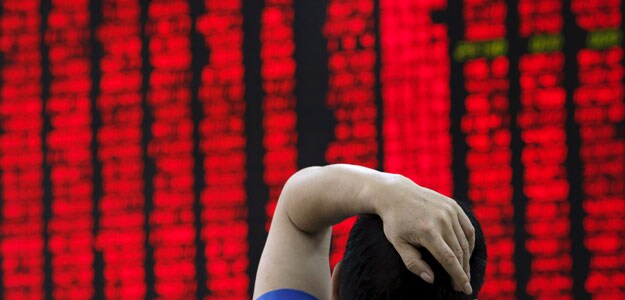
The coffee at the diner counter is lukewarm, tasting faintly of scorched steel and old ambition. Arthur wipes down the laminate surface with a gray rag he has rinsed a thousand times. Outside, the morning commute crawls past in a blur of tail lights and exhaust, the city breathing its usual anxious rhythm. But Arthur isn’t watching the traffic. He is watching the news ticker running across the small television mounted in the corner. Red numbers. Down again. Another hundred points shaved off an index that feels as distant to him as the moons of Jupiter, yet possesses the quiet gravity to pull the roof right over his head.
He remembers 2008. He remembers the heavy silences at the dinner table when the mortgage adjustment letter arrived like a death warrant. He remembers the feeling of solid ground turning to wet sand beneath his boots. And today, as he listens to men in tailored suits on the screen speak in soothing platitudes about correction and cyclical normalization, his stomach tightens. The language changes, but the fear remains identical.
We live in a culture addicted to the upward trajectory. We treat the stock market not as a complicated, fragile machine built by human hands, but as a permanent weather pattern—a perpetual summer where prices only climb and tomorrows are always richer than yesterdays. When reality intrudes, when the gears begin to grind and catch, we pretend it is merely a passing cloud.
Yet storms announce themselves long before the first drop of rain hits the dust. They whisper in the ledger books of ordinary households, in the nervous cadence of corporate boardrooms, and in the strange, inverted behavior of bond markets that few care to understand until the siren sounds. Five distinct warnings are flashing right now across the global dashboard. They do not require a degree in advanced economics to decipher; they require only the courage to look past the ticker tape and observe human behavior under stress.
Consider the first sign: the silent rebellion of the everyday consumer.
For the past few years, the economic narrative has rested on a single, stubborn pillar: consumer resilience. People kept spending. They booked flights, bought new phones, filled shopping carts, and dined out despite rising prices. Economists praised this unyielding appetite as proof of a bulletproof economy. But resilience has an expiration date, and it is measured in available credit.
Imagine Elena, a graphic designer living in a mid-sized apartment who prides herself on financial independence. Two years ago, a trip to the grocery store required a casual swipe of her debit card. Today, that same cart of essentials requires a quiet calculation at the register, a mental sorting of bills to determine which utility can wait until next week. When her car transmission shuddered last month, she didn’t dip into savings. Savings had already vanished during the summer of soaring utility bills and insurance hikes. She turned to credit cards, watching her revolving balance tick upward into territory she swore she would never enter.
Multiply Elena by tens of millions. National credit card debt has ballooned to historic peaks, while household savings rates have shriveled to near-zero. Delinquency rates on auto loans and credit cards are creeping upward, particularly among younger workers and lower-income households. This is not strength. This is exhaustion. When the consumer—who drives two-thirds of the economic engine—runs out of gas, the engine sputters. The market cannot indefinitely outearn the reality of empty bank accounts.
Next, observe the labor market. For a long time, job reports were heralded as invincible. Unemployment hovered near historic lows, and workers possessed unprecedented leverage to demand higher wages or switch jobs for better pay. It felt like a permanent shift in the balance of power between labor and capital.
But beneath the headline job numbers, a profound shift has occurred. The frantic hiring sprees of the post-pandemic reopening have curdled into caution. Companies that bloated their payrolls during the euphoria are quietly trimming the fat. They are implementing stealth layoffs—not announcing sweeping cuts that make evening news broadcasts, but simply leaving open positions unfilled, rescinding internship offers, and tightening performance reviews to ease employees out the door.
White-collar professional services—tech, marketing, consulting, finance—are feeling the chill first. Job openings are evaporating. For someone recently laid off, the months spent searching for a comparable role stretch from weeks into half-years. They send out dozens of resumes into a black hole of automated screening software. When the labor market shifts from expansion to contraction, fear replaces ambition. Workers stop spending on discretionary goods, not because they want to, but because the shadow of unemployment makes every dollar look like a life raft.
Then there is the corporate ledger. For years, companies maintained robust profit margins by passing every inflationary cost directly onto the consumer. If raw materials rose in price, the price tag on the shelf rose twice as fast. Wall Street applauded this pricing power. Analysts rewarded corporations that beat earnings expectations quarter after quarter, fueling a stock market boom disconnected from underlying economic output.
Yet pricing power has a breaking point. You can only raise the price of a box of cereal or a software subscription so many times before customers simply walk away or substitute a cheaper alternative. Corporate revenue growth is slowing. Profit margins, having reached stratospheric heights, are beginning to compress under the weight of higher borrowing costs.
Companies gorged on cheap debt during the decade of near-zero interest rates. Much of that debt is now maturing, forcing businesses to refinance at interest rates double or triple what they were paying before. Millions of dollars that once went toward research, development, or share buybacks are now being diverted simply to service interest payments. It is a slow bleed. It happens in conference rooms with closed blinds, far away from public view, until an unexpected earnings miss triggers a sudden, violent reprisal from investors who assumed the gravy train would never derail.
Look deeper still, into the subterranean machinery of the financial world: the bond market.
To the casual observer, bonds are boring. Stocks are where the drama lives—the thrilling ascents, the stomach-churning drops. But bonds are the nervous system of global finance. They reflect what institutional investors—banks, pension funds, sovereign wealth managers—truly believe about the future.
For the past couple of years, an ominous signal has flashed in the yield curve, specifically the relationship between short-term and long-term government bonds. Ordinarily, investors demand a higher yield for locking up their money over ten or thirty years compared to a few months, because the future is inherently uncertain. When that relationship inverts—when short-term yields spike above long-term yields—it has historically served as a flashing red beacon. Every single modern recession has been preceded by an inverted yield curve.
Wall Street analysts spent months dismissing this indicator, arguing that this time was different, that the old rules no longer applied in a post-pandemic economy. But history rarely tolerates the arrogance of the present. The inversion has begun to un-invert, which sounds like relief, but historically, the true danger arrives precisely when the curve normalizes again. It means the central bank has started cutting interest rates, not out of proactive benevolence, but because the economic machinery is beginning to break down and emergency intervention is required.
And finally, consider the psychology of the crowd.
Markets are driven by two primal forces: greed and fear. For a long time, greed held the steering wheel. Investors chased speculative frenzies, piling money into artificial intelligence startups, meme stocks, and crypto tokens with the casual abandon of gamblers playing with house money. Valuations soared into the stratosphere, detached from any rational calculation of future cash flows.
When sentiment shifts, it does not do so gradually. It avalanches.
Imagine a crowded theater where someone whispers the word fire. At first, a few people turn their heads toward the exit. Then a row stands up. Then the entire room surges toward the doors at once. Stock markets operate on the exact same emotional circuitry. The current complacency—the unshakable belief that a soft landing is guaranteed and that the Federal Reserve will magically rescue any downturn—is dangerously fragile.
When valuations are stretched to historical extremes, there is no margin for error. If corporate earnings miss expectations by even a fraction of a percent, or if inflation proves stickier than anticipated, the realization hits all at once. The algorithms trade in microseconds, stripping billions of dollars of paper wealth in minutes. Panic replaces euphoria with terrifying speed.
We are standing at a peculiar juncture in economic history. The signs of strain are accumulating like tectonic pressure beneath a quiet landscape. A consumer base running on empty credit cards, a cooling labor market where finding a job is becoming a trial of endurance, corporations grappling with crushing debt refinancing costs, flashing warning lights in the debt markets, and a collective psychological mood primed for sudden panic.
None of this guarantees tomorrow will bring an apocalyptic crash. Economics is not astrology; it is a study of human choices under scarcity. But ignoring these warnings because the sun is still shining today is the equivalent of ignoring the smell of smoke because you cannot yet see the flames.
Back at the diner, Arthur pours another cup of coffee for a regular who hasn't spoken a word in twenty minutes. The television in the corner flashes a brief update on treasury yields before cutting to a cheerful commercial for a luxury SUV. Arthur watches the screen for a second longer, shakes his head slowly, and sets the pot down on the burner. He doesn't know what the indexes will do by closing bell. But he knows how to weather a winter, and he can feel the temperature dropping.