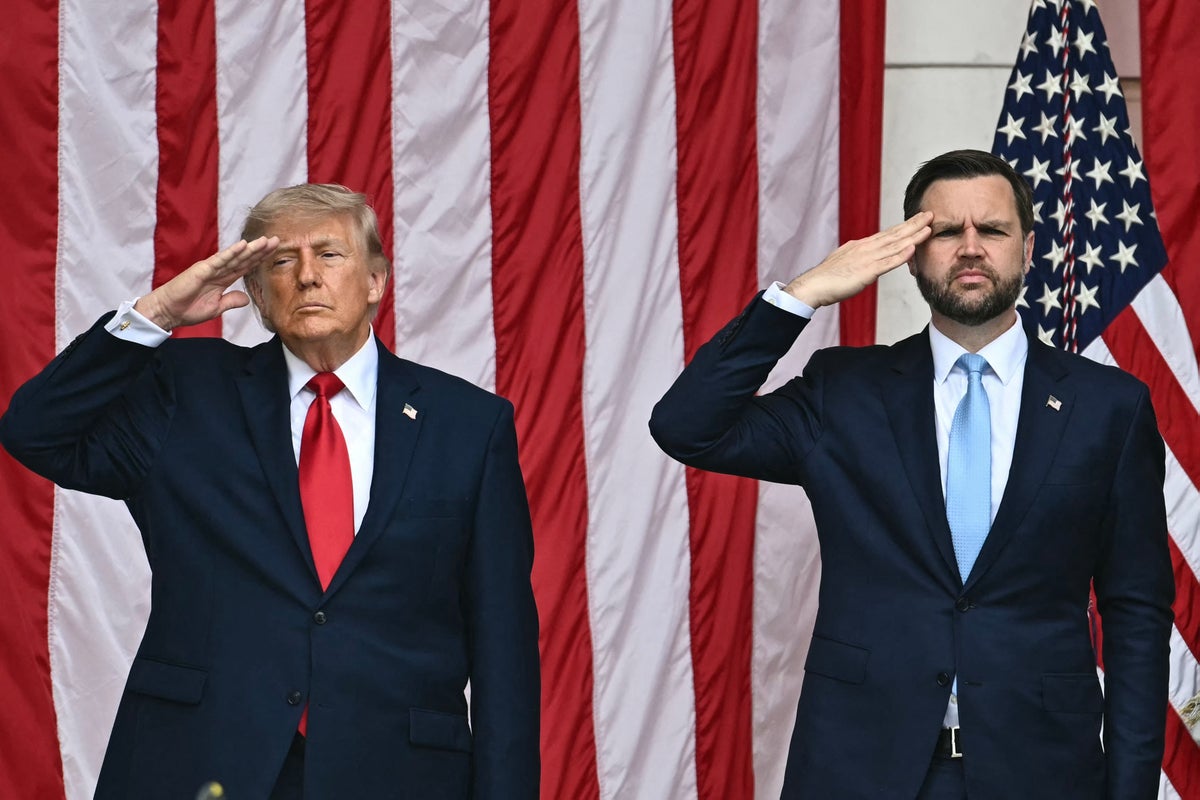
The media elite just spent a long weekend fainting on their couches because Donald Trump managed to read a teleprompter at Arlington National Cemetery without starting a Twitter feud. The mainstream press wants you to believe the headline from Memorial Day is that the president "stayed on script." They are obsessed with the optics of his discipline, treating a standard wreath-laying ceremony like an impossible administrative feat.
They are looking at the wrong script.
While beltway pundits hyperventilate over whether Trump looked sufficiently presidential next to JD Vance and Pete Hegseth, they completely missed the actual geopolitical ledger. The media is clapping like seals because the administration presented a neat narrative: 13 American lives lost in Operation Epic Fury, a clean three-month war, and a looming peace deal that supposedly stops a nuclear Iran. It is a comforting fiction.
The lazy consensus says this was a win for disciplined executive execution. The reality is that treating a hot military conflict like a reality TV season finale is a dangerous strategic failure.
The Arithmetic of Illusion
The established narrative surrounding Operation Epic Fury relies on a mathematically absurd premise. We are told that the loss of 13 service members is a tragic but acceptable premium to pay for guaranteeing that Tehran will never obtain a nuclear weapon.
Let us look at the actual mechanics of regional deterrence. I have watched defense intellectuals manipulate theater metrics for two decades to justify interventions, and the math never changes. A short-term kinetic campaign that neutralizes immediate infrastructure does not eliminate a nation's native engineering capability.
Trump stood at the Amphitheater and declared that because of these 13 fallen heroes, Iran "will never have a nuclear weapon."
This is a profound misunderstanding of modern counter-proliferation.
- The Knowledge Problem: You cannot bomb an equation. The intellectual capital required to enrich uranium to weapons-grade levels already exists within the minds of Iranian scientists.
- The Sovereign Asset Fallacy: The administration's current negotiation position demands that Iran's enriched material be handed over or destroyed under IAEA oversight. Forcing a sovereign nation into total capitulation via a brief air and special operations campaign usually produces a coiled spring, not a compliant partner.
- The Economic Spillover: While the White House boasts of a "complete and total victory" in places like Venezuela, the economic fallout from the ongoing friction in the Persian Gulf is actively destabilizing global energy markets.
The media spent the day counting Trump's ad-libs. They should have been counting the centrifuges that are currently being spun deeper underground where Operation Epic Fury couldn't reach them.
Dismantling the Teleprompter Triumph
The political establishment loves a sanitized tragedy. They want a Memorial Day where the President says "before we hail the founding, we honor the fallen," everyone sheds a tears, and nobody asks why the deployment happened in the first place.
Consider the "People Also Ask" standard that dominates the cable news ecosystem during these events: Did the President show appropriate respect to Gold Star families?
It is a flawed question designed to elicit a superficial answer. Respect is not measured by avoiding erratic ad-libs during a speech. Respect is measured by the strategic clarity of the missions into which you send American troops.
The competitor press noted with subtle condemnation that Trump failed to read the specific names of the 13 fallen troops from the podium. They view this as a personal slight, a flaw in his performance. That is a lightweight critique. The real issue is not that he omitted their names; it is that he used their collective sacrifice to build immediate leverage for his Truth Social posts later that afternoon.
Within hours of leaving the Tomb of the Unknown Soldier, the administration was on social media threatening that the fighting would be "bigger and stronger than before" if Iran does not sign the pending agreement. This is the commodification of military sacrifice. It reduces the solemnity of Arlington into a tactical chip for a high-stakes real estate negotiation.
The Risk of the Great Deal
The proposed peace agreement following the six-week ceasefire is being framed as an unprecedented triumph. Hard-line factions within the political spectrum are already panicking that the administration is rushing the process, while centrist commentators are relieved that a wider war might be averted.
Both sides are wrong. The danger is not that the deal is rushed; the danger is that the deal relies entirely on the personal brand of the executive.
"Negotiations with the Islamic Republic of Iran are proceeding nicely! It will only be a Great Deal for all or, no Deal at all."
This approach treats international diplomacy as a bilateral transactional arrangement. Imagine a scenario where a corporate raider buys a distressed asset, forces a quick restructuring, and sells it back for a nominal profit. That works in private equity. It fails in the Middle East.
An agreement signed under the duress of kinetic strikes without a structural shift in regional power dynamics is a temporary pause, not a permanent solution. The administration promises that a signed treaty will lead to a "United, Powerful, and Economically Strong" Middle East. This is geopolitical fantasy. It ignores decades of sectarian reality, proxy networks, and structural animosities that do not vanish because a signature is dried on a piece of paper in Washington.
The True Cost of Tactical Success
We must separate tactical proficiency from strategic victory. Operation Epic Fury may well have executed its immediate mission profiles with minimal American casualties relative to the scale of the theater. The men and women who executed those orders did so with the standard excellence of the American military apparatus.
But let us stop pretending that a disciplined public reading of a holiday address changes the underlying arithmetic of the conflict. The administration has pinned its entire foreign policy legacy on the assumption that total economic isolation and targeted military strikes will force a ideological regime to abandon its primary geopolitical ambition.
The downside to this contrarian view is obvious: it offers no easy alternative. De-escalation requires acknowledging your adversary's leverage, which no administration wants to do during an election cycle when approval ratings are under pressure.
The establishment media will continue to grade the presidency on a curve based on whether the executive can stand still for thirty minutes without causing an international incident. Do not buy into the theater. The real story of Memorial Day 2026 wasn't that the president stayed on script—it was that the script itself is hiding the true cost of an unfinished war.