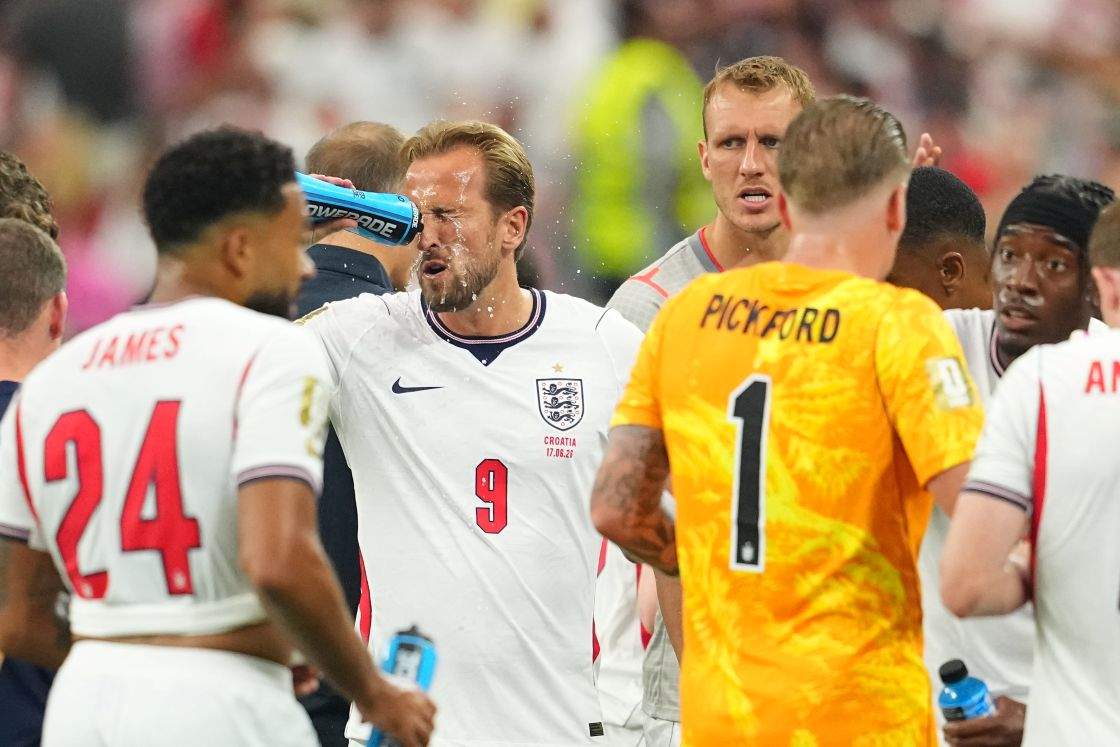
Fans love to scream that FIFA is killing the beautiful game for an extra buck.
When the referee blows the whistle in the 30th minute of a scorching World Cup match to signal a hydration break, the internet melts down. The prevailing narrative is lazy, predictable, and entirely wrong. Critics point at the broadcast screen, watch a 90-second ad spot for a sports drink or a car manufacturer, and declare that player safety is just a convenient smoke screen for corporate greed.
It is a neat, cynical conspiracy theory. It also ignores how elite human physiology and modern sports broadcast economics actually function.
The standard critique assumes that a three-minute pause destroys the artistic purity of a continuous 90-minute sport. It views the hydration break as an artificial intrusion. In reality, the traditional, uninterrupted 45-minute half is an archaic relic of the 19th century that actively degrades the quality of modern, high-intensity football.
We do not need fewer hydration breaks. We need scheduled, tactical pauses baked into the rules of every major tournament.
The Pseudoscience of the Continuous 90 Minutes
The argument against these breaks rests on a romanticized obsession with stamina. Traditionalists believe that football is meant to be a war of attrition. They argue that forcing players to endure extreme heat without a pause tests their character and tactical discipline.
This is dangerous nonsense.
Look at the data from the thermal stress indices used by FIFA—specifically the Wet Bulb Globe Temperature (WBGT). When the WBGT hits 32°C (90°F), the human body is no longer just sweating; it is actively failing to cool itself through evaporation.
I have spent years analyzing player performance metrics and speaking with sports scientists who work with national teams. When core body temperatures cross the 39°C (102.2°F) threshold, cognitive function drops off a cliff.
- Decision-making slows down. Spatial awareness shrinks.
- Neuromuscular coordination degrades. Passing accuracy plummets.
- The risk of acute soft-tissue injuries—hamstring tears, groin pulls, ACL ruptures—spikes by over 40% in the final fifteen minutes of a half under extreme heat.
When fans complain that a hydration break "ruins the flow" of a match, they are advocating for worse football. They are asking to watch exhausted, sluggish athletes misplace simple five-yard passes and coast through defensive assignments because their brains are literally cooking.
A hydration break is not a disruption of the product. It resets the product. It allows players to top off glycogen stores, lower their heart rates slightly, and re-engage the high-press tactics that modern managers like Pep Guardiola or Jürgen Klopp popularized. The continuous 90-minute model is an outdated framework that treats elite athletes like mechanical engines rather than biological systems.
Follow the Money: The Flawed Logic of the Commercial Squeeze
Let us dismantle the financial paranoia. The core accusation is that FIFA introduces these breaks to squeeze more advertising inventory into a broadcast. This argument falls apart the moment you analyze how international sports broadcasting rights are negotiated and packaged.
Television networks do not buy World Cup rights on a fluctuating, per-minute basis that changes if a referee calls a weather timeout. They buy tournament packages years in advance for billions of dollars.
| Broadcast Element | Traditional Model | The Reality of Live Sports |
|---|---|---|
| Ad Inventory | Fixed blocks at halftime, pre-game, and post-game. | Dynamic digital overlays and picture-in-picture formats. |
| Revenue Driver | Mass viewership metrics and cultural reach. | Subscriber retention and streaming platform dominance. |
| Risk Factor | Dead air or unscripted delays. | Player injuries reducing the star power of the knockout stages. |
Broadcasters do not need a three-minute hydration break to make their money. They already dominate the pre-match, halftime, and post-match windows. When an unexpected cooling break occurs, networks usually scramble. Most regional broadcasters run a split-screen or cut to a generic studio feed because their ad inventory for the hour is already locked in.
To believe that FIFA creates a massive geopolitical controversy over player health just to hand a local broadcaster an extra 60 seconds of regional commercial time is to misunderstand the scale of sports capitalism. FIFA makes its money from global sponsorships, ticket sales, and massive, fixed-fee broadcast contracts. They do not care about a mid-afternoon ad spot for a regional insurance company in Ohio or Munich.
The real financial risk for FIFA is not a missed commercial break; it is a decimated tournament. Imagine a World Cup where the top three global superstars tear their hamstrings in the group stage because of heat exhaustion. The knockout rounds lose viewership, social media engagement craters, and the value of the next tournament's rights package takes a massive hit.
Player preservation is profit preservation.
The Hidden Tactical Revolution
The most frustrating part of the anti-break discourse is that it ignores the tactical evolution of the sport. Football purists treat the pitch like a sacred canvas where managers should not interfere once the whistle blows. This is an obsolete view of coaching.
In every other major global sport—basketball, American football, tennis, rugby—coaches have mechanisms to pause the action, adjust strategies, and alter the tactical framework. Football forces a manager to scream instructions over 80,000 roaring fans, hoping their winger hears a positional adjustment.
A hydration break functions as an unscripted tactical timeout.
"During the 2014 World Cup in Brazil, Louis van Gaal famously used a cooling break against Mexico to completely switch his team's formation from a 5-3-2 to a 4-3-3. The tactical pivot allowed the Netherlands to score two late goals and advance."
This is not a dilution of the sport. It enhances the strategic depth of the game. It turns a match from a simple test of physical survival into a chess match between world-class tactical minds. We see higher-quality goals, fewer defensive blunders born of pure exhaustion, and sharper tactical execution.
Dismantling the "People Also Ask" Objections
The skepticism surrounding this topic usually manifests in a few specific, flawed questions. Let us address them directly.
Do hydration breaks give an unfair advantage to defensive teams?
The exact opposite is true. High-pressing, possession-heavy offensive teams suffer the most when fatigue sets in. A defensive unit sitting in a low block requires less explosive energy than an attacking side trying to break them down with constant overlapping runs and high-tempo passing. By allowing players to recover their breath and hydrate, you give the attacking team the physical capability to maintain a high-intensity offense. It breaks the deadlock of a boring, defensive stalemate.
Why can't players just drink water on the sideline during a substitution?
Because football is a fluid, continuous game where a single open pocket of space can lead to a goal. A midfielder cannot simply wander over to the technical area for a drink while the opposing team is building an attack. Relying on sporadic, individual water runs creates an uneven playing field where teams are penalized for taking care of basic biological needs. A centralized, mandatory break ensures that neither team gains a spatial or numerical advantage while an athlete avoids heatstroke.
Will this lead to a slippery slope of American-style commercial stoppages?
This fear is rooted in xenophobia and a lack of trust in governing bodies, which is understandable but misdirected. The structure of football does not allow for the stop-start nature of the NFL or NBA. The global audience would instantly revolt if play stopped every time the ball went out of bounds. Hydration breaks are strictly governed by objective environmental metrics (WBGT), not by a producer in a television truck. The boundaries are clear, measurable, and fixed.
Accept the New Reality
The continuous 90-minute match is dead. It was designed for an era when players ran four kilometers per game at a jogging pace while wearing heavy leather boots. Today's elite footballers cover upwards of eleven kilometers, hitting sprint speeds of over 35 kilometers per hour in environments that are becoming progressively hotter due to shifting global climates.
Chasing the ghost of "tradition" at the expense of player health and tactical sophistication is a losing strategy. The hydration break is not a corporate conspiracy. It is a necessary, permanent evolution of the sport.
Stop complaining about the commercials on your screen. Drink some water, let the managers coach, and enjoy the higher standard of football that results from athletes who can actually breathe.