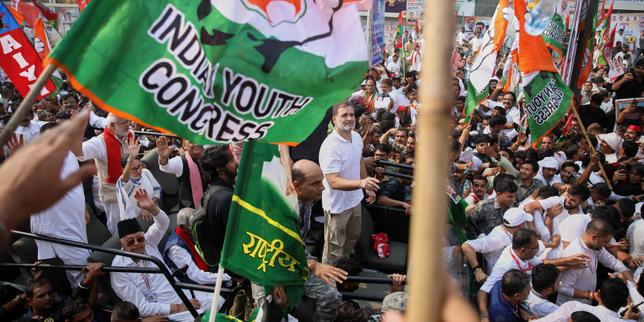
The heat in New Delhi does not merely sit on your skin; it presses against your chest until breathing feels like an act of quiet rebellion.
On a Tuesday morning near Jantar Mantar, the air smells of diesel exhaust, crushed marigold petals, and wet concrete washed down before dawn. Thousands of people have gathered here, shoulder to shoulder, holding laminated squares of plastic above their heads like shields. Those squares are Elector Photo Identity Cards. Voter IDs. In the world’s largest democracy, that small piece of laminated paper is supposed to be a shield. Lately, for tens of thousands of citizens marching through the capital, it has felt more like a ghost’s receipt—proof that you once existed in the eyes of the state, right up until the moment an algorithm or a clerk’s pen decided you did not.
Look closely at the crowd protesting the revision of India’s electoral rolls and demanding the resignation of the Chief Election Commissioner, and you will see that this is not an abstract constitutional debate. It is a street-level panic over erasure.
The Architecture of an Erasure
To understand why tens of thousands of people would brave tear gas, water cannons, and the suffocating humidity of New Delhi over something as bureaucratic-sounding as "electoral roll revision," you have to stop thinking of a voter list as a spreadsheet. Think of it instead as a mirror. When a democracy holds that mirror up to a nation of nearly a billion eligible voters, everyone expects to see their own reflection staring back.
Now imagine walking up to that mirror on election morning, ink already drying on the clerk’s table, only to find blank glass.
Consider a hypothetical scenario—a composite drawn from the exact complaints echoing across New Delhi’s protest barricades today. Meet Rajesh, a forty-two-year-old welder living in a dense, working-class colony on the outskirts of the capital. Rajesh has voted in every municipal, state, and general election since he turned twenty-one. He has not moved houses. He has not changed his name. Yet during a routine "special summary revision" of the electoral rolls—a process meant to clean out duplicates, deceased voters, and citizens who have relocated—Rajesh’s name vanishes.
No notice arrives at his door. No booth-level officer knocks to verify his address. He only discovers he has been deleted when he checks the online portal weeks before a crucial vote, or worse, when he stands in line outside a government schoolhouse at seven in the morning and the presiding officer shakes his head.
Multiply Rajesh by hundreds of thousands. Suddenly, a clerical error stops looking like an accident and starts looking like architecture.
The protesters flooding the streets of New Delhi are not reacting to a single isolated glitch. They are reacting to a pattern that opposition parties, civil society groups, and ordinary citizens allege has turned the periodic cleansing of voter lists into a selective purge. Across multiple states—from Maharashtra and Uttar Pradesh to the capital itself—reports have mounted of mass deletions occurring quietly in the months between elections, often disproportionately affecting minority communities, migrant laborers, and neighborhoods known to favor opposition candidates.
Meanwhile, in the very same districts, critics point to sudden, unexplained surges in new voter additions just weeks before polling day. Subtraction in one neighborhood; addition in another. In arithmetic, that is a simple equation. In a democracy, it is an earthquake.
Why the Streets Are Calling for One Man’s Resignation
Every storm needs a lightning rod, and in New Delhi, that rod is the office of the Chief Election Commissioner.
For decades, the Election Commission of India (ECI) enjoyed a reputation that most democratic institutions on earth could only envy. From the snowy passes of Ladakh to the remote islands of the Andaman Sea, the ECI built its legend on a singular, stubborn promise: no matter how poor you are, no matter how far you live from the corridors of power, a polling booth will come to you, and your vote will count the same as a billionaire’s. Trust in that institution was the invisible glue holding together a country of staggering linguistic, religious, and economic complexity.
Trust, however, takes seventy years to build and seventy days to crack.
The demands reverberating through New Delhi for the Chief Election Commissioner to step down are rooted in a crisis of confidence over how the Commission operates—and who controls it. Not long ago, India’s Supreme Court ruled that the appointment of Election Commissioners should be overseen by a neutral panel including the Prime Minister, the Leader of the Opposition, and the Chief Justice of India. Almost immediately afterward, Parliament passed new legislation that removed the Chief Justice from that panel, replacing the top judge with a cabinet minister nominated by the government.
You do not need a law degree to grasp the optics of that change. It is like asking the captain of one cricket team to select the umpires, and then telling the crowd not to worry about the call when a batter is ruled out on a razor-thin margin.
When protesters chant for the Chief Election Commissioner’s resignation outside Nirvachan Sadan—the headquarters of the Election Commission—they are not merely attacking an individual bureaucrat. They are confronting a structural vulnerability. If the referee is chosen by one of the players, every disputed call feels rigged, even when the rulebook is quoted verbatim.
The Invisible Stakes Behind Bureaucratic Jargon
It is easy to lose the human pulse of this crisis beneath the heavy language of official press releases. The Election Commission insists that electoral roll revisions are standard, transparent, and governed by strict legal safeguards. Officials point out that draft rolls are published publicly, that political parties appoint Booth Level Agents to monitor additions and deletions, and that anyone whose name is wrongly struck off can file Form 6 to be reinstated.
On paper, the system looks airtight. In lived reality, paper leaks.
Have you ever tried to navigate a government bureaucracy when you earn four hundred rupees a day as a daily-wage laborer? Taking a morning off work to stand in line at a municipal office, hunt down attested photocopies of residency proofs, and file a corrective form is not a minor inconvenience. It is the difference between feeding your family that night or going to bed hungry.
I have watched people stand at the counters of local electoral registration offices clutching faded electricity bills and ration cards like sacred relics, their faces tight with a mixture of exhaustion and quiet humiliation. They are being asked to prove, all over again, that they belong to the country that taxes their tea, their fuel, and their labor.
And the stakes stretch far beyond a single election cycle. In India, your presence on the electoral roll is deeply intertwined with your broader civic existence. When your name is scrubbed from the voter list as "shifted" or "absent," it casts a shadow over your documentation, your residency status, and your standing as a citizen. For marginalized communities—especially Muslims, Dalits, and internal migrants who already live with the constant anxiety of having their belonging questioned—an unannounced deletion from the voter roll feels like a quiet, bureaucratic dress rehearsal for disenfranchisement.
How a Democracy Bleeds Without a Single Shot Fired
History rarely announces when a democratic institution is hollowing out. There are no trumpets. Usually, there is just paperwork.
Political scientists have a clinical term for this phenomenon: democratic backsliding through administrative capture. Unlike a coup, which shatters the glass in front of everyone, administrative capture works like termites inside timber. From the outside, the house still looks magnificent. The elections still happen on schedule. The electronic voting machines still beep. The ink still stains millions of index fingers purple.
Yet inside the walls, the load-bearing beams are quietly compromised.
Look at what happens when citizens lose faith in the neutrality of the voter rolls:
- The burden of proof flips. Instead of the state working tirelessly to ensure every eligible adult can vote, citizens must fight an uphill battle just to remain on the list.
- Turnout becomes skewed by design. Even a two- or three-percent selective suppression of voters in tightly contested constituencies can flip dozens of seats, altering the composition of Parliament without a single ballot box ever being stuffed.
- The legitimacy of every outcome fractures. Once the public suspects the referee, winners cannot govern with unquestioned authority, and losers refuse to accept defeat as fair.
Consider what happens next if this erosion goes unchecked. Democracy does not die the day an election is canceled; it dies the day millions of people decide that showing up to the polling booth is a waste of time because the outcome was decided months earlier on a data-entry screen.
The Noise in the Streets Is a Pulse Check
That is why the images coming out of New Delhi matter so intensely right now.
When tens of thousands of students, farmers, opposition leaders, and ordinary workers march toward the barricades demanding accountability from the Election Commission, they are performing the single most vital maintenance check a democracy possesses. Street protests are messy. They block traffic, test the patience of commuters, and provoke heavy-handed policing. Yet in a moment when institutional guardrails feel bent, the street becomes the last honest courtroom left.
The protesters are asking for measures that are neither radical nor impossible: complete transparency in how names are deleted from electoral rolls; mandatory physical verification before any voter is removed; public, machine-readable release of booth-level voting data; and an appointment process for Election Commissioners that restores genuine independence from the ruling party of the day.
None of these demands favor one political party over another. A clean, transparent, verifiable voter list protects the supporter of the ruling coalition just as fiercely as it protects the supporter of the opposition. It is the baseline agreement that makes peaceful political competition possible in the first place.
Late in the afternoon, as the sun drops behind the sandstone buildings of central Delhi, the crowds near Jantar Mantar begin to thin, though the police barricades remain bolted in place. An elderly woman sits on the curb, carefully wrapping her laminated voter card back inside the corner of her cotton sari before tying a knot around it.
She holds that knot tight against her chest as she stands up to walk toward the metro station, guarding a small piece of plastic as though her entire future depended on keeping it from vanishing into thin air.