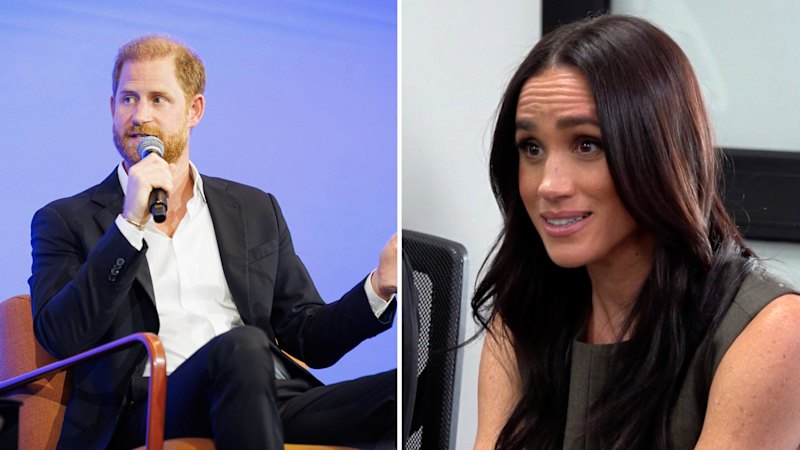
The Duke and Duchess of Sussex operate within a unique paradox of brand equity where their market value is inversely proportional to their formal institutional integration. While their public-facing strategy prioritizes a "post-royal" identity focused on independent philanthropy and media production, their operational relevance relies on a recurring mechanism: the strategic deployment of royal history and lineage as a credibility anchor. This is not merely a series of anecdotes; it is a calculated narrative arbitrage. By analyzing their international tours—specifically the recent engagements in Nigeria and Colombia—we can map the specific logic of how royal references are used to bridge the gap between their current private status and the diplomatic gravitas required to maintain global visibility.
The Dual-Status Operational Framework
Harry and Meghan utilize a bifurcated communication strategy that allows them to navigate the space between private citizens and quasi-state actors. This framework relies on three distinct pillars of referencing:
- Ancestral Validation: Direct citations of Princess Diana or King Charles III to establish a biological and emotional link to the British monarchy.
- Institutional Continuity: The adoption of protocols, language, and event structures that mirror official Commonwealth or State visits.
- Reformist Contrast: Referencing royal life through the lens of personal struggle or systemic critique to reinforce their independent brand identity.
This strategy creates a self-sustaining feedback loop. Each mention of the royal family generates the media metrics necessary to sustain high-valuation contracts with streaming platforms and book publishers. Without these references, the Sussex brand risks drifting into the saturated market of general celebrity philanthropy, where competition for attention is significantly higher and margins of influence are thinner.
Quantification of Narrative Hooks in International Contexts
During recent international visits, the frequency and nature of royal references shifted based on the specific audience and the intended "diplomatic" outcome. In Nigeria, the references were predominantly ancestral. Harry’s mentions of his mother were not just personal reflections; they served as a geopolitical currency. In regions where Princess Diana maintains a high degree of retrospective popularity, invoking her name functions as a "legacy bridge." It grants the Duke an immediate, unearned level of trust and familiarity that a private citizen would take years to cultivate.
In Colombia, the focus shifted toward institutional continuity. While the couple no longer represents the Crown, their itinerary—meetings with the Vice President, visits to cultural centers, and formal security details—was designed to replicate the aesthetics of a royal tour. This "phantom protocol" relies on the audience’s inability to distinguish between the sovereign's representative and the sovereign's relative. When Meghan references her "royal life" in this context, it isn't a casual observation. It is a tool to elevate the stakes of the event, transforming a private visit into a pseudo-diplomatic summit.
The Mechanism of Emotional Transference
The Sussexes utilize a psychological mechanism known as emotional transference. By consistently linking their current activities to their time as working royals, they transfer the historical prestige of a 1,000-year-old institution onto their contemporary, often profit-driven, ventures.
- The Halo Effect: Associations with royal duty provide a "halo" of seriousness to their Archewell Foundation initiatives.
- The Martyrdom Narrative: Referencing the "difficulties" of royal life provides a relatable struggle, humanizing them to a demographic that may find extreme wealth alienating.
The Economics of Royal Referencing
The decision to mention royal life is rarely accidental; it is driven by the economic necessity of the "Sussex Premium." In the attention economy, the couple’s most valuable asset is their proximity to the British throne.
The Royalty Decay Rate
Brand value in the celebrity sector typically follows a decay curve. As the couple spends more time away from the center of royal activity, their "insider" status naturally diminishes. To combat this, they must periodically refresh their royal credentials through public mentions or appearances that evoke their previous roles.
- Direct Monetization: References in high-ticket items like memoirs (Spare) or docuseries. These are high-density, high-impact mentions designed for maximum immediate revenue.
- Indirect Maintenance: Mentions during "tours" or charity events. These are low-density, high-frequency mentions designed to keep the royal association "warm" in the public consciousness, ensuring that their market value for future contracts does not bottom out.
Risk Mitigation and Narrative Control
The primary risk in this strategy is the "Irrelevance Threshold"—the point at which the public no longer views their royal connection as valid or interesting. To mitigate this, the Sussexes use a "Selective Transparency" model. They share enough about their royal experiences to satisfy the demand for "behind-the-scenes" content but retain enough distance to claim a desire for privacy. This creates a supply-and-demand dynamic where each mention of the King or the Prince of Wales is treated as a major news event, thereby inflating the value of the next mention.
Logical Frameworks of Displacement
Why does the couple mention royal life so frequently during what are billed as "private" tours? The answer lies in the displacement of authority. In a standard royal tour, authority is derived from the Letters Patent and the government’s mandate. In a Sussex tour, authority must be manufactured.
The Authority Construction Model
The model follows a four-step process:
- Step 1: Visual Framing. Use of high-end tailoring, official motorcades, and structured press pools to signal importance.
- Step 2: The Royal Reference. Harry or Meghan mentions a specific royal tradition or family member to ground the event in a historical context.
- Step 3: The Narrative Pivot. They transition from the royal reference to their current work, effectively siphoning the authority of the first to the second.
- Step 4: Media Amplification. The press focuses on the royal mention, ensuring the event reaches a global audience that would otherwise ignore a generic charity visit.
This process is highly effective but has a significant structural flaw: it reinforces the very institution they claim to have escaped. By constantly defining themselves in relation to the monarchy—even if that relation is one of opposition—they remain tethered to it. They are not a separate brand; they are a "derivative" brand. In financial terms, a derivative’s value is entirely dependent on the underlying asset. If the British Monarchy’s brand value drops, or if the public loses interest in the Royal Family, the Sussexes’ ability to generate "tour" interest collapses.
The Causality of Contentious Diplomacy
The "mention strategy" also serves as a defensive mechanism against the loss of diplomatic standing. When the Duke mentions his father’s health or his brother’s past actions, he is exerting a form of "narrative soft power." It is a reminder to the institution that he remains a primary source of information regarding their internal workings.
This creates a stalemate. The Palace cannot fully ignore the Sussexes because their mentions can shift public opinion or create PR crises. Conversely, the Sussexes cannot stop mentioning the Palace because their global platform depends on that friction. The friction is the product.
The Cost Function of Contradiction
There is a measurable cost to this strategy: brand dilution through contradiction.
- Claimed Goal: Financial and emotional independence from the Crown.
- Operational Reality: Continuous reliance on royal titles, royal history, and royal-style events to generate revenue and relevance.
This contradiction creates a bottleneck in their growth. While it secures a dedicated base of followers interested in the royal soap opera, it prevents them from being taken seriously as independent global leaders in fields like climate change or media reform. They are perpetually viewed through the "royal" lens because they have optimized their strategy to ensure that lens never goes out of focus.
Tactical Reconfiguration of Global Perception
The Sussexes have mastered the art of the "pseudo-official" statement. By referencing royal life while standing on foreign soil, they are effectively conducting their own foreign policy. This is particularly evident in how they handle security and logistics. By insisting on high-level protection and protocol, they force the host country to treat them as royals, regardless of their official status.
Once that treatment is secured, any mention of their royal life acts as a confirmation of the host’s behavior. It validates the Vice President or the local dignitary who welcomed them, creating a mutual benefit. The host gets the prestige of a "royal" visit, and the Sussexes get the imagery required to maintain their brand's high-tier status.
The Hierarchy of Reference Types
Not all mentions are equal. Their strategy utilizes a hierarchy to manage the "Royal Reserve":
- Tier 1: Personal Vulnerability (High Impact). Mentions of the trauma of royal life. Used for building deep, emotional connections with the audience.
- Tier 2: Legacy/Motherhood (Medium Impact). Mentions of Princess Diana. Used for broad, cross-generational appeal and "sainthood" by association.
- Tier 3: Institutional Critique (Strategic Impact). Mentions of "The Firm" or "The System." Used to position themselves as modernizers and disruptors.
The danger lies in over-saturation. If every speech contains a Tier 2 reference, the value of that reference diminishes. The Sussexes have shown a keen awareness of this, often spacing out their most potent references to coincide with major project launches or high-profile tours.
The Strategic Path Forward
To maintain their current trajectory, the Duke and Duchess must resolve the "Derivative Value" problem. As the gap between their time as working royals and their current lives grows, the potency of their royal mentions will naturally fade. The market will eventually demand a product that stands on its own merits without the royal preamble.
The strategic play is to transition from Royal Referencing to Royal Archiving. This involves moving away from active mentions of current family dynamics and toward the curation of a permanent "Sussex Legacy" that exists as its own institution. This requires:
- Establishing Proprietary Protocols: Developing a unique visual and operational language for their tours that does not mimic the Palace.
- Intellectual Property Development: Focusing on original content that solves specific global problems rather than content that explains their personal history.
- Strategic Silence: A period of non-referencing to rebuild the "scarcity value" of their royal insights.
The current "tour" model is a bridge, not a destination. It serves to extract the maximum remaining value from their royal past to fund the infrastructure of their independent future. The success of this transition depends entirely on their ability to stop being the "Ex-Royals" and start being the "Sussexes"—a brand that is recognized for what it does, rather than who it was born from. The pivot must be executed before the "Royalty Decay Rate" reaches a point of no return, where they are seen not as global leaders, but as historical footnotes.