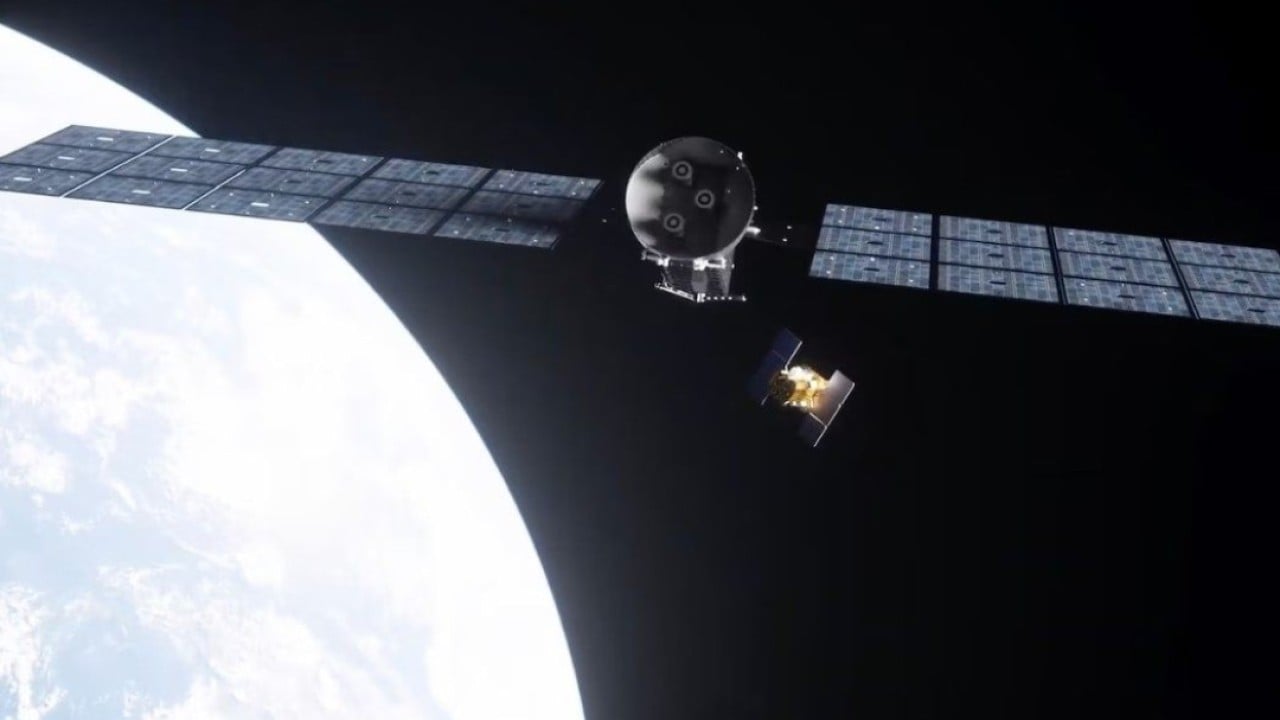
The upper layers of our atmosphere are swelling, and they are dragging down millions of dollars of scientific history with them. Right now, NASA is executing a high-stakes, $30 million rescue mission in the middle of the Pacific Ocean to stop one of its most critical space telescopes from burning up in a fiery, uncontrolled reentry.
The target is the Neil Gehrels Swift Observatory. For nearly 22 years, this space telescope has acted as astronomy's ultimate first responder, pivoting within minutes to capture gamma-ray bursts, exploding stars, and black holes ripping apart stellar bodies. But Swift is in deep trouble. It has no onboard propulsion system. It has drifted down from its original altitude of 373 miles to a perilous 224 miles above the surface.
To fix this, NASA is turning to an unproven commercial savior. A Flagstaff, Arizona-based startup called Katalyst Space Technologies has built a refrigerator-sized, 937-pound robotic spacecraft named LINK. Its job is simple yet terrifyingly complex. It must rendezvous with a tumbling telescope that was never designed to be serviced, grab it with three robotic arms, and push it back up into a stable orbit before October rolls around.
If it works, it rewrites the rules of satellite maintenance. If it fails, a legendary telescope becomes space junk by the end of the year.
The Hidden Enemy Expanding Earth's Atmosphere
Space isn't completely empty, especially not in low Earth orbit. Satellites constantly plow through a thin soup of atmospheric gases. Usually, this causes a predictable, slow decay in altitude.
Lately, the Sun has changed the math entirely. We are currently navigating a period of intense solar activity. Solar flares and coronal mass ejections are hammering the upper atmosphere with radiation. When this energy hits, the atmosphere heats up and expands outward like a balloon.
Suddenly, spacecraft at lower altitudes find themselves swimming through much denser gas than they were built to handle. Swift started sinking faster and faster. By late 2024, NASA scientists crunched the numbers and realized they were looking at a 90% chance of total destruction by the end of 2026.
The Swift operations team at the Goddard Space Flight Center had to act fast. In February, they turned off all of the telescope's scientific instruments. They oriented the spacecraft into a position that minimizes cross-sectional area, trying desperately to reduce the surface area catching the atmospheric drag. That bought some time. It kept the telescope hovering just above the 185-mile mark. That is the absolute redline. Drop below 185 miles, and the air is too thick for any rescue craft to safely wrestle the telescope back up.
How LINK Intends to Grab an Uncatchable Satellite
The engineering hurdles behind this mission are staggering. When the space shuttle crews famously repaired the Hubble Space Telescope decades ago, they were working on a multi-billion-dollar machine specifically designed with handrails, grapple fixtures, and standardized docking interfaces.
Swift has none of that. Nobody expected to touch it again after its 2004 launch. In fact, Katalyst Space CEO Ghonhee Lee admitted that his team couldn't even find a photograph of the backside of Swift before it left Earth. They had to build a docking system based on old blueprints and guesswork.
The solution they came up with is a custom robotic capture mechanism. LINK uses advanced LiDAR sensors to map Swift in real-time as it approaches. Once it gets close enough, it deploys three mechanical arms. The ends of these arms feature specialized claws that engineers compare to the hands of a Lego minifigure. These claws are designed to lock onto structural elements of Swift's primary frame without crushing the delicate, hyper-sensitive scientific equipment surrounding them.
The launch strategy itself reflects the rushed, aggressive nature of the project. Instead of waiting for a traditional rocket pad opening, the mission utilized a midair launch. A Northrop Grumman Pegasus XL rocket was strapped to the belly of an airplane, flown out over the Kwajalein Atoll in the Marshall Islands, and dropped over the open ocean before igniting its engines. This method gives the team incredible orbital flexibility, letting them drop LINK into the exact plane needed to chase down the dying telescope.
Why We Can't Afford to Lose Swift
You might wonder why NASA is spending $30 million to save a 22-year-old piece of hardware instead of just building a new one. The reality comes down to federal budgets and unique architectural capabilities.
NASA simply lacks the cash right now to replace Swift. More importantly, newer and flashier instruments like the James Webb Space Telescope actually rely on Swift to do their jobs. Webb is a sniper rifle. It has a narrow field of view and takes days to point toward a new target. Swift is a wide-angle security camera. It scans massive swathes of the sky, spots a sudden explosion of gamma radiation, and instantly broadcasts the coordinates to telescopes worldwide.
Without Swift acting as the cosmic tip line, Webb would miss the opening acts of the most violent events in the universe.
The Broader Orbital Crisis
Swift is not an isolated incident. The same solar activity putting this telescope in jeopardy is also actively degrading the orbit of the Hubble Space Telescope. Hubble is significantly heavier and larger than Swift, meaning a rescue mission for the iconic observatory will require a much larger, next-generation robot.
Katalyst Space is already developing a scaled-up version of its robotic savior, aiming for a potential Hubble boost mission within the next two years. Until now, only China has successfully pulled off a similar orbital maneuver, using a robotic craft to push an aging satellite into a high graveyard orbit four years ago. This mission marks the first time an American autonomous robot will attempt an on-orbit servicing operation on a non-cooperative target.
The entire space industry is watching this play out. If LINK successfully docks with Swift over the next month and begins the two-month process of pushing it from 224 miles back up to its safe haven of 373 miles, it shifts the economic model of spaceflight. We move away from treating satellites like disposable cups and start viewing them as permanent infrastructure.
What Happens Next
The timeline for the rescue is tight, and there is absolutely no guarantee of success. Here is what the schedule looks like over the coming weeks.
- Rendezvous Phase: LINK will spend the next few weeks performing systems checks and gradually aligning its orbit with Swift.
- The Capture: By late July, the autonomous docking sequence will initiate, using LiDAR to guide the three mechanical arms into position.
- The Lift: Once secured, LINK will fire its thrusters intermittently over a two-month span, fighting gravity to raise the altitude.
- Science Resumption: If the orbit reaches the targeted 373 miles, NASA plans to power up Swift's instruments and resume full scientific operations by September.
Keep an eye on the orbital tracking data for Swift over the next thirty days. If you notice its altitude numbers finally stop dropping and start ticking upward, you'll know that a three-armed robotic claw just saved one of the most vital tools in modern astrophysics.


:max_bytes(150000):strip_icc()/parts-of-a-swamp-cooler-2718628-a477e6f0787b4f8bb62ddf2def31d495.png)