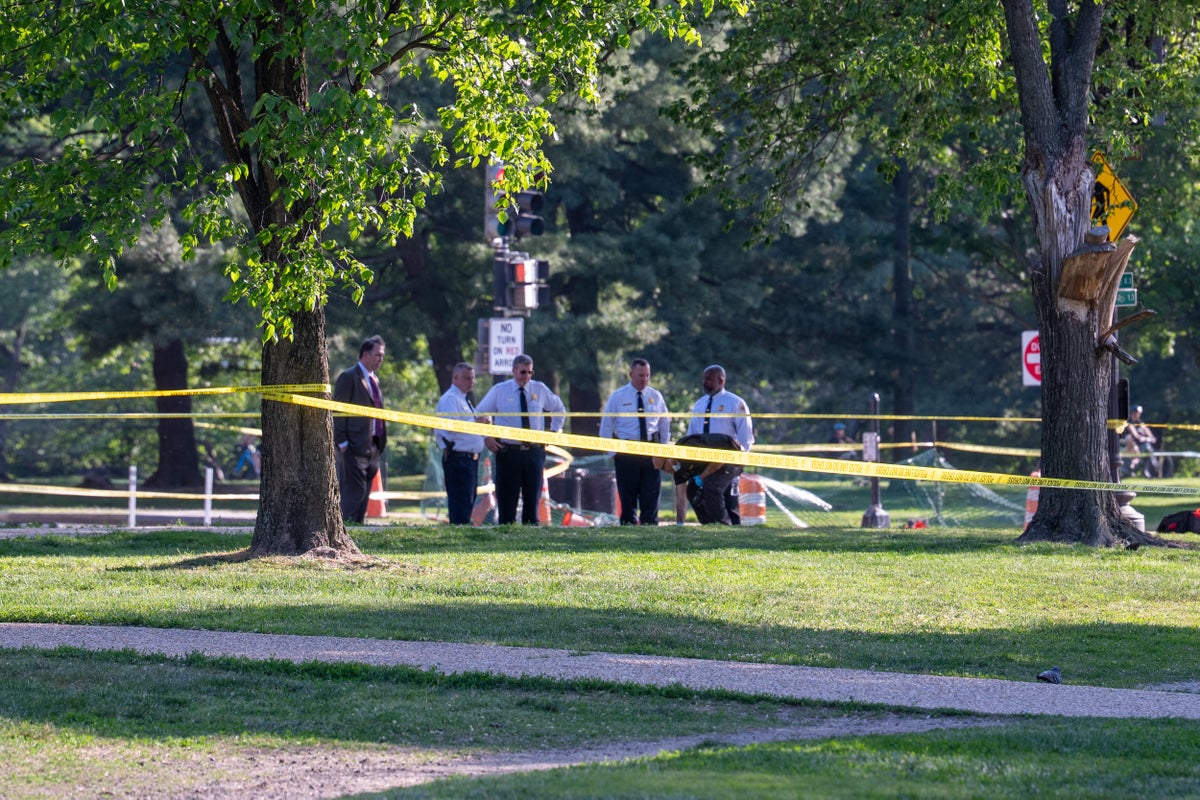
The recent arrest of a suspect following a shooting on the National Mall has shifted from a local crime report into a troubling investigation of federal security failures and the radicalization of individuals targeting symbolic American landmarks. Prosecutors revealed that after being taken into custody, the suspect reportedly shouted profanities directed at the White House, signaling a motive that stretches far beyond a random act of violence. This incident marks another fracture in the perceived safety of the capital’s most high-profile public spaces, forcing a reckoning over how individuals with clear hostile intent manage to carry weapons into the heart of the federal district.
While initial reports focused on the chaos of the scene, the emerging courtroom evidence suggests a premeditated strike designed to grab headlines and broadcast a message of dissent. Federal investigators are now tracing the suspect's movements in the days leading up to the gunfire, looking for the specific trigger that turned a grievance into a kinetic attack. The National Mall is not just a park; it is a sprawling, open-air stage where the tension between public access and national security is constantly at a breaking point.
The Failure of the Invisible Perimeter
The National Mall is one of the most heavily surveilled pieces of land on the planet. Between the National Park Service, the U.S. Capitol Police, and the Secret Service, there are thousands of cameras and sensors monitoring every square inch of the grass and gravel. Yet, a gunman was able to navigate these layers of protection and discharge a firearm. This reality shatters the illusion of total control that federal agencies try to project.
Law enforcement experts argue that the sheer openness of the Mall makes it an impossible target to fully harden without turning it into a fortress. Unlike the White House or the Capitol building itself, the Mall relies on "soft" security measures. These include plainclothes officers and behavioral detection teams. In this instance, those layers failed. The suspect moved through the crowd unnoticed until the first shot rang out, proving that high-tech surveillance is often a reactive tool rather than a preventative one.
Tracing the Weaponry
A central question remains: how did the suspect obtain the firearm, and how did they transport it into a high-security zone? Washington D.C. maintains some of the strictest gun laws in the United States. Carrying a firearm on federal parkland is a complex legal minefield, and for most civilians, it is outright prohibited.
Investigators are currently looking into whether the weapon was a "ghost gun"—an untraceable firearm assembled from kits—or if it was straw-purchased in a neighboring state like Virginia or Maryland. The ease with which weapons flow across the district’s borders remains the primary hurdle for capital security. You can have all the police in the world stationed at the Lincoln Memorial, but if the person walking toward them has a concealed weapon and no prior criminal record, the system is essentially flying blind.
Radicalization in the Shadow of Power
The suspect's alleged outburst regarding the White House points to a deeper trend of political volatility manifesting as physical violence. We are seeing a rise in "lone actor" threats where individuals, fueled by online rhetoric or personal perceived slights against the government, decide to take their grievances to the doorsteps of power.
This is not a new phenomenon, but the frequency is increasing. In the past, security focused on organized groups or foreign entities. Today, the threat is decentralized. It is a person with a smartphone and a grudge. Prosecutors are likely to use the suspect's post-arrest statements to argue for maximum sentencing, but the broader societal issue remains unaddressed. When a person views the literal seat of government as an enemy, the National Mall becomes a front line.
The Psychology of the Attack
Psychological profiling of such suspects often reveals a desire for infamy. By choosing the National Mall, the suspect ensured that their message—no matter how crude or incoherent—would be amplified by every major news outlet in the country. The act of shouting at the White House while in handcuffs was the final act of a planned performance.
It serves as a reminder that for certain individuals, the arrest is not the end of the mission; it is the moment the megaphone is handed to them. The legal system now has to balance the need for a public trial with the risk of giving a platform to someone who used violence to get attention.
Resource Strains and Officer Burnout
We have to look at the people on the ground. The U.S. Park Police and Metropolitan Police Department are facing historic staffing shortages. When departments are understaffed, proactive patrolling is the first thing to go. Officers are moved from walking beats to stationary posts or vehicle patrols, reducing their ability to spot suspicious behavior before it escalates.
Staffing levels have dropped significantly over the last five years across almost all federal law enforcement branches. This creates a "security theater" where the presence of police is visible, but the actual depth of coverage is thin. A tired officer on hour twelve of a shift is less likely to notice the subtle signs of a person "casing" a location or concealing a weapon under a heavy coat on a warm day.
The Legal Path Forward
The prosecution's case will hinge on the intent behind the shooting. If they can prove that the suspect intended to harm federal officials or disrupt government functions, the charges could move into the realm of domestic terrorism. This would carry significantly heavier penalties than standard assault or weapons charges.
- Evidence Collection: Digital forensics on the suspect’s phone and social media accounts.
- Witness Testimony: Corroborating the timeline of the shooting.
- Ballistics: Matching the casing found on the Mall to the weapon recovered.
The defense will likely lean on mental health evaluations, a common tactic in cases where the suspect makes inflammatory political statements upon arrest. However, the premeditated nature of bringing a weapon to a restricted federal zone often overrides claims of a spontaneous mental break.
Reevaluating Public Access
There is already talk among lawmakers about increasing the "security envelope" around the Mall. This could mean more checkpoints, more fencing, or more intrusive surveillance. But every time we add a fence, we lose a piece of the American ideal that these spaces belong to the people. It is a grim trade-off.
The reality of 2026 is that the National Mall is a target because of what it represents. As long as it remains an open symbol of democracy, it will remain vulnerable to those who wish to strike at that symbol. Security can be tightened, but it can never be absolute without destroying the very essence of the space.
The focus must shift toward better intelligence and intervention long before a suspect ever reaches the grass of the Mall. Once the gun is drawn in a crowded public space, the system has already lost. The shouts of "F the White House" are just the echoes of a failure that started months before the first shot was fired.