Two seemingly unrelated political stories collided in September 2026 to reveal the exact same shift in American governance. While roughly 130 heads of state gathered in New York for the 81st session of the United Nations General Assembly (UNGA) amid active wars in Ukraine and the Gulf, President Donald Trump announced via Truth Social that his proposed 250-foot triumphal arch in Washington, D.C., would be repurposed as a "top grade military complex" to store weapons.
The connection isn't thematic. It is procedural. Both events expose how the executive branch is aggressively bypassing established institutional guardrails—whether international treaties in Manhattan or federal preservation laws on the Potomac—by invoking unilateral national security authority.
The Architecture of a Legal Maneuver
To understand why a monument designed to celebrate America’s 250th anniversary suddenly became a weapons depot, you have to look at the litigation docket in Washington, D.C., rather than the Pentagon's strategic needs.
Originally unveiled in late 2025 as a neoclassical tribute sitting on Memorial Circle between the Arlington Memorial Bridge and Arlington National Cemetery, the project—derisively dubbed the "Arc de Trump" by critics—immediately ran into a buzzsaw of regulatory and legal obstacles. Preservationists, local officials, and plaintiffs who filed suit in February 2026 pointed out an obvious statutory problem. Under the Commemorative Works Act, building a massive monument on federal parkland in the capital requires explicit authorization from Congress, alongside rigorous environmental and aesthetic reviews from bodies like the National Capital Planning Commission and the Commission of Fine Arts.
The administration's own internal assessments admitted the 250-foot granite structure, topped with three golden statues, would inflict "adverse effects" on the sightlines of Arlington National Cemetery and the Lincoln Memorial just across the river. In normal times, that finding alone stalls a project for years.
Then came the September pivot. By rebranding the structure at the purported "strong request" of the military as a hardened facility for weapons storage, the White House attempted to shift the project out of the jurisdiction of parks and preservation statutes and into the realm of defense infrastructure.
Legal scholars immediately recognized the playbook. Harold Hongju Koh, a former State Department legal adviser, noted that the administration routinely slaps a national security label on domestic policies to insulate them from judicial review. It is the exact same legal argument the White House deployed to defend the construction of its controversial White House State Ballroom—claiming that excavation beneath the ballroom was tied to classified military infrastructure.
The Regulatory Blowback Nobody Planned For
Reclassifying a monument as a military installation is a clever courtroom tactic, yet it creates a massive operational headache that the administration's PR rollout completely ignored.
Memorial Circle sits directly under the primary flight path for Ronald Reagan Washington National Airport (DCA), one of the most tightly restricted and congested airspaces in the United States. For six months prior to the September announcement, the Federal Aviation Administration (FAA) had been conducting airspace and safety evaluations based on the premise that the structure was an inert, unoccupied stone monument.
An active military weapons facility changes every variable in that equation.
- Airspace and Radar Interference: Hardened military facilities require specialized communications arrays, perimeter sensors, and security protocols that alter aviation clearance zones.
- Force Protection Perimeters: Storing munitions or tactical gear next to a public traffic circle—and mere yards from the civilian visitors at Arlington National Cemetery—triggers strict Department of Defense standoff distance requirements.
- Environmental and Hazmat Reviews: Munitions storage falls under entirely different federal environmental mandates than granite masonry, voiding prior administrative sign-offs.
Aviation and regulatory analysts quickly pointed out that turning the arch into a military complex renders the FAA's previous six months of safety studies obsolete, forcing federal agencies back to square one while state attorneys general from Virginia and D.C. piled on with fresh lawsuits. By November 2026, federal judges had already stepped in to temporarily block construction, proving that the national security shield is far from bulletproof when applied to real estate.
Meanwhile in Manhattan The Empty Chairs Tell the Real Story
While Washington fought over whether a triumphal arch constitutes a military base, the 81st U.N. General Assembly opened in New York under the theme of "Restoring trust, managing transformation." The irony was thick enough to cut.
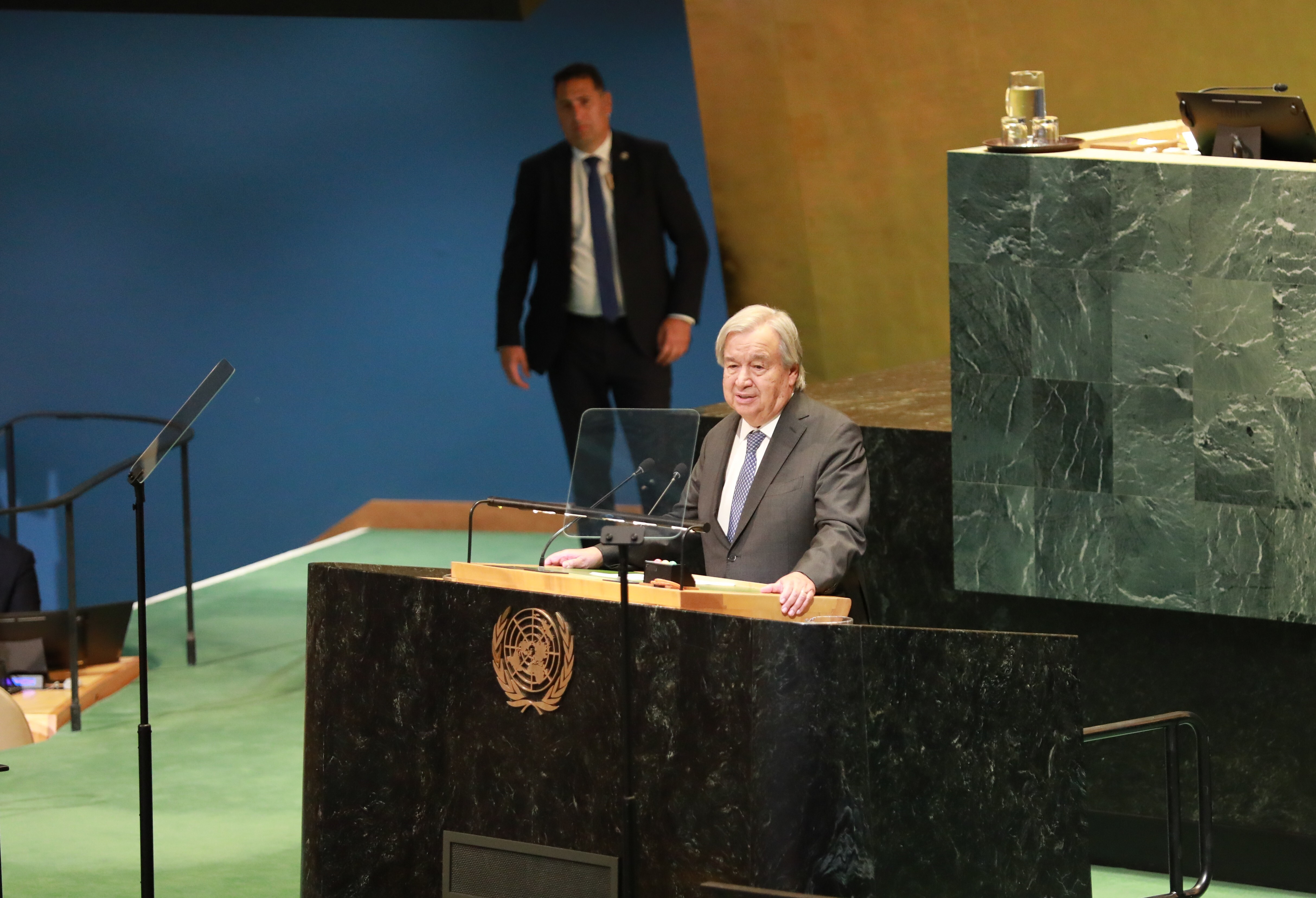
On paper, the September 2026 gathering looked like business as usual. Over a hundred leaders arrived to debate runaway artificial intelligence, climate overshoot, maritime supply chain shocks, and grinding wars in Eastern Europe and the Middle East. Outgoing Secretary-General António Guterres, presiding over his final General Assembly, warned delegates that global power was fracturing in an era of deep uncertainty.
Look at the seating chart, however, and you see a multilateral system quietly hollowing out.
Chinese President Xi Jinping skipped the New York assembly entirely, sending a vice president in his place—even though Xi was scheduled to travel to Washington that very same week for bilateral talks with Trump. Russian President Vladimir Putin stayed home. Indian Prime Minister Narendra Modi backed out. At the same time, the U.S. government refused to issue a visa to Palestinian Authority President Mahmoud Abbas, forcing him to address the assembly via video link despite the 1947 U.N. Headquarters Agreement obligating the host country to grant access to invited diplomats.
The message from the world’s major powers was unmistakable. Real power politics no longer happens in the General Assembly Hall.
Bilateral Deals Over Multilateral Consensus
For decades, the UNGA served as the premier stage where superpower friction was managed through institutional norms. Even at the height of the Cold War, Soviet and American diplomats treated the floor of the General Assembly as essential diplomatic terrain.
In 2026, that consensus has evaporated. When Xi Jinping bypasses Turtle Bay to fly straight to Washington, he is validating a transactional, bilateral worldview where great powers cut deals directly and treat international bodies as expensive theater.
Consider the structural rot inside the U.N. itself. At 81 years old, the Security Council still reflects the victors of 1945 rather than the economic and demographic reality of the 2020s. With permanent members routinely vetoing resolutions tied to Ukraine or the Gulf, the institution has been reduced to hosting emergency side-summits on AI governance and sea-level rise that produce non-binding declarations rather than enforceable treaties.
Even the race to replace Guterres reflected this diminished stature. Only four candidates stepped forward to audition for the Secretary-General post during the 2026 session, a sharp drop from the crowded field of ten that competed in 2016. Diplomats know the job now involves managing institutional decline with shrinking budgets and hostile host-nation politics.
The Common Thread Behind Both Stories
Mainstream news summaries often bundle these two developments together simply because they happened during the same week in September. That surface-level framing misses the deeper story.
Both the D.C. triumphal arch controversy and the UNGA attendance slump are symptoms of executive unilateralism replacing rules-based governance.
Domestically, rules-based governance means submitting monumental public works to congressional appropriations, public comment periods, and historic preservation boards. When those processes threaten to stall or kill a signature project, the executive branch reaches for emergency powers—redefining aesthetics as national defense to bulldoze institutional friction.
Internationally, rules-based governance means adhering to host-country visa obligations and working through multilateral frameworks like the U.N. Security Council to resolve conflicts in Ukraine and the Persian Gulf. When those frameworks prove slow or constraining, Washington and Beijing alike simply walk around them, relying on bilateral leverage, visa denials, and unilateral force.
Why Historic Precedent Offers a Warning
History shows that monumental architecture and diplomatic isolationism often travel together.
When Napoleon commissioned the Arc de Triomphe in Paris in 1806—the explicit inspiration behind Trump’s Memorial Circle design—it was intended to project imperial permanence at the exact moment France was dismantling European diplomatic norms through unilateral conquest. Centuries later, autocratic and populist leaders alike have repeatedly turned to neoclassical stone to project strength when international alliances are fraying.
Yet the American constitutional system was specifically engineered to prevent monuments—and militaries—from becoming personal vanity projects.
By placing Memorial Circle at the threshold of Arlington National Cemetery, planners in the early twentieth century intended the space to symbolize reconciliation and collective sacrifice, not executive dominance. Retired military officers have publicly warned that planting a 250-foot gilded arch—let alone an active weapons depot—at the entrance to the nation’s most sacred military burial ground violates both the visual solemnity of the site and the apolitical tradition of the armed forces.
What Happens When Legal Shortcuts Collide With Reality
The immediate fallout from both September flashpoints demonstrates that bypassing institutions carries steep hidden costs.
In Washington, the administration’s attempt to fast-track the United States Military Triumphal Arch through a "national security" designation has actually slowed the project down. By triggering new aviation safety reviews, environmental challenges, and joint lawsuits from Virginia and the District of Columbia, the White House traded a slow legislative approval process for an indefinite judicial injunction. Even a slick promotional website unveiled in November 2026 proclaiming the arch "long overdue" could not override a federal judge's halt order.
Meanwhile, in New York, sidelining the United Nations has not produced cleaner solutions to global crises. The wars in Ukraine and the Gulf grind on without a viable diplomatic off-ramp. Commercial shipping lanes remain vulnerable to regional choke points, driving up global inflation and supply chain volatility. And without a functioning multilateral enforcement mechanism, artificial intelligence weapons development is accelerating in a regulatory vacuum.
Institutions are slow, bureaucratic, and maddening by design. They exist to force consensus before concrete is poured or treaties are torn up. When leaders treat those guardrails as inconveniences to be bypassed by decree, they don't achieve speed—they simply trade predictable rules for permanent gridlock.