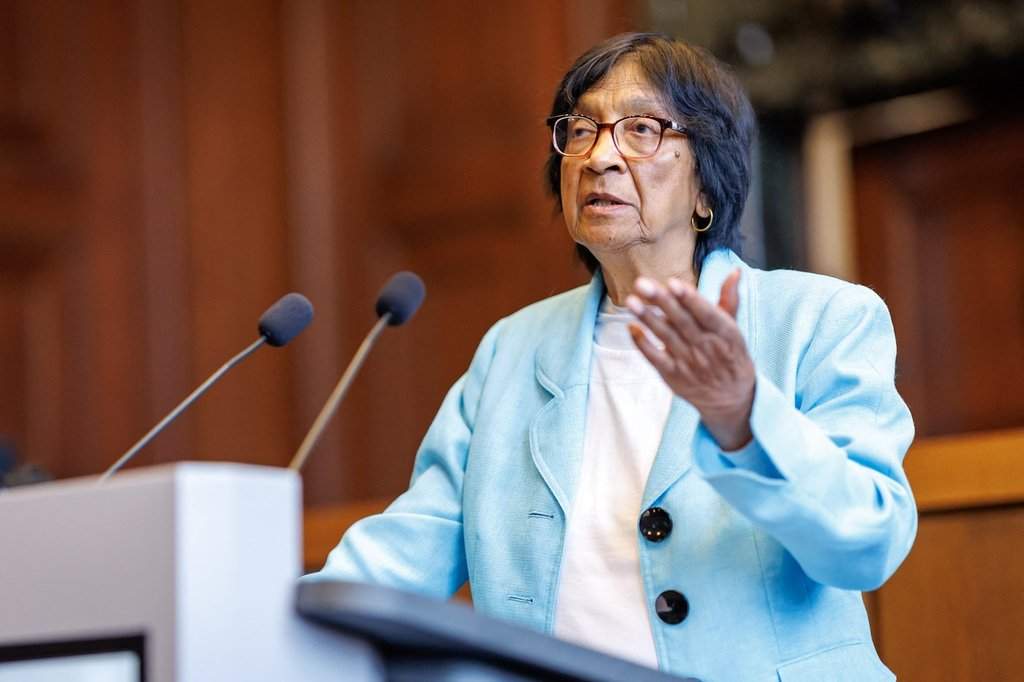
When Navanethem "Navi" Pillay learned she won the Nobel Peace Prize, she wasn't relaxing at home. She sat in Courtroom 600 of the Nuremberg Palace of Justice, the exact historical room where post-war Nazi leaders answered for genocide and crimes against humanity. That setting wasn't an accident. It served as a stark reminder of what global justice looks like when the powerful are finally forced to follow the rules.
The Norwegian Nobel Committee didn't hand this prize to a symbolic peacemaker who cuts ribbons or signs empty treaties. They awarded it to a fierce jurist who spent decades dismantling impunity. From defending anti-apartheid activists in South Africa to prosecuting genocidal leaders at international tribunals, Pillay represents a terrifying concept for modern politicians: nobody is above the law.
The Roots of a Legal Titan
Pillay's path to international jurisprudence started far away from the gilded halls of the United Nations. Born in Durban, South Africa, in 1941, she grew up under the brutal boot of the apartheid regime. In 1967, she established her own law firm in Natal, becoming the first non-white woman to do so.
She didn't practice corporate law or safe defense work. She took on the state, representing political prisoners, documenting police torture, and fighting for detainees denied basic humanity. She knew firsthand what systemic oppression looked like because she lived inside it.
When people ask how she developed such unshakeable professional courage, the answer goes back to those early Durban courtrooms. She learned early on that institutional power crumbles the moment ordinary lawyers and brave judges refuse to look away.
Rewriting the Rules on War Crimes
Fast forward to the late 1990s, and Pillay's impact went global. Appointed by Nelson Mandela to the High Court of South Africa, she quickly moved to the international stage as a judge for the International Criminal Tribunal for Rwanda (ICTR), eventually serving as its president.
Under her watch, the tribunal achieved a legal breakthrough that changed international criminal law forever. Pillay pushed hard to ensure that rape and sexual violence were legally classified not just as ugly side effects of war, but as explicit acts of genocide and crimes against humanity.
Skeptics argued at the time that international courts were toothless theater. Pillay proved them wrong. She demonstrated that building a meticulous, evidence-based historical record strips war criminals of their narrative. It makes denial much harder and sanctuary much smaller.
Why This Award Stings Global Superpowers
The timing of Pillay's Nobel victory carries heavy geopolitical weight. As the United Nations High Commissioner for Human Rights from 2008 to 2014, and later as chair of the UN Independent International Commission of Inquiry on the Occupied Palestinian Territory, she never shied away from investigating powerful states.
Her recent investigative work concluding that Israeli actions in Gaza constituted genocide drew fierce blowback from Washington and Jerusalem. When the Nobel Committee announced her prize, critics immediately labeled the move political.
Yet supporters point out that true international justice is rarely convenient for superpowers. Pillay herself addressed the controversy with characteristic dry wit while speaking in Nuremberg, joking that if people kept applauding her independence, she might just share the prize with Donald Trump—whose administration had recently slapped sanctions on the International Criminal Court.
The Norwegian Nobel Committee made a deliberate statement by honoring her. They wanted to signal that the international rule of law is fracturing under the pressure of modern conflicts, and that protecting independent judges is the only defense we have against total lawlessness.
What the Nobel Committee Really Meant
We live in a political climate where international courts face daily threats, economic sanctions, and outright dismissal from nations that prefer raw military might over legal accountability. By celebrating Pillay, the committee is pushing back against that erosion.
Her career proves a simple, unvarnished truth: peace without justice is just a pause between atrocities. If global institutions bow to political pressure every time a powerful nation commits a violation, international law ceases to exist.
Navi Pillay didn't spend her life trying to win popularity contests among world leaders. She spent it building a paper trail of accountability. That's precisely why she won, and precisely why the architects of modern conflict are squirming.