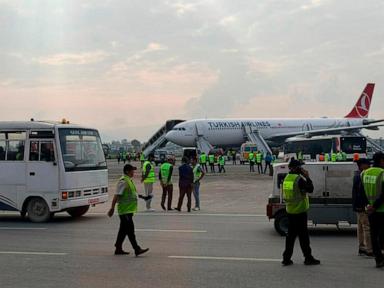
The recent emergency involving a Turkish Airlines Airbus A330 at Kathmandu’s Tribhuvan International Airport is more than a momentary travel disruption. While the immediate focus remained on the safe evacuation of all passengers and crew, the incident exposes a dangerous intersection of aging infrastructure, high-altitude physics, and the razor-thin margins of safety at one of the world's most challenging aviation hubs. When a jet of this magnitude suffers a landing gear failure or brake fire in the Himalayas, it isn't just an accident; it is a systemic warning.
The aircraft, flight TK726, encountered significant landing gear issues upon touchdown, leading to the collapse of the nose gear and subsequent sparks that ignited a localized fire. This wasn't a freak occurrence. It was the result of a heavy airframe attempting to decelerate on a runway that has long been criticized for its "tabletop" geography and deteriorating surface quality.
The Physics of Himalayan Landings
Kathmandu is a pilot’s nightmare. The airport sits in a bowl-shaped valley at nearly 4,400 feet above sea level. This altitude matters because the air is thinner. Thinner air means less lift at standard speeds, forcing pilots to fly faster approach speeds to remain stable. When you combine higher ground speeds with a runway that is relatively short for long-haul widebody jets, the energy that the braking system must dissipate is enormous.
The kinetic energy of a landing aircraft is calculated by the formula $E_k = \frac{1}{2}mv^2$. Because the velocity ($v$) is squared, even a slight increase in approach speed due to thin air results in a massive surge in the energy the brakes must absorb. If the runway is damp—as it often is in Nepal—the friction coefficient drops, and the aircraft relies more heavily on its mechanical braking and thrust reversers. In this instance, the heat generated by the carbon brake disks likely exceeded their design limits, leading to the ignition of hydraulic fluid or tire rubber.
The Infrastructure Deficit
Tribhuvan International Airport has been operating at or beyond its capacity for a decade. The single runway serves as the only gateway for international widebody jets, meaning any incident here effectively cuts Nepal off from the rest of the world. The pavement itself is under constant stress. Engineers have frequently pointed out that the runway surface suffers from "peeling," where the top layer of asphalt separates under the sheer weight and torque of heavy jets like the Airbus A330 or Boeing 777.
When a pilot hits the brakes on a compromised surface, the anti-skid system works overtime. This creates a pulsing effect that can, under specific conditions, exacerbate mechanical fatigue in the landing gear strut. In this specific Turkish Airlines case, the collapse of the nose gear suggests a structural failure that occurred after the initial impact, likely during the high-energy phase of the rollout.
Why Maintenance Records Matter Now
Investigative focus will inevitably turn to the maintenance history of this specific airframe. Widebody jets are subject to rigorous "C-Checks" and "D-Checks," but the landing gear is a specific focus. The seals and valves within the oleo strut—the shock absorber of the plane—must withstand immense pressure. If there was a pre-existing leak, the heat from the brakes could have easily ignited the atomized hydraulic oil.
Turkish Airlines has expanded its fleet and its global reach faster than almost any other carrier in the last twenty years. This rapid scaling often puts pressure on turnaround times and maintenance schedules at outstations. While the airline maintains a modern fleet, the stress of high-frequency operations into demanding environments like Kathmandu, Mogadishu, and Kabul takes a unique toll on airframes that might not show up in standard pressurized-cabin inspections.
The Human Element in the Cockpit
We often praise pilots for "heroic" evacuations, but the real heroism happens in the three seconds after touchdown. The crew of TK726 had to manage a collapsing nose gear while maintaining directional control to prevent the aircraft from sliding off the runway into the ravines that surround the airport. If the aircraft had veered, the casualty count would not be zero.
The decision-making process during a "hot brake" warning involves a delicate balance. If the pilots taxi to the gate, they risk a fire spreading to the wing tanks. If they stop on the runway, they risk blowing the fuse plugs in the tires, which is exactly what happened here to prevent a total explosion. The fuse plugs are designed to melt at a specific temperature to let the air out of the tires safely, rather than letting the tire burst like a bomb.
The Hidden Risk of Monopolized Access
Nepal’s reliance on a single international runway is a geopolitical and safety bottleneck. When this Turkish Airlines jet blocked the runway, thousands of travelers were stranded, and emergency supplies were halted. This is a recurring theme. Years ago, another Turkish Airlines jet skidded off the same runway, shutting the country down for four days because Nepal lacked the heavy equipment necessary to move a disabled widebody aircraft.
Despite the construction of newer airports in Bhairahawa and Pokhara, international airlines remain hesitant to shift operations due to lack of ground infrastructure and technical landing aids. This keeps the pressure on Kathmandu. The runway is being asked to do something it wasn't built for: handle high-frequency, heavy-jet traffic in a high-altitude, monsoon-prone environment.
Technical Failures vs Environmental Realities
The fire was the symptom, not the disease. The disease is a combination of high-altitude density altitude effects and a runway surface that is no longer fit for purpose. Aviation investigators will look at the Flight Data Recorder (FDR) to see exactly how hard the touchdown was. A "hard landing" can exceed the structural load limits of the gear, but even a normal landing on a "bumpy" or uneven runway can induce a resonant frequency that snaps a weakened metal component.
Metallurgical analysis of the collapsed gear will be the "smoking gun." If investigators find evidence of stress corrosion cracking or fatigue, it points toward a maintenance oversight. If the gear snapped purely from the force of impact, the focus shifts back to pilot training and the specific challenges of the Kathmandu approach.
The airline industry operates on the "Swiss Cheese Model." For an accident to happen, the holes in multiple layers of safety—maintenance, weather, infrastructure, and pilot judgment—must align. In Kathmandu, those holes are larger than they are in London or Dubai. The thin air reduces the margin for error. The mountains limit the go-around options. The runway surface reduces the braking efficiency.
The Economic Pressure of Long Haul Flight
Airlines are businesses. Flying an A330 into Kathmandu is a high-margin but high-risk endeavor. These planes are often loaded to their maximum landing weight with cargo and fuel to avoid expensive refueling costs in Nepal. A heavier plane requires more runway, generates more heat during braking, and puts more strain on the landing gear.
The aviation community has been sounding the alarm on Tribhuvan's runway for years. This fire is a loud, smoky reminder that physics does not care about tourism budgets or airline schedules. Until the runway is completely reconstructed with higher-grade polymer-modified bitumen or the traffic is effectively diverted to airports that don't require "cowboy" landings, we are simply waiting for the next strut to snap.
Check the flight logs of any major carrier frequenting high-altitude ports and you will see a pattern of "unscheduled maintenance" on braking systems. This isn't a Turkish Airlines problem; it is a global aviation challenge. The industry must decide if the cost of operating into these regions outweighs the price of a lost hull—or worse, lost lives. The safety of the passengers on TK726 was a result of the aircraft's fire suppression systems and the crew's training, but relying on "failsafes" is a losing strategy when the environment is fundamentally hostile to the machinery.
Stop looking at the flames and start looking at the asphalt. The fire was extinguished in minutes, but the structural flaws of Nepal's aviation gateway will take years to fix. Every heavy jet that thuds onto that runway today is betting against the laws of thermodynamics and the limits of 20-year-old metal.
Demand better than "safe enough." The next time a gear collapses in the Himalayas, the fire might not stay contained to the wheel well. Ground crews, regulators, and airlines need to address the energy-dissipation limits of high-altitude landings before the friction becomes a catastrophe.