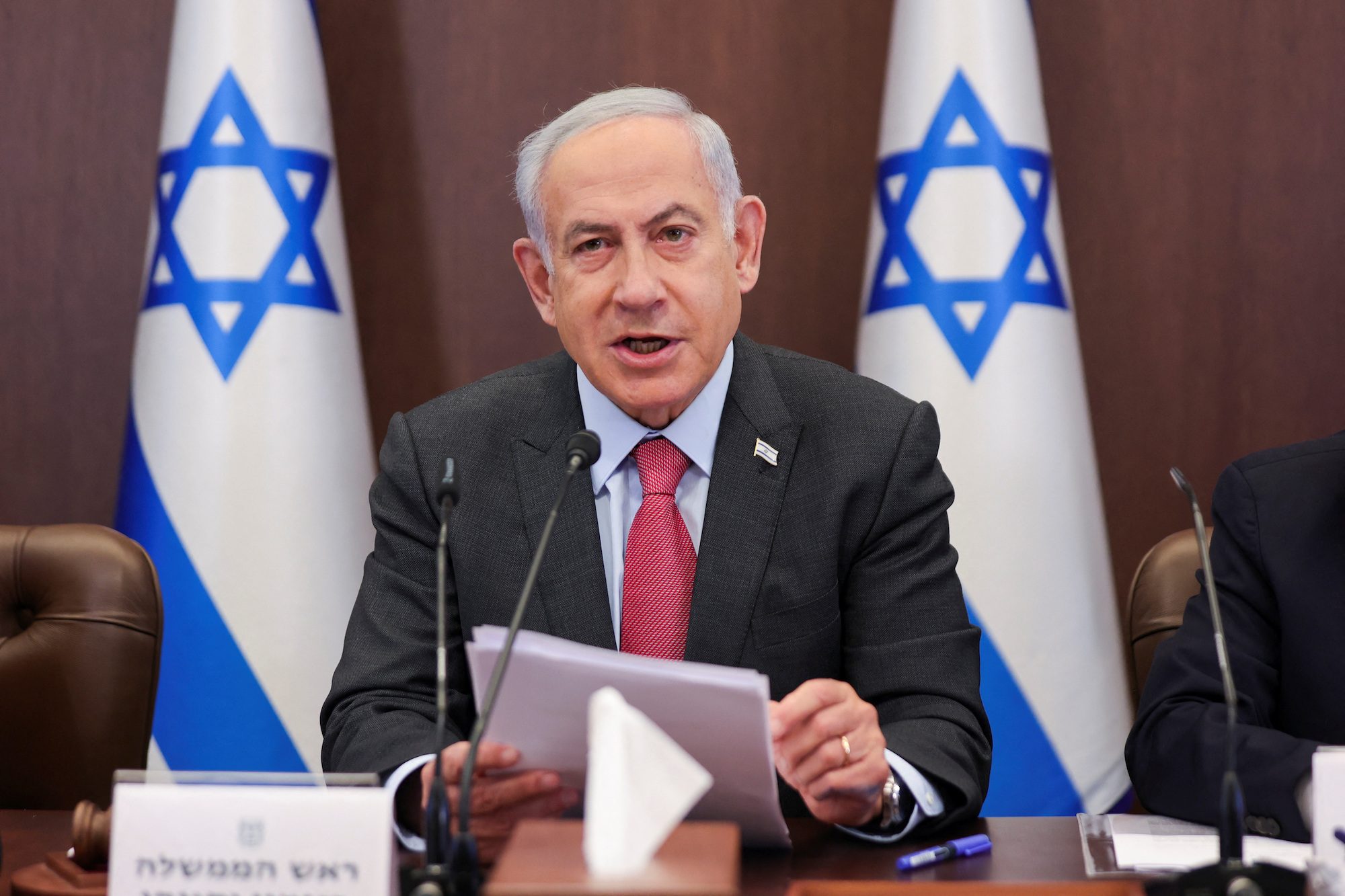
Israeli Prime Minister Benjamin Netanyahu has once again floated the prospect of a broad national unity government during a turbulent session in the Knesset, framing the move as a necessary step to confront regional security threats and domestic instability. Speaking from the podium amid vocal interruptions from opposition benches, Netanyahu argued that political convergence is achievable despite the deep ideological and personal fractures that have defined Israeli politics in recent years. While supporters characterize the outreach as a pragmatic call for national solidarity during wartime, opposition leaders and political analysts largely view the overture as a tactical maneuver aimed at easing coalition pressures and neutralizing domestic dissent.
The pitch arrives at a moment of acute legislative friction. Inside the Knesset plenum, debates over war management, hostage negotiations, ultra-Orthodox military conscription, and the state budget have routinely devolved into shouting matches. By declaring that a unity government is possible, Netanyahu is attempting to shift the political narrative from internal coalition survival to collective national responsibility.
The Anatomy of a Recurring Political Overture
Calls for national unity are a familiar feature of Israeli political history, particularly during periods of sustained military conflict or economic crisis. However, the mechanics of forming such a coalition in the current Knesset face structural obstacles that go well beyond standard policy disagreements.
According to statements made during the Knesset session, Netanyahu positioned the unity appeal around shared existential imperatives—specifically countering regional adversaries and securing the return of hostages held in Gaza. From the perspective of the Prime Minister’s Office and Likud lawmakers, broadening the government would project strength to external enemies and reduce the leverage held by smaller, more extreme factions within the existing right-wing coalition.
Yet opposition figures immediately questioned the sincerity and feasibility of the proposal. Leaders of the main opposition parties, including Yesh Atid and National Unity, have repeatedly stated that they will not sit in a government led by Netanyahu, citing deep mistrust over his handling of the events leading up to October 7, his management of the ensuing multi-front conflict, and his administration's earlier judicial overhaul push. For these lawmakers, joining a Netanyahu-led coalition would mean lending political legitimacy to a leadership they believe should face voters in early elections.
Why Now
Timing is everything in parliamentary politics. Netanyahu’s renewed pitch coincides with mounting friction inside his own governing bloc. The coalition faces severe internal strain over legislation regarding military service exemptions for Haredi (ultra-Orthodox) men—a core demand of his religious partners that clashes sharply with public sentiment and the operational needs of the Israel Defense Forces. Simultaneously, far-right coalition partners have threatened to collapse the government if Israel agrees to certain ceasefire or hostage-release frameworks.
By publicly extending an olive branch to the opposition, Netanyahu achieves two immediate objectives without needing to finalize an actual deal:
- Internal Deterrence: He signals to his current coalition partners that they are not irreplaceable, reminding them that alternative parliamentary arithmetic exists if they push their demands too far.
- Public Framing: He shifts the burden of political division onto the opposition, allowing Likud messaging to portray opposition leaders as prioritizing personal boycotts over national security during a crisis.
The Historical Precedent of Israeli Unity Governments
To understand why current unity talks carry so much skepticism, one must look at how similar arrangements have functioned—and collapsed—in Israel’s past. Israel has formed unity governments several times since 1967, each driven by distinct geopolitical or economic emergencies, and each carrying its own political fallout.
| Unity Coalition Era | Primary Catalyst | Structural Outcome |
|---|---|---|
| 1967–1970 (Eshkol / Meir) | Six-Day War and War of Attrition | Broad consensus lasted through the immediate military crisis before fracturing over diplomatic initiatives. |
| 1984–1990 (Peres / Shamir) | Hyperinflation and Lebanon War withdrawal | Introduced the rotation premiership model; stabilized the economy but ended in gridlock and the "dirty trick" political crisis. |
| 2020–2021 (Netanyahu / Gantz) | COVID-19 pandemic and electoral deadlock | Collapsed within months over budget disputes, preventing the scheduled premiership rotation. |
| October 2023 Emergency Cabinet | Hamas attack and outbreak of war | Provided temporary wartime legitimacy; dissolved after key centrist ministers exited over strategic disagreements. |
The 2020 power-sharing agreement between Netanyahu and Benny Gantz remains the most relevant benchmark for current lawmakers. In that instance, Gantz broke a central campaign promise not to serve under Netanyahu, citing the unprecedented public health emergency of the COVID-19 pandemic. The government ultimately fell apart when the coalition failed to pass a state budget—a mechanism widely interpreted by political observers as a deliberate maneuver to prevent Gantz from assuming the premiership under their rotation agreement.
For current opposition leaders, the 2020 experience serves as a cautionary tale. Similarly, the emergency wartime cabinet formed in October 2023 eventually unraveled when centrist leaders concluded that critical strategic decisions were being delayed or shaped by Netanyahu's need to appease his far-right base.
Competing Perspectives Inside the Knesset
The debate surrounding a potential unity government exposes fundamental disagreements over what Israel requires at this juncture: political continuity or a fresh electoral mandate.
The Coalition Argument
Supporters of Netanyahu’s outreach argue that Israel is fighting a prolonged, multi-front war that demands maximum domestic cohesion. From their viewpoint, constant calls for early elections and fierce parliamentary infighting embolden adversaries like Hezbollah, Hamas, and Iran, who monitor Israeli domestic divisions closely. Proponents maintain that a broad-based government would create the diplomatic room needed to secure international backing, manage sensitive hostage negotiations, and pass an equitable military conscription framework without being held hostage by narrow sectoral interests.
The Opposition Counter-Argument
Opposition lawmakers, including Yair Lapid and Benny Gantz, offer a fundamentally different diagnosis. They contend that the current government is inherently dysfunctional and that adding centrist or center-left parties to a coalition still dominated by Netanyahu and his ideological allies would only mask the paralysis rather than resolve it.
In their view, true national unity cannot be engineered through backroom Knesset deals that bypass the electorate. Instead, opposition figures argue that returning to the polls is the only democratic mechanism capable of producing a government with a clear, unified mandate and restored public trust. Many opposition members also suspect that any new unity proposal is designed primarily to help Netanyahu survive critical parliamentary hurdles—such as passing the state budget or resolving the Haredi draft crisis—after which centrist partners would once again be sidelined.
Structural Barriers to a Deal
Even if ideological hostility were set aside, the mathematical and institutional realities of the 120-seat Knesset make a genuine unity government exceptionally difficult to assemble.
First, there is the question of veto power and cabinet composition. For opposition parties to consider entering the government, they would almost certainly demand the removal or marginalization of far-right ministers such as Itamar Ben-Gvir and Bezalel Smotrich, whose policies on Gaza, the West Bank, and judicial reform are incompatible with centrist platforms. However, expelling those factions would leave Netanyahu entirely dependent on opposition partners who have already expressed a desire to see him leave office.
Second, the Haredi conscription issue acts as an immediate litmus test. Ultra-Orthodox parties—Shas and United Torah Judaism—are among Netanyahu's most loyal allies, yet their insistence on broad military exemptions for yeshiva students is unacceptable to virtually every opposition faction, as well as a growing segment of Likud’s own voter base. A unity government cannot simultaneously satisfy ultra-Orthodox demands for blanket exemptions and opposition demands for universal service.
Third, trust deficits have reached a point where standard coalition agreements carry little weight. In Israeli parliamentary practice, coalition deals are political commitments rather than legally binding contracts. Without ironclad legislative guarantees—such as automatic dissolution mechanisms or pre-agreed election dates—opposition leaders see little reason to believe a new partnership would end any differently than previous iterations.
The Strategic Reality Behind the Rhetoric
In the Knesset, rhetoric often serves purposes far removed from the literal words spoken at the podium. Netanyahu’s declaration that a unity government is possible functions less as a blueprint for an imminent coalition overhaul and more as a pressure valve in an increasingly volatile political environment.
For the Israeli public, weary from prolonged conflict, economic strain, and relentless political polarization, the concept of unity carries undeniable emotional appeal. Every major political camp claims to desire it, yet each defines it on mutually exclusive terms. Until either the coalition’s internal contradictions force a collapse or opposition leaders calculate that joining the government outweighs the political cost, calls for unity in the Knesset will remain a potent rhetorical weapon rather than a governing reality.