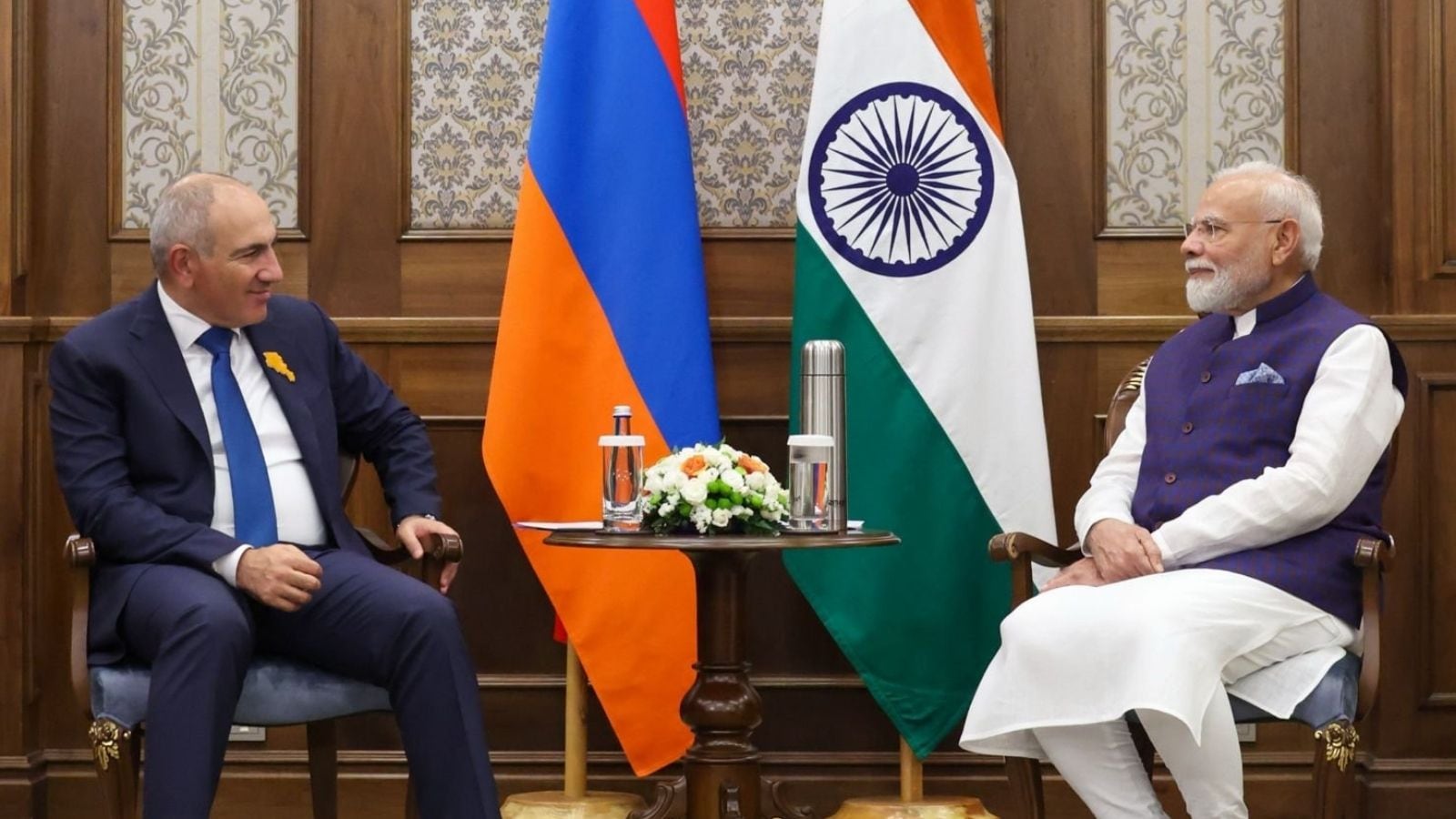
The headlines love a neat, romantic narrative. When Indian Prime Minister Narendra Modi sits down with Armenian Prime Minister Nikol Pashinyan to chat about defence deals, IT corridors, and space cooperation, the commentariat wets itself over a brilliant counter-encirclement strategy against Pakistan and Turkey. It sounds like a geopolitical thriller written by a first-year undergraduate.
Every mainstream defense analyst in New Delhi and Washington is currently pushing the same lazy consensus: that India is systematically building an axis with Armenia to counter the aggressive posture of the Turkey-Azerbaijan-Pakistan triad. They point to the sale of Pinaka multi-barrel rocket launchers, Swathi radar systems, and ATAGS howitzers as proof of a grand, sweeping masterstroke. Meanwhile, you can explore similar stories here: The Strait of Hormuz Chokehold: Inside the War for the World's Energy Lifeline.
They are missing the entire point.
I have watched nations sign multi-million-dollar memorandums of understanding while their actual administrative machinery sits completely paralyzed by bureaucratic inertia. This isn't a masterclass in strategic chess. It is a desperate, transactional scramble where both sides are heavily overestimating what the other can actually deliver. To explore the full picture, we recommend the recent report by NBC News.
Let us dismantle the fiction piece by piece.
The Defense Export Delusion
Everyone points to the artillery and radar sales to Yerevan as definitive proof of India's arrival as a tier-one arms exporter. Let us look at the raw mechanics of defense procurement. India's defense industrial base is notorious for domestic delivery delays, quality control bottlenecks, and a suffocating reliance on public sector undertakings that move at glacial speeds.
When you export frontline systems to a nation actively engaged in a frozen-yet-hot border conflict, you are not just selling hardware; you are exporting your own logistical vulnerabilities. Armenia needs immediate, plug-and-play capability to deter Azerbaijani armor. What they are getting from India are initial batches of systems that require extensive training cycles, spare parts pipelines that span thousands of miles across volatile air corridors, and doctrinal integration that takes years, not months.
Imagine a scenario where a border skirmish flares up in the Syunik province and half the Indian-supplied artillery batteries face immediate maintenance failures due to supply chain chokepoints in the Middle East. Who takes the reputational hit? New Delhi's defense sector, which can ill afford another international quality control scandal while trying to market the Tejas fighter jet globally.
The IT And Space Mirage
Then we come to the technology and space cooperation agreements. Analysts love to rattle off terms like digital public infrastructure, software partnerships, and joint satellite launches.
Let us be brutally honest about administrative realities. Armenia has a brilliant pool of raw mathematical talent and a vibrant niche tech sector, largely centered around isolated software development houses. But pretending that Yerevan can integrate into India's massive Aadhaar-scale digital public infrastructure stack is administrative fantasy. The structural scales are completely incompatible. India operates at a billion-user volume where algorithmic efficiency dictates survival. Armenia operates at a boutique scale.
The space cooperation angle is even more theatrical. India’s ISRO is a world-class launch vehicle provider, no doubt. But signing space cooperation pacts with landlocked, cash-strapped South Caucasian republics does nothing for India's primary strategic imperatives in the Indo-Pacific. It is diplomatic window dressing designed for domestic consumption—a way for New Delhi to signal to its electorate that it is projecting power across multiple continents, even when its core immediate neighborhood in South Asia faces severe, compounding pressures.
The Ankara And Baku Factor
The mainstream thesis treats Turkey and Azerbaijan as passive observers who will simply watch India arm their primary regional rival without consequence. That is breathtakingly naive.
Ankara views the South Caucasus through a Pan-Turkic lens that treats any Indian military footprint in Armenia as a direct, hostile provocation. Baku has billions in oil and gas revenue, deep diplomatic ties with Islamabad, and a clear military edge established during the 2020 Nagorno-Karabakh war.
By aggressively stepping into the South Caucasus, New Delhi is stepping out of its core strategic theater and inviting retaliatory interference in Kashmir. Pakistan already utilizes its iron-clad alliance with Azerbaijan and Turkey to coordinate anti-India rhetoric at international forums like the Organisation of Islamic Cooperation. Every artillery shell India ships to Yerevan deepens that hostile axis, hardening Islamabad, Ankara, and Baku into a permanent, coordinated anti-New Delhi bloc.
You do not provoke three capable nation-states in their own backyard unless you have absolute dominance of your own logistics and domestic economy. India does not.
What Actually Needs To Happen
If New Delhi wants to play global defense merchant, it needs to stop treating foreign military sales as diplomatic press releases and start treating them as iron-clad supply chain commitments. That means establishing forward-deployed maintenance hubs, permanent technical advisory teams on the ground in Yerevan, and supply lines that bypass hostile airspace.
If Armenia wants real security, it needs to stop shopping for symbolic hardware to appease domestic political optics and focus intensely on tactical drone warfare, electronic counter-measures, and resilient domestic manufacturing. Buying a few dozen howitzers from a nation five thousand miles away does not save a state surrounded by hostile geography.
Stop reading the press releases. Start looking at the logistics manifests. The Modi-Pashinyan handshake makes for a great photograph, but geopolitics is not won with photo-ops. It is won with logistics, endurance, and knowing when to stay out of fights you cannot finish.