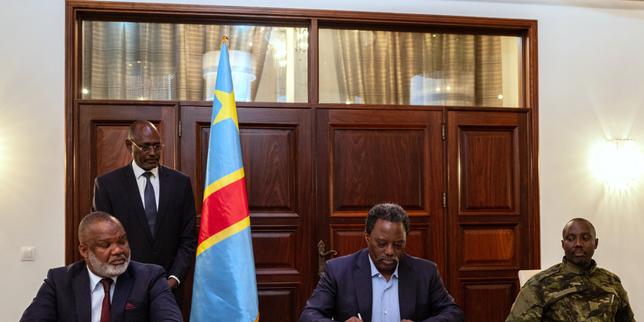
"Surprise." That one word does heavy lifting for lazy headlines. When former president Joseph Kabila stepped forward in Goma in October 2026 as the head of the Front pour la Refondation de la Nation (FRN), absorbing and succeeding the Alliance Fleuve Congo (AFC) and M23 coalition, commentators rushed to call it a bolt out of the blue. It wasn't. Anyone tracking Kinshasa's courts, UN group of experts reporting, and Kabila's own movements in eastern Democratic Republic of the Congo saw this coming months ago.
Calling the FRN a brand-new politico-military force is the central mistake of conventional coverage. A fresh acronym does not erase old rifles, old patrons, or old fractures. The real story in eastern DRC is not a sudden rebirth of rebel idealism. It is an alliance of convenience between a cornered former head of state and an entrenched armed apparatus trying to solve two separate problems at once. You might also find this similar coverage insightful: The Price of Being Owned.
The "Surprise" Myth Falls Apart Under Basic Scrutiny
Competitor coverage loves a neat narrative arc: quiet ex-president in exile, shock announcement in Goma, sudden shake-up of Congo's war. Neat narratives sell clicks. They also miss how power actually moves in the Great Lakes region.
Kabila's ties to the anti-government rebellion in the east were not a secret waiting to be revealed at a press event. Kinshasa had already moved against him legally and politically. A DRC military court sentenced him to death in absentia in September 2025 over alleged treason, war crimes, and crimes against humanity tied to his links with the AFC/M23. In April 2026, Washington slapped sanctions on him over his role with the coalition. When a man already sentenced to death by his own state's military justice system formalizes his leadership of an armed coalition in Goma, that is not a surprise plot twist. It is a formalization of a war that was already underway. As highlighted in detailed coverage by The Washington Post, the results are widespread.
Look at the lineup announced in October 2026:
- Joseph Kabila as president of the FRN, bringing former regime networks and name recognition.
- Corneille Nangaa and Bertrand Bisimwa as vice-presidents, bridging the AFC political platform and M23 leadership.
- Sultani Makenga remaining in command on the military side as chief of staff of the Armée révolutionnaire congolaise.
- Freddy Kaniki stepping in as secretary-general, linking in Twirwaneho.
That roster is not a grassroots uprising. It is a merger of existing factions under a freshly painted banner.
What Analysts Get Wrong About "Nationalizing" the Rebellion
Here is the second lazy consensus: slapping a Congolese former president at the top of the ticket will wash away the rebellion's foreign baggage and turn a Kivu-centered insurgency into a national movement.
That misreads both Congolese politics and armed group mechanics.
First, label swaps do not change regional arithmetic. The UN and Western governments have repeatedly accused Rwanda of backing the M23—a charge Kigali denies—while Uganda has also faced scrutiny in the broader regional web, even after Rwanda's reported troop withdrawal of 2,500 personnel in July 2026 under the Washington peace process. Putting Kabila at the front of the FRN may give the group a more familiar Congolese political face on paper, as observers have noted. In practice, it carries its own poison. A former president tied in critics' eyes to eastern insurgents and regional backers faces deep skepticism across much of the DRC, not automatic national legitimacy.
Second, political branding does not automatically transfer loyalty. Think tanks like African Security Analysis have pointed out that Kabila's old patronage networks and party machinery are not a plug-and-play asset. When senior figures linked to Kabila's PPRD camp distance themselves from taking on legal or political risk for an armed front, the coalition's "national" reach looks much thinner than its name suggests.
A coalition that cannot recruit durable organizers and financiers beyond its existing base has a bigger press release than a political machine.
The Real Question Isn't Who Formed It—It's Who Controls the Guns
People asking "What does this new movement want?" are asking the wrong question. Every armed group in eastern DRC claims to want national refoundation, justice, or inclusive dialogue. Words are cheap. Command and territorial incentives are what govern behavior on the ground.
The harder—and far more revealing—question is this: Does political leadership inside the FRN actually control military strategy, or does battlefield leverage still sit elsewhere?
Consider a thought experiment. Imagine a scenario where Kabila and Nangaa want to push operations well beyond North and South Kivu to pressure Kinshasa politically, while M23 military commanders prioritize holding and consolidating their core eastern footholds and bargaining positions. Reporting ahead of the FRN's launch pointed to exactly that kind of friction over expanding fighting beyond the Kivus. When political leaders and military commanders have different geographic goals, unity on paper rarely survives pressure in the field.
Add to that the diplomacy problem. The FRN declared that it took over the AFC's commitments, including in the Doha track, even as ceasefire pledges and regional agreements have struggled to hold on the ground. Meanwhile, Kinshasa still holds constitutional and international recognition as the state government, even while facing a serious challenge to its authority and security in the east.
Why Conventional Peace Playbooks Keep Stalling
Another flawed premise running through standard commentary is that one more negotiation table—or one more communiqué—will neatly settle things once the right actors are named.
It won't, for three blunt reasons:
- Negotiating scope lags behind battlefield reality. Mediators often treat armed coalitions as single, unified negotiators when internal power balances, regional interests, and local militias pull in different directions.
- Extreme legal stakes harden positions. When a movement's top figure faces a death sentence from Kinshasa's military court and international sanctions, standard political off-ramps become far harder to construct.
- Side fronts keep bleeding attention. Violence in eastern DRC has never been a single tidy front; parallel clashes, local armed groups, and political crackdowns in cities like Kinshasa complicate any single bargain.
Battle Scars From Reading Conflicts in the DRC
I have watched analysts and policy teams burn credibility for years by treating every rebranding in eastern Congo as a structural reset. From earlier rebel iterations to today's shifts between AFC, M23, and the FRN, the names change faster than the underlying power struggles.
Precise definitions matter here. An alliance is a pact between distinct actors who keep separate interests. A political rebrand changes the public banner and leadership framing without necessarily erasing prior factional rivalries or military command realities. Confusing the two leads policymakers to overestimate how cohesive a new front really is.
To be completely candid about my own contrarian take, there is a real risk in underestimating how much political noise a former president can generate. Even an imperfect coalition can squeeze Kinshasa, test opposition unity, or complicate diplomatic talks in Doha and Washington. Calling the FRN a rebrand does not mean it is harmless. It means its strengths and limits are much more specific—and fragile—than breathless coverage lets on.
What to Watch Instead of Headlines
If you want to track where this actually goes without getting played by political theater, ignore the grand speeches and watch four concrete indicators:
- Defections and real-world risk-taking: Watch whether seasoned political brokers outside the immediate inner circle actually stick their necks out for the FRN, rather than offering vague sympathy.
- Command alignment on the front lines: Watch whether military operations stay focused on Kivu strongholds or push outward in ways that match Kabila's political pitch.
- Opposition split lines in Kinshasa: Watch whether mainstream Congolese opposition groups keep distancing themselves from armed action—as seen when opposition figures called for dialogue rather than violence—or get pulled into Kabila's orbit.
- Diplomatic follow-through vs. ceasefire violations: Compare pledges in Doha or regional frameworks against actual clashes and troop movements on the ground.
Acronyms do not end wars in eastern Congo, and new labels rarely create instant legitimacy. Watch who holds the leverage when the cameras turn off.
Joseph Kabila takes head of FRN movement in DRC
This video directly covers the October 2026 announcement in Goma naming Joseph Kabila head of the Front pour la Refondation de la Nation alongside the AFC/M23 realignment.