We like to think we've mapped every corner of this planet, cataloged its secrets, and filed them away. Then, the Congo Basin reminds us how little we actually know.
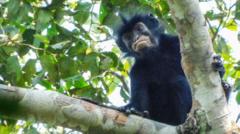
In July 2026, scientists officially announced the discovery of Colobus congoensis, known locally as the Likweli. It's a small, black-furred monkey with a striking, almost comical splash of vibrant orange-cream framing its mouth and nose. It looks a bit like it got caught face-first in a bowl of bright orange cheese dust. Discover more on a similar topic: this related article.
But this isn't just another neat animal photo to scroll past. This is only the fifth new monkey species identified in Africa in the last 75 years. It represents a massive evolutionary puzzle piece that rewrite our understanding of how primates spread across the continent.
And yet, we almost missed it entirely. Additional journalism by Al Jazeera highlights similar perspectives on this issue.
A Twenty Year Game of Hide and Seek
Finding a new mammal in the 21st century doesn't happen during a casual weekend hike. It takes decades of grime, muddy boots, and sheer luck.
The first hint of the Likweli came in 2008. A research expedition deep in the Lomami Basin of the Democratic Republic of Congo (DRC) snapped a blurry, partially obscured photo of an unfamiliar primate. At the time, nobody could confirm what they were looking at. The forest was too dense, and the monkey too elusive.
Ten years passed.
In 2018, a park ranger named Jean Pierre Kapale managed to snap another photo of the mysterious primate, noting its distinct pale facial markings and a white patch near its tail. This second sighting lit a fire under the scientific community. Over the next four years, researchers from institutions like Florida Atlantic University, Yale, and local Congolese conservation groups launched grueling foot patrols spanning thousands of miles.
They ultimately logged 114 sightings over a 1,700-square-kilometer area between the Lomami and Lilo rivers. By matching these field observations with anatomical and genetic testing of specimens salvaged from the illegal bushmeat trade, the team finally confirmed they had found an entirely new species.
What Makes the Likweli So Strange
Physically, the Likweli stands out immediately. Weighing about 15 pounds, it's roughly the size of a small dog, making it smaller than most of its colobus relatives. While its body is draped in sleek, glossy black fur, its face features bare, slate-grey cheekbones that frame dark, watchful eyes. The real showstopper is the bright orange-cream pout, which gives it a perpetually unimpressed, mask-like expression.
But its behavior and genetics are where things get truly bizarre.
1. It stares back
Most monkeys in the Congo Basin bolt the second they spot a human. Hunting pressure has taught them that two-legged creatures mean danger. But the Likweli is different. According to Kate Detwiler, an anthropologist at Florida Atlantic University who co-authored the study, these monkeys are incredibly quiet and watchful. Instead of fleeing, they climb higher into the canopy, sit still, and simply stare down at the researchers.
2. It roars like a house music track
You wouldn't expect a 15-pound monkey to have the voice of a foghorn, but the Likweli does. The males produce incredibly deep, booming, resonant roaring calls accompanied by sharp snorts. Some researchers have jokingly described the call as a cross between a massive burp and the heavy bassline of a house music track. These calls carry over immense distances through the thick canopy, acting as an acoustic fingerprint that separates them from other colobus species.
3. The 1,200-kilometer evolutionary gap
This is the scientific bombshell. You would assume the Likweli’s closest relative lives nearby in the DRC. It doesn't.
Genetic analysis revealed that the Likweli’s closest relative is actually the black colobus (Colobus satanas), a species found over 1,200 kilometers away in West-Central African countries like Cameroon and Gabon. The two lineages split roughly 4 to 5 million years ago. This makes it one of the oldest known evolutionary splits within the entire Colobus genus, leaving scientists with a massive question: how did these two sister species end up separated by such a massive expanse of forest?
Even the Locals Didn't Know It Was There
We often assume that indigenous communities know every single animal in their backyard. But the Likweli is so quiet and isolated that it managed to fly under the radar of almost everyone.
When researchers surveyed 52 villages surrounding the Lomami National Park, residents in only eight of them could actually recognize or describe the monkey. It was mostly known only to seasoned local hunters. The Balanga people call it "Likweli," while the Mituku people call it "kasaba nkoni," which translates to "the branch shaker".
The fact that a medium-sized mammal could live right next to human settlements and remain largely a mystery to them shows just how incredibly dense, rugged, and protective the Congo Basin rainforest really is.
Why This Scientific Triumph is Also a Warning
Finding the Likweli is an incredible achievement, but the mood among conservationists is far from celebratory. The monkey is likely already in deep trouble.
The Likweli’s entire known habitat is tiny—roughly 1,700 square kilometers, which is about two-thirds the size of Luxembourg. They are naturally boxed in by massive rivers and depend entirely on highly specific, scattered upland forest patches. Because of this incredibly restricted range, combined with the constant threat of habitat destruction and illegal hunting, researchers are urgently pushing for the Likweli to be classified as Endangered on the IUCN Red List.
The discovery highlights a brutal reality of modern conservation: we are currently in a race against time. The Congo Basin is facing unprecedented pressures from logging, agriculture, and the bushmeat trade. The very same patrols that collected the genetic samples for this study often had to salvage them from intercepted bushmeat confiscated from poachers.
It is highly probable that other undiscovered, highly localized species are quietly slipping into extinction before we even get a chance to photograph them.
If we want to keep finding wonders like the orange-lipped, bass-booming branch shaker of the Congo, protecting areas like the Lomami National Park isn't just a nice-to-have policy. It is a critical, immediate necessity. Supporting local park rangers, funding remote biodiversity surveys, and cracking down on illegal logging in the DRC are the only real ways to ensure the Likweli's home remains intact.


