The coffee in my mug had gone cold two hours ago. Out on the back deck, the air felt like damp wool, clinging to my skin with the peculiar chill of a pre-dawn Saturday. I wasn't alone. Across the neighborhood, porch lights flickered off. I could see the silhouette of my neighbor, a man who usually spends his weekends obsessing over the pH balance of his lawn, standing perfectly still with a pair of dusty binoculars pressed to his eyes.
We were all waiting for the parade.
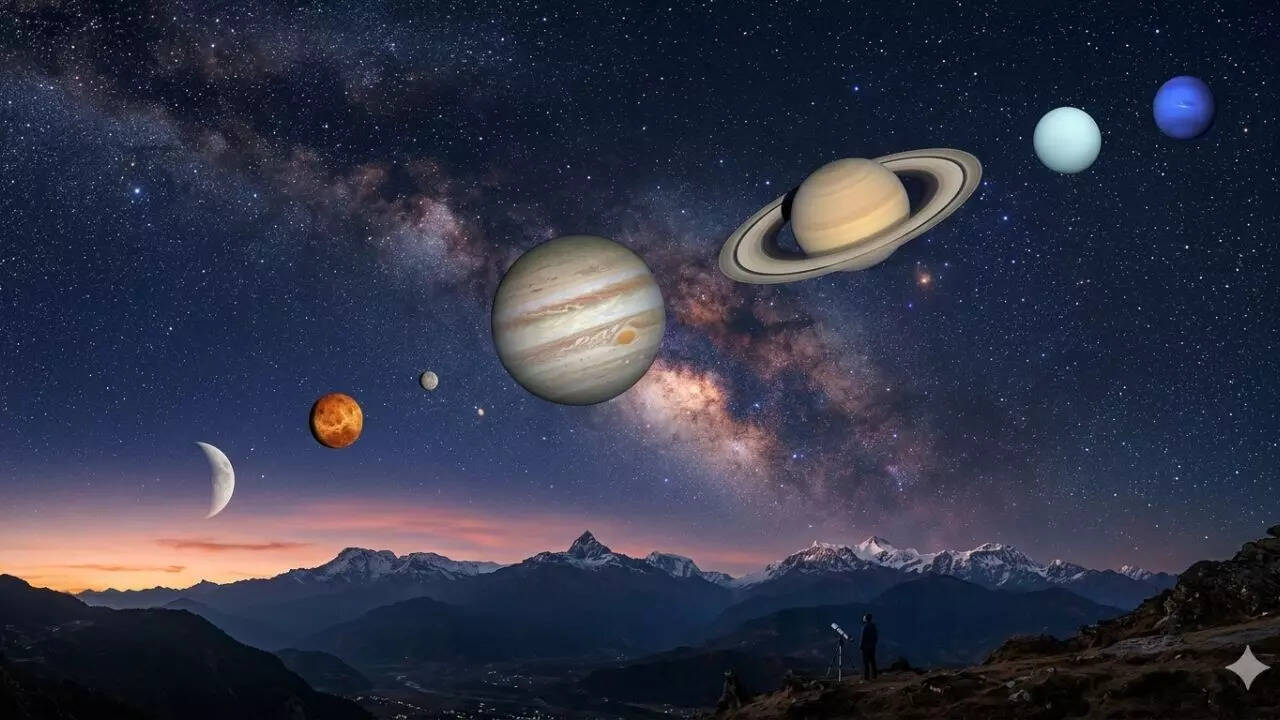
There is something haunting about the word "alignment." It suggests a hidden order, a moment where the chaotic tumbling of rocks through a vacuum suddenly snaps into a straight line. This weekend, six planets—Mercury, Mars, Jupiter, Saturn, Uranus, and Neptune—decided to march together. To the cynical, it is a matter of orbital mechanics and gravitational math. To those of us standing in the dark, it feels like a rare moment of cosmic eye contact.
The Anatomy of a Ghostly Procession
The math is precise, even if the view is fleeting. To see this six-planet spectacle, timing is your only currency. The "parade" isn't a static event you can catch at your leisure. It is a window.
The most vibrant participants are Saturn and Mars. You can find them with the naked eye if you know where to look. Saturn rises first, a steady, yellowish dot that refuses to twinkle like the surrounding stars. Then comes Mars, distinct in its angry, rusted hue. By the time the sky begins to transition from ink to a bruised purple, Jupiter joins the fray, outshining almost everything else in the celestial neighborhood.
But the others? They are the shy guests at the party.
Mercury sits so close to the horizon that the sun’s rising glare often swallows it whole. Uranus and Neptune require more than just a hopeful gaze; you need binoculars or a telescope to pull them out of the black. It is a reminder that even when the universe aligns, it doesn't always do so for our convenience.
The Man on the Hill
Consider a hypothetical observer named Elias. Elias is seventy-four. He hasn't looked at the sky with any real intent since 1997, when Hale-Bopp hung like a frozen firework over his farmhouse. Life got in the way. Bills, a hip replacement, the slow softening of his eyesight—these things have a way of narrowing a man's horizon to the distance between his chair and the television.
But when Elias heard about the parade, he dug out his old tripod.
He represents the invisible stakes of this event. We live in a world of screens, of blue light and digital notifications that demand our immediate, frantic attention. The planetary alignment offers the exact opposite. It is slow. It is ancient. It is entirely indifferent to whether or not Elias—or you—is watching.
When Elias finally spotted the faint glow of Saturn, he didn't feel small. He felt connected. There is a profound difference. Feeling small is a weight; feeling connected is a tether. He realized that the very same carbon in his aching hip was forged in the hearts of stars similar to the ones currently framing the gas giants.
Why the Horizon Matters
The logistical reality of the parade is dictated by the ecliptic. Think of the solar system as a giant, flat dinner plate. The planets all stay roughly on the rim of that plate as they circle the sun. From our perspective on Earth, tucked inside that circle, we see the other planets move along a specific path across our sky.
When their orbits happen to bunch them up on one side of the sun, we get an alignment. It is a celestial coincidence of the highest order.
To catch it, you have to look toward the east and southeast shortly before dawn. This is where the narrative of the sky meets the geography of your backyard. If you live in a valley or a city choked with skyscrapers, the parade is invisible to you. You are trapped in the "canyon of the man-made." To see the alignment, you have to seek out the periphery. You have to find a place where the earth meets the sky without interruption.
The Illusion of Proximity
It is a trick of the light, of course.
When we see these six points of light forming a neat row, we imagine them as beads on a string. In reality, they are separated by gulfs of space so vast they defy human intuition. Saturn is roughly 800 million miles away. Mars is a mere 140 million. They aren't "together" in any physical sense.
They are millions of miles apart, lonely and cold, yet for one weekend, they agree to look like a family.
Using a metaphor of a long-distance relationship helps bridge the gap. Imagine six friends who haven't spoken in decades. They live in different time zones, speak different languages, and have entirely different lives. But on one specific Saturday, they all agree to stand in their respective front yards at exactly the same moment and look toward the same house. They aren't touching. They aren't even close. But the shared intent creates a bridge.
The Gear and the Gaze
You don't need a thousand-dollar telescope to participate in this. In fact, over-complicating the optics can ruin the experience.
- The Naked Eye: Sufficient for Jupiter, Mars, and Saturn. They provide the anchors for the line.
- Binoculars: Necessary for Mercury and potentially Uranus. They allow you to pierce the "light pollution" of the coming dawn.
- A Dark Sky App: Essential for the modern observer. Apps like SkyGuide or Stellarium act as a translator, turning "that dot over there" into "the ice giant Neptune."
I watched my neighbor struggle with his binoculars. He kept shaking his head, adjusting the focus, his breath blooming in little white clouds. Then, he stopped. His shoulders dropped. He had found it. He wasn't looking at a "celestial event" anymore; he was looking at a map of where we are.
The Invisible Stakes
Why does a parade of rocks in the vacuum matter to a person who has to work a double shift on Monday?
It matters because we are currently living through a crisis of perspective. We are the first generations of humans who can go an entire lifetime without seeing the Milky Way. We have traded the infinite for the immediate. When we lose the sky, we lose the context of our own existence.
The alignment is a correction. It is a reminder that the "clockwork" of the universe is still ticking, regardless of our politics, our economies, or our personal anxieties. The planets don't care about your credit score. They don't know who is winning the election. They simply exist in a state of magnificent, rhythmic permanence.
The Departure
As the sun began to bleed over the horizon, the parade started to fade.
First went Neptune, lost in the brightening blue. Then Uranus. Mercury was the first to be drowned by the sun's direct light. Saturn hung on for a while, a stubborn ghost, until finally, only Jupiter remained, and then it too vanished into the morning.
The "parade" ended not with a bang, but with a slow dissolution into the mundane.
My neighbor went back inside. I heard his kitchen door click shut. Somewhere, Elias was probably putting his tripod back in the closet, the dust on the lenses now disturbed by the touch of his fingers.
The world felt different than it had two hours ago. The cold coffee was still sitting on the railing, but the silence of the dawn had been replaced by the first few cars starting up on the main road. The magic of the alignment isn't that it changes the planets. It's that for a few minutes, it changes the person standing on the deck.
We spent the night looking at the clockwork of the gods, and then we went back to the clockwork of our lives. But as I walked back into my house, I found myself glancing over my shoulder. The sky was empty now, bright and blank.
It didn't matter. I knew what was behind the curtain.
Wait for the next one. Not because the science changes, but because you do.