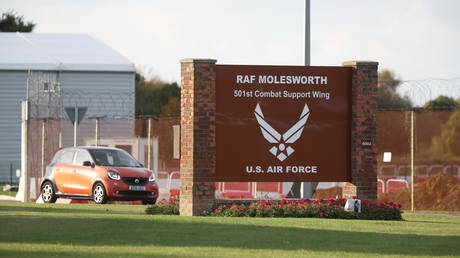
The coffee in the glass pitcher at Royal Air Force Base Molesworth had gone cold hours ago. It sat on a burner that nobody was watching, turning the dregs thick and bitter, smelling of the burnt oil characteristic of every secure facility on earth between midnight and dawn.
Outside, the Cambridgeshire fog did what it always does. It swallowed the perimeter lights until they looked like blurred orange bruises in the soup. Security cameras scanned arcs of empty asphalt, their lenses coated in the damp English mist, turning every shadow into a quiet uncertainty. Meanwhile, you can read related events here: What Most People Miss About the New US Peace Push for Ukraine.
Then came the footsteps.
Not the heavy, rhythmic trudge of a standard military patrol, but something lighter, faster, carrying the reckless confidence of youth and the specific, terrifying adrenaline of men who believed they were smarter than the hardware arrayed against them. Two men. Ordinary shoes. Breath pluming white in the chill. They were not carrying heavy explosives or encrypted military radios. They carried basic tools, restless curiosity, and the staggering underestimation of what happens when you cross the invisible tripwires of global intelligence. To understand the complete picture, check out the recent article by The Guardian.
They thought they were breaking into a building. They were actually walking onto the stage of an ongoing, silent war.
The Architecture of Whispers
To understand why two ordinary individuals trespassing at a quiet British installation caused shockwaves from London to Washington, you have to look past the concrete and razor wire.
RAF Molesworth is not just an airstrip. It is a node. In the modern architecture of defense, data flows like high-voltage current through underground veins, connecting listening posts in the Middle East with analytical cells in Virginia. It houses the Joint Analysis Center, a facility where terabytes of intercepted communications, satellite imagery, and field reports are funneled, sorted, and turned into actionable strategy. It is a place where maps are drawn and un-drawn before breakfast.
Imagine a library that never closes, where every book is written in a code you are not cleared to read, and where the librarians are watching you through six layers of glass and digital surveillance.
For decades, the public imagined espionage as a shadowy exchange on a foggy bridge in Berlin—a briefcase slipped into a park bench, a roll of microfilm tucked inside a hollowed-out paperback. But the reality of modern security is brutally mundane. It is server racks humming in climate-controlled rooms. It is firewalls, intrusion detection systems, and badge readers that log every heartbeat within a hundred yards.
When the two men breached the perimeter that night, they weren't dodging James Bond villains. They were running headfirst into a nervous system.
The Anatomy of a Breach
Security systems are built on layers of paranoia. They assume failure. They assume a camera will fail, a guard will blink, a sensor will drift out of calibration. That is why defense in depth is not a buzzword; it is a survival mechanism.
When the alarm tripped, it didn't sound like a klaxon blaring across the base. In modern facilities, alarms whisper. They flash amber on a monitor three thousand miles away. A security analyst in a dim room looks up from a screen, blinks against the blue light, and watches a tiny pixel turn from green to red.
Consider the human element in that moment.
A watch commander sitting miles or yards away feels the sudden spike of cold dread that every security professional knows. Is it a drill? Is it a stray fox triggering an infrared beam? Or is it something real?
The response is swift, governed by protocols written in the blood and breaches of the past. Within minutes, local law enforcement and base security converged. The two men were intercepted, detained, and stripped of their illusion of cleverness.
The public headlines the next morning were dry and clinical: UK arrests two men for breaking into US intelligence hub.
They listed the ages, the location, the formal charges. They used words like unauthorized entry and secure perimeter. But they missed the deeper narrative entirely. They missed the vertigo that comes from realizing how fragile our borders really are—not geopolitical borders drawn on ancient parchment, but the invisible digital and physical thresholds that separate ordinary civilian life from the machinery of state survival.
The Ripple Effect
Why does a break-in at a sleepy Cambridgesher base matter to a person sitting in a coffee shop in Chicago or a bakery in Istanbul?
Because we live in a glass house, and we pretend the walls are made of steel.
Every time a perimeter is breached, whether by sophisticated state-sponsored hackers typing from air-conditioned apartments in distant capitals or by two reckless amateurs testing their luck against a fence, the calculus of global security shifts. It forces commanders to ask an uncomfortable question: If they got that far, what else can get through?
We rely on walls because walls are comforting. They give us the illusion of control. But in the twenty-first century, walls are porous. They are pierced by fiber-optic cables, satellite beams, and human error. The real defense has never been the chain-link fence or the razor wire. The real defense is the vigilance of people who spend their entire careers staring into the dark, waiting for the one shadow that doesn't belong.
The two men who climbed that fence are facing legal systems that do not have a sense of humor about military installations. Their names will fade into court dockets and police blotters. But the image remains.
Two figures standing in the English fog, looking up at a building that holds the secrets of empires, realizing too late that the door they just forced open led directly into a storm they were entirely unequipped to weather.
The coffee pot at Molesworth has long since been emptied. The guards have changed shifts three times since that night. But the fence has been mended, checked, and reinforced. Somewhere out in the mist, another sensor is blinking green, waiting for the next person who thinks they can outsmart the dark.