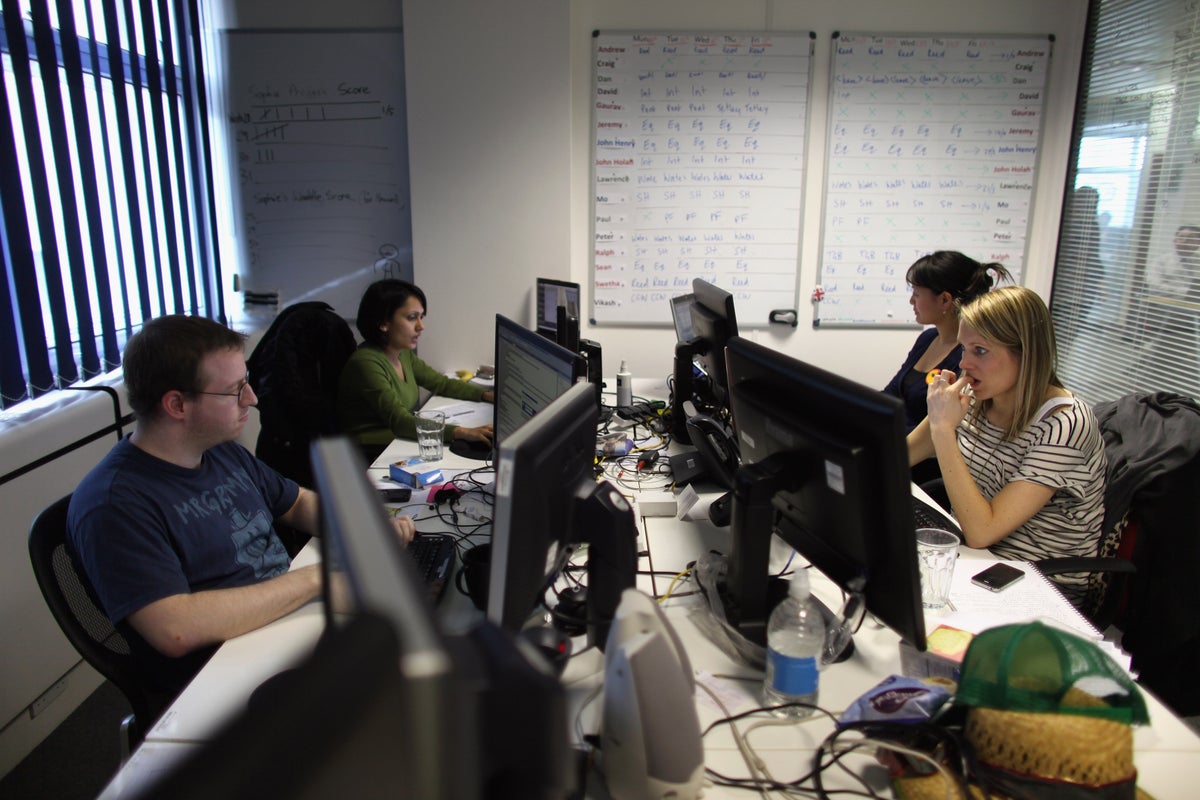
The glow of three monitors illuminated the small basement office in Arlington, Virginia. It was 2:00 AM. Michael, a software engineer who had spent the last five years building compliance algorithms for federal agencies, stared at a blinking cursor. For years, his job was to build digital brakes. He was the person who ensured artificial intelligence didn't accidentally leak private medical data or discriminate against mortgage applicants.
Then, the news broke.
An outgoing White House technology adviser confirmed what many in Washington had whispered for months. The incoming Trump administration planned to dismantle the nascent framework of heavy federal AI regulations.
Michael leaned back in his chair. The brakes he had spent half a decade engineering were suddenly obsolete.
This is not just a story about policy papers, executive orders, or partisan gridlock. It is a story about a fundamental shift in how the human race will build its future. We are standing at a crossroads where the global race for dominance meets the fragile need for safety. The decisions made in the coming months will dictate the code that governs our lives.
The Friction of the Red Tape
To understand why this shift is happening, we have to look at the frustration that built up under the previous administration's approach. Under President Biden, the federal government viewed AI through a lens of cautious protection. The landmark Executive Order on AI required major tech companies to share safety test results with the government before releasing powerful models.
For regulators, this was common sense. You do not let a new commercial airplane fly without federal inspection. Why should a trillion-parameter algorithmic brain be any different?
But inside the tech hubs of Silicon Valley and Austin, Texas, that caution felt like handcuffs.
Imagine a hypothetical startup founder named Sarah. She created a small AI company designed to analyze crop yields using satellite data. Every time Sarah wanted to update her neural network, she faced a maze of compliance questions. Did her dataset include biased historical data? Could her algorithm be repurposed by a foreign adversary to map critical infrastructure?
Sarah spent more money on lawyers than on compute power. Meanwhile, her competitors in countries with zero regulatory oversight were moving at lightspeed. They launched new iterations every week.
The outgoing tech adviser's announcement signaled that the United States is tired of playing defense. The incoming administration views heavy regulation not as a shield, but as an anchor dragging down American innovation. The new philosophy is simple. To win the future, America must run faster than everyone else. And you cannot run fast while wearing lead boots.
The Ghost in the Machine
The argument for deregulation is built on a powerful truth. Innovation requires messiness. The internet we know today would not exist if Congress had heavily regulated the web in 1995. By allowing the early internet to grow wildly, the U.S. captured the global tech market, creating millions of jobs and trillions of dollars in value.
But AI is different from the web. The web is a library. AI is an actor.
Consider what happens when an AI model is allowed to train without boundaries. We are no longer talking about simple chatbots that write college essays or generate images of cats. We are talking about autonomous agents that control electrical grids, manage financial portfolios, and diagnose illnesses.
When you remove the requirement for independent, third-party safety testing, you place absolute trust in the hands of a few corporate executives. History shows that when profits collide with caution, profits usually win the race.
Let us look at a real-world parallel from recent history. In the early 2000s, the financial sector developed highly complex algorithmic trading models. Regulators did not fully understand them. Wall Street assured Washington that their internal risk models were bulletproof. The result was the 2008 financial collapse, driven by derivatives that no single human fully comprehended.
AI models are infinitely more complex than 2008 financial derivatives. Even the engineers who build them cannot always explain why a deep learning network makes a specific decision. It is a black box. If a model decides that a certain demographic is a high credit risk, or that a specific medicine should be withheld from a patient, the reasons remain locked away in millions of interconnected digital weights.
Without federal oversight, the burden of discovering these biases falls entirely on the consumer. You become the test subject.
The Global Chessboard
The drive to strip away AI regulation is not born out of pure corporate greed. It is driven by geopolitical anxiety.
Washington is gripped by a singular fear. If the U.S. slows down to ensure ethical AI, Beijing will leap ahead. The Chinese government is investing heavily in AI integration, particularly in military and surveillance applications. They are not pausing to debate algorithmic bias or data privacy.
From a nationalist perspective, the incoming administration’s stance is a tactical necessity. If American companies are bogged down by compliance audits, the global standard for AI will not be set in San Francisco. It will be set in Beijing.
This creates a terrifying paradox. To protect democratic values globally, we may have to sacrifice democratic oversight domestically.
But speed carries its own catastrophic risks. When two superpowers engage in an unregulated arms race for artificial intelligence, the temptation to cut corners becomes irresistible. The first country to deploy fully autonomous military drones or automated cyber-defense systems wins an enormous advantage. But what happens when those systems glitch? Who holds the kill switch when the software operates at speeds faster than human thought?
The Invisible Stakes
Back in his Arlington basement, Michael deleted a line of code designed to flag algorithmic variance. It felt like tearing down a stop sign at a blind intersection.
The debate over AI regulation is often framed as a battle between tech billionaires and Washington bureaucrats. That framing misses the point entirely. The real stakes belong to the ordinary people whose lives will be quietly reordered by invisible software.
It is the graduate who gets rejected by an automated hiring system without ever speaking to a human. It is the small business owner whose loan application is denied by a proprietary risk algorithm that cannot be questioned or appealed. It is the patient who receives a flawed treatment plan because an AI model was trained on incomplete data.
When the government steps back from regulation, it does not mean the rules disappear. It just means the corporations write the rules.
We are about to embark on the greatest socio-technological experiment in human history. The guardrails are melting, the engines are roaring, and the track ahead is completely unmapped. We can only hope that our capacity for innovation is matched by our ability to survive its consequences.
The monitors in Michael's office flickered, casting long, sharp shadows against the wall, as the machine continued to learn in the dark.