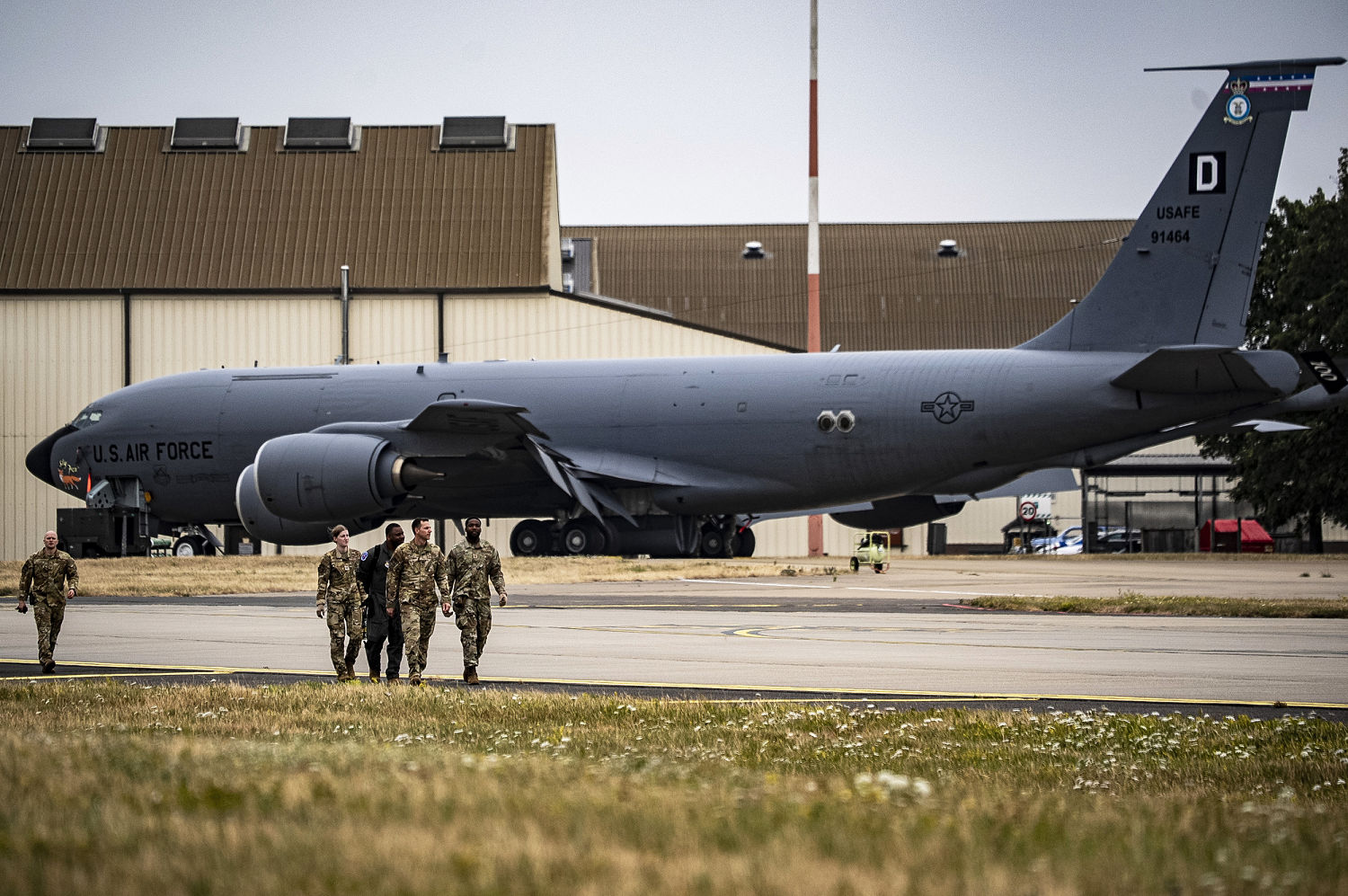
The rain in rural Oxfordshire does not fall so much as it hangs, a cold, grey mist clinging to the limestone cottages and flat pastures around RAF Fairford. On most nights, the villagers along the River Coln sleep through a familiar, low-frequency rumble. It is the sound of American heavy metal warming up on the tarmac—the deep, guttural thrum of B-52 Stratofortresses and KC-135 Stratotankers preparing to cross an ocean or patrol a distant border.
Then came the night the engines stopped.
Wait.
Listen to that silence. For forty-eight hours, the sky over the Cotswolds felt strangely empty, stripped of the grey silhouettes that have anchored the horizon since the height of the Cold War. While the evening news reduced the event to a sterile ticker—U.S. moves military aircraft from British base amid Iran threats—the reality on the ground was neither sterile nor routine. Behind that single, clinical headline lies a high-stakes game of modern deterrence, a quiet admission of vulnerability, and the human weight carried by the men and women who fly twelve-hour missions into the unknown.
The Anatomy of a Midnight Departure
To understand why a fleet of multi-million-dollar aircraft suddenly vanishes from a tranquil English countryside, you first have to stop thinking of a military base as a fortress. In modern warfare, a stationary airfield is a bullseye.
Picture a hypothetical flight line crew chief—let’s call him Sergeant Miller—standing on the wet asphalt at two in the morning. His fingers are numb inside his Nomex gloves as he runs a final pre-flight check on a tanker’s refueling boom. He doesn't read classified intelligence briefings from the Pentagon, nor does he sit in the Situation Room in Washington. Yet, he knows what a sudden, unscheduled dispersal order means. When the brass tells you to pack up the spare parts, drain the ground support equipment, and launch every airworthy frame before dawn, you aren't going on a training exercise. You are getting out of the line of fire.
The strategic reality driving this movement is brutally simple. Over the past decade, the reach and accuracy of Iranian ballistic missiles and long-range loitering munitions have altered the geometry of global conflict. Bases that once sat comfortably outside the blast radius—places like RAF Fairford or RAF Lakenheath, tucked safely behind the English Channel—are no longer immune to the calculus of asymmetric warfare. Even if a direct strike on British soil remains an extreme escalation, the threat of proxy sabotage, drone swarms, or regional spillover forces commanders into a difficult choice. Do you leave your most valuable strategic assets parked wingtip-to-wingtip on a predictable runway, or do you scatter them like seeds in the wind?
They chose to scatter.
Why Move Planes Away from a Threat?
To the casual observer scrolling through headlines over morning coffee, pulling aircraft back—or shifting them to undisclosed locations—looks like a retreat. It feels like blinking first.
That intuition gets modern military strategy completely backward.
Think of a heavyweight boxer stepping out of the corner. To someone who has never thrown a punch, stepping backward looks like fear. To anyone who understands the ring, stepping back creates the space required to throw a knockout blow without eating an uppercut first. In Pentagon terminology, this is called Agile Combat Employment, a doctrine born out of the realization that fixed bases are death traps in an era of precision-guided weapons.
When the United States repositions bombers, fighters, or refueling tankers out of the United Kingdom in response to heightened tensions with Tehran, two things happen simultaneously:
- First, you deny the adversary a static target. If an opponent spends months mapping satellite coordinates of fuel depots and hangars in Gloucestershire, moving those planes overnight renders their targeting data useless.
- Second, you reposition the chessboard. Moving aircraft from a British base does not necessarily mean sending them home to North Dakota or Louisiana. Often, it means pushing them closer to the theater of operations—to hardened shelters in the Mediterranean, bases in the Persian Gulf, or scattered airfields across Southern Europe—where response times drop from hours to minutes.
I remember standing near the perimeter fence of an allied airbase during a similar Middle Eastern flare-up several years ago. The air smelled sharply of unburned JP-8 jet fuel and wet grass. A local pub owner, leaning against the stone wall with a pint glass still in his hand, watched the tail lights of the final transport plane disappear into the low cloud ceiling. "Whenever they leave in a hurry," he told me quietly, "it means the bill is coming due somewhere else."
He was right. The movement of aircraft is never the story itself; it is the tremor before the earthquake.
The Invisible Weight of the Airbridge
We tend to fixate on the glamorous machines—the stealth fighters with their razor-sharp angles or the massive bombers capable of carrying bunker-busting ordnance across continents. Yet the real backbone of any American military response in the Middle East is far less photogenic. It is the tanker fleet.
Consider the logistics of projecting power across thousands of miles of ocean and desert. A fighter jet burning afterburners over the Strait of Hormuz drinks fuel at a terrifying rate. Without flying gas stations circling endlessly in the dark, a billion-dollar air wing becomes a collection of very expensive gliders within ninety minutes.
British bases have long served as the ultimate transatlantic stepping stone—a massive, unsinkable aircraft carrier moored off the coast of Europe. When the United States shifts aircraft out of these UK hubs amid Iranian threats, it is reorganizing the entire plumbing system of global airpower. Every tanker that lifts off from England and heads south toward Crete, Cyprus, or Al Udeid is extending an invisible umbilical cord toward a potential flashpoint.
And inside those aluminum tubes sit twenty-two-year-old boom operators and thirty-year-old pilots who packed a single duffel bag six hours earlier.
Let’s return to our hypothetical crew chief, Sergeant Miller, and his neighbor on the flight line, a co-pilot named Lieutenant Vance. Yesterday afternoon, Vance was arguing with his wife over FaceTime about whether to buy a used Vauxhall or a Honda for their eighteen-month tour in England. Tonight, he is strapped into an ejection seat at thirty-five thousand feet, watching the lights of Paris pass beneath his left wing while monitoring encrypted high-frequency radio channels for updates on missile launches thousands of miles away.
This is the human reality stripped out of standard news reports. Geopolitics is not moved by arrows on a cable news map. It is moved by exhausted young adults drinking lukewarm coffee out of thermoses in pressurized cabins, trying to keep their hands steady while politicians trade warnings across diplomatic backchannels.
The Ghosts of Cold War Runways
To grasp why the British public reacts with a mixture of stoicism and quiet unease whenever American jets vanish from their skies, you have to look at the soil beneath those runways.
RAF Fairford was built in 1944 for the D-Day invasion, launching gliders and troop transports across the Channel into the teeth of German defenses. During the Cold War, it became one of the few European airfields reinforced specifically to handle the massive weight of nuclear-armed B-52s. In 1991, bombers took off from those exact concrete slabs to strike targets in Iraq during Operation Desert Storm. In 2003, they did it again.
For eighty years, the quiet villages of southern England have served as the quiet backstage of Western military power. Locals know the rhythm. When the B-52s arrive, tension is rising. When the spotters with their massive telephoto lenses line the perimeter fences, a deployment is underway. And when the base suddenly empties out under the cover of darkness, everyone knows the script has entered a dangerous new act.
There is an inherent vulnerability in acknowledging how fragile this balance truly is. Honestly, watching these massive machines shuffle across the globe in response to threats from a regional power like Iran can feel disorienting. For decades, the United States operated under the assumption of total sanctuary—the idea that once an aircraft was parked on allied European soil, it was untouchable until the moment it crossed into hostile airspace.
That era is gone.
The proliferation of cheap, long-range drones and mobile ballistic missile launchers has democratized long-distance threat. A weapon system built for a fraction of the cost of a single jet engine can now force the world’s most powerful military to rethink where it parks its planes, how it guards its fuel farms, and how quickly it can evacuate an airfield. It is unsettling to realize that the shield we assumed was impenetrable now requires constant, anxious footwork just to avoid taking a hit.
What Happens When the Chessboard Shifts?
So what actually happens in the days immediately following a sudden aircraft relocation?
If you are watching from the outside, the silence feels ominous. Rumors fill the vacuum. Social media explodes with flight-tracking screenshots showing transponders blinking off over the English Channel or heavy cargo planes descending into bases in Jordan, Qatar, or Italy.
Inside the command centers, however, the departure from Britain is merely the opening move of a tightly choreographed sequence:
- The Shadow Network Activates: As primary aircraft leave their British hubs, smaller, modular teams deploy to austere airfields—sometimes little more than commercial strips or cold-war relics with minimal infrastructure. The goal is unpredictability. An enemy cannot target what it cannot find.
- Air Defense Tightens: While bombers and tankers move toward forward operating locations, air defense batteries—Patriot systems, THAAD interceptors, and allied naval destroyers equipped with Aegis radar—shift their posture to cover the newly concentrated assets.
- The Waiting Game Begins: Deterrence is fundamentally psychological. By moving aircraft out of a vulnerable or predictable posture and dispersing them into combat-ready positions, Washington sends an unmistakable message to Tehran without firing a single shot: We see the threat, we have removed your easy targets, and we are now positioned to respond within minutes.
Look closely at the sheer choreography required to pull this off without a single mid-air collision, mechanical failure, or diplomatic misstep. Coordinating overflight clearances across six European countries at two in the morning while simultaneously scheduling aerial refueling tracks over the Mediterranean is an astonishing feat of human organization.
Yet, for all its technical brilliance, it remains a high-wire act without a net. Every time aircraft are pushed forward into heightened readiness, the margin for miscalculation shrinks. A radar operator misreading a commercial transponder, a rogue militia commander launching a rocket without authorization, a sudden gust of wind during a dark refueling rendezvous—any of these sparks can turn a defensive repositioning into an irreversible escalation.
The View from the Perimeter Fence
By morning, the mist in Oxfordshire finally begins to lift, revealing wet tarmac stretching out toward the horizon.
The base is not entirely deserted. Security patrols still sweep the perimeter roads in idling SUVs. Maintenance crews still sweep the hangars, inspecting empty bays where massive wingspans shadowed the concrete just twelve hours earlier. In the nearby towns, the bakeries open, the school buses roll down narrow lanes bordered by dry-stone walls, and life resumes its measured, centuries-old pace.
Except the sky is different now.
Somewhere three thousand miles to the southeast, the engines that used to rattle the windows of Cotswold cottages are roaring through dry, desert air. The pilots who bought groceries in Swindon yesterday are checking wind speeds over the Persian Gulf tonight.
We like to believe that wars and crises happen far away, neatly contained within the borders of distant regions and summarized in two-sentence news alerts. We tell ourselves that the movement of a few dozen planes from one runway to another is just routine military housekeeping—a chess piece nudged an inch to the left on a board we never have to touch.
Step outside tonight, wherever you are, and look up at the dark, empty space between the clouds. Just because you cannot hear the engines anymore does not mean they have stopped running.