The rain in Michoacán does not merely fall; it hunts. On the night of July 29, 2024, it found exactly what it was looking for in the ancient basin of Lake Pátzcuaro.
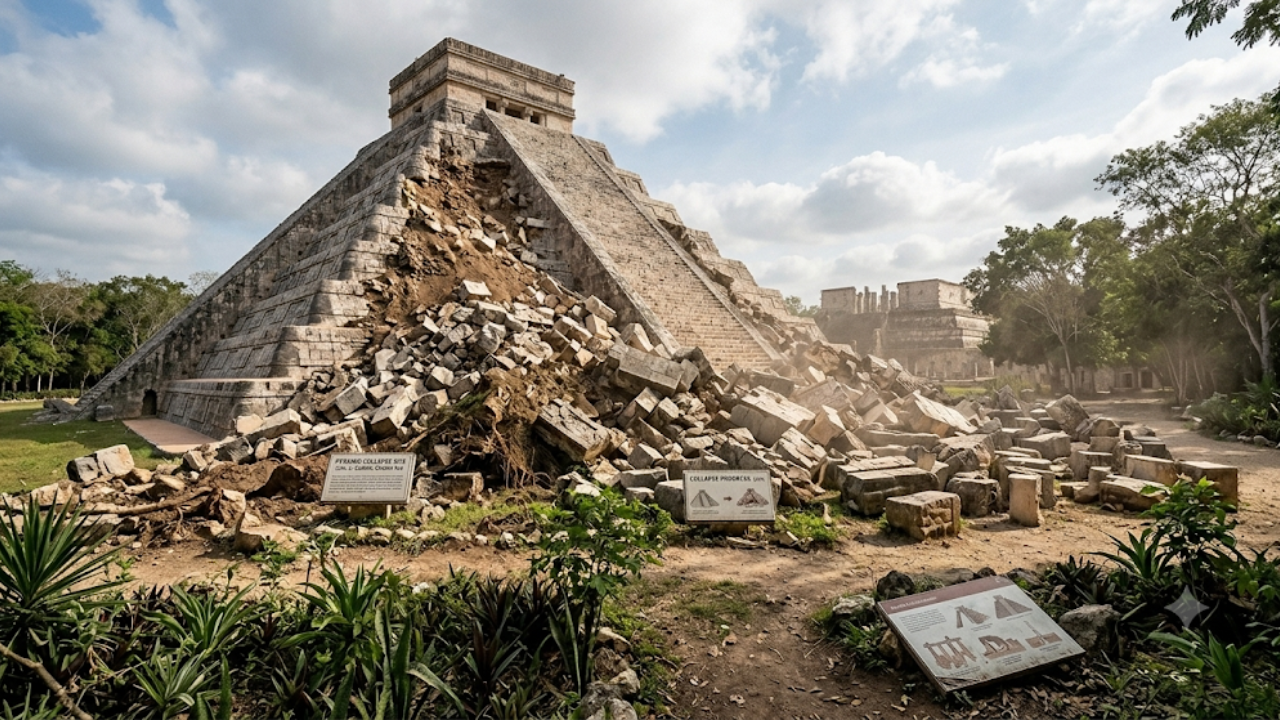
For eleven centuries, a fifteen-meter-tall stepped pyramid stood as a silent, formidable sentinel over the archaeological zone of Ihuatzio. It was a masterpiece of the Purépecha Empire—a civilization so fierce, so structurally and militarily brilliant, that even the sweeping war machines of the Aztecs could never conquer them. Their stone walls were built to endure empires, Spanish steel, and the slow march of a millennium.
But they were not built for the whiplash of a changing sky.
When the southern facade of the pyramid slumped into a catastrophic heap of rubble that night, the sound wasn't just stone grinding against stone. It was the sound of history fracturing. To the archaeologists who rushed to the scene the following morning, it was an environmental crisis. To the living descendants of the Purépecha, it was something far more terrifying.
It was a message.
The Ghost in the Masonry
To understand why a monument survives 1,100 years only to drop its guard on a random summer night, you have to look beneath the skin of the structure.
Imagine a sponge that has been baked in an oven for months. That was Mexico in the first half of 2024, enduring its worst drought in thirty years. The heat was relentless, a suffocating weight that parched the soil and drained entire lakes across the nation. At Ihuatzio, this prolonged baking caused the ancient building materials to contract. Deep inside the core of the pyramid, microscopic shifts began to occur. The earth and mortar core—the very heart of the structure—began to split, spiderwebbing with invisible fissures.
Then came the thunderstorms.
When the clouds finally broke over Michoacán, they did not bring relief; they brought a deluge. The precipitation accumulation shattered local averages. Metaphorically speaking, the pyramid’s cracked exterior acted like an open funnel. Rainwater poured into the newly formed micro-cracks, seeping deep into the core and retaining walls.
Consider what happens next: the internal material, dry and desperate, absorbed the water instantly. But a stone core can only hold so much mass. As the moisture load skyrocketed, the internal pore pressure increased dramatically. The weight became unbearable. The shear resistance—the friction keeping the stones locked together—dropped to zero.
In a matter of hours, the south wall suffered a localized internal landslide. At least six of the pyramid’s stepped bodies collapsed outward, scattering beautifully carved xanamu blocks across the grass like broken teeth.
The Displeasure of the Gods
While the specialists from Mexico’s National Institute of Anthropology and History (INAH) arrived with clipboards, insurance adjusters, and structural engineers to assess the core damage, local communities looked at the ruin through a vastly different lens.
Tariakuiri Alvarez, a living descendant of the Purépecha tribe, felt a chill that had nothing to do with the damp summer air. In the oral traditions of his people, sacred buildings do not fail because of physics alone. They fail when the relationship between humanity and the divine has withered to dust.
In the days following the disaster, Alvarez shared a haunting perspective rooted in ancestral memory. Before the Spanish conquistadors arrived centuries ago, a similar catastrophic failure occurred among the sacred structures of the region. The old builders recorded these events not as structural engineering failures, but as warnings.
To the modern Purépecha, the crumbling of the Ihuatzio pyramid is a profound spiritual emergency. It is an indication that an event of massive, irreversible consequence is approaching. The gods, quite simply, are displeased.
It is easy for a modern, secular reader to dismiss this as superstition. But consider the reality of our global climate. Is a world that swings from historic, bone-dry droughts to violent, structure-destroying deluges not a sign of a deeper, systemic imbalance? Whether you call it atmospheric feedback or divine anger, the message remains identical: something is deeply wrong with the world we are managing.
A Double Fracture in the Continent
The tragedy at Ihuatzio was not an isolated incident. In a chilling historical coincidence that feels almost too deliberate to be random, the American continent lost another of its ancient icons just nine days later.
Far to the north, in the red rock country of Utah’s Glen Canyon, a 190-million-year-old natural wonder known as the Double Arch collapsed entirely into Lake Powell. For generations, travelers had stood beneath its massive sandstone canopy, marvelling at a structure that had survived since the age of the dinosaurs.
The culprit behind its demise? The exact same tag-team of environmental stressors that broke the Mexican pyramid. Decades of drought had caused the water levels of Lake Powell to recede, altering the pressure on the Navajo sandstone, while shifting shorelines and temperature extremes eroded the arch’s base until gravity claimed it.
Two completely different structures—one meticulously shaped by human hands to honor the gods, the other carved over millions of years by the wind—destroyed by the exact same atmospheric whiplash within days of each other.
The Fragile Premium of Our Past
We like to think of ancient monuments as permanent fixtures, anchor points in a world that moves too fast. We visit them on vacation to feel small, to connect with a sense of durability that our modern lives lack. But the collapse at Ihuatzio exposes a vulnerable truth: our heritage is mortal.
The structural failure has forced institutions like INAH into a race against time. While they have initiated insurance claims through Agroasemex to fund a meticulous restoration, the path forward is complex and uncertain. Past restoration attempts at the site during the late twentieth century occasionally utilized rigid, outdated materials that did not allow the ancient masonry to breathe, inadvertently contributing to the structural stress. Now, experts must figure out how to rebuild using techniques that respect both original Purépecha engineering and the volatile weather patterns of the twenty-first century.
This is the hidden cost of a changing climate. It doesn't just threaten our future; it actively erodes our ability to remember where we came from. From the crumbling cave paintings of Oceania to the sliding stone facades of Michoacán, the physical library of human history is being systematically dismantled by the weather.
The true weight of the Ihuatzio collapse is felt most acutely when standing at the edge of the Plaza de Armas, looking at the raw earth exposed where the stone used to be. The pyramid was built as an astronomical observatory and a ceremonial center—a place designed to read the heavens and find order in the cosmos.
Today, the heavens have rewritten the monument, leaving behind a lesson written in rubble.
The rain has stopped for now, and the specialists will eventually put the stones back into place, binding them with modern lime mixes and careful architectural supports. But the scar on the south wall will remain, a visible reminder of the night the sky broke the stones of Ihuatzio, and a lingering question of what comes next when the earth decides it can no longer carry the weight of our past.