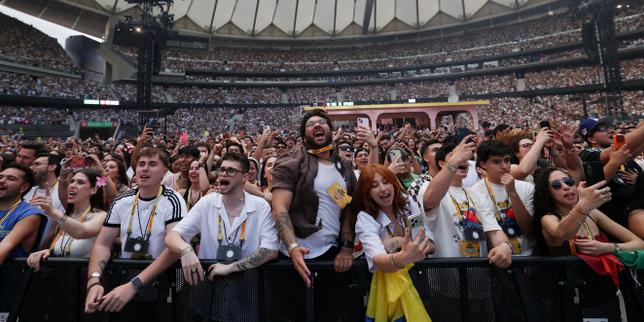
The coffee spoon vibrates against the porcelain. It is 11:30 PM on a Tuesday. In a third-floor apartment in Chamartín, a residential district in northern Madrid, a retired schoolteacher named Elena rests her forehead against the cool glass of her bedroom window. Outside, the sky does not look like night. It glows an unnatural, electric violet, illuminated by the stadium lights of the newly renovated Santiago Bernabéu. Through the double-paned glass, a sound penetrates. It is not a murmur. It is a physical weight. The bass line of a global pop star’s stadium tour thumps directly into Elena’s ribcage, a rhythmic, inescapable pounding that has been vibrating through her floorboards for four consecutive hours.
Madrid is a city built on the beauty of the late night. It is a culture of midnight dinners, animated terrace chatter, and the soft, ambient hum of a capital that refuses to sleep. But there is a vast difference between a city that stays up late and a city that is forced to vibrate.
Over the last year, the Spanish capital has transformed into the epicenter of a fierce, desperate battle over urban space. On one side are the mega-promoters, the tourism boards, and the legendary football club Real Madrid, all eager to turn the city into the concert capital of Europe. On the other side are thousands of exhausted citizens who simply want to sleep. The stadium, once a secular cathedral reserved for twenty-two men chasing a ball twenty-five times a year, has become a multi-use entertainment factory operating on an industrial scale.
The story of Madrid’s noise war is not just a local zoning dispute. It is a cautionary tale about what happens when the commercialization of public spectacle collides head-on with the basic human right to peace.
The Sound of €400 Million
To understand how a neighborhood became an acoustic war zone, consider the engineering marvel that started it all. Real Madrid recently completed a massive, €900 million renovation of the Santiago Bernabéu. The crown jewel of this redesign is a hyper-futuristic, retractable pitch. In a matter of hours, the pristine grass turf divides into massive longitudinal trays, which are then lowered into a deep underground vault. Inside this subterranean cave, the grass is preserved with automated irrigation, LED lighting, and climate control systems.
This engineering feat means the stadium no longer needs to wait weeks between football matches for the turf to heal. The venue can host a Taylor Swift concert on a Wednesday, a Luis Miguel show on a Friday, and a massive reggaeton festival on Sunday.
Promoters call it optimization. Elena calls it torture.
The fundamental flaw in this grand design lies in the stadium’s anatomy. The Bernabéu was built in 1947, nestled deep within a densely populated, upper-middle-class neighborhood. It is surrounded by apartment buildings, schools, and hospitals. Unlike modern mega-arenas in London or Paris, which are often pushed to the outer industrial fringes or isolated suburban hubs, the Bernabéu sits directly across the street from where people raise their children and care for their elderly.
When the stadium was wrapped in its sleek, new stainless-steel skin, the architects created an iconic aesthetic. They did not, however, build an acoustic seal. The metal slats that give the stadium its futuristic glow are open to the air. The venue acts as a colossal, open-air megaphone, funnening 100-plus decibels of sound upward and outward, spraying it directly into the living rooms of Chamartín.
Imagine turning a concert speaker face-down on your neighbor’s ceiling. Now multiply that speaker by a thousand.
The Invisible Toll of the Tremor
We often treat noise pollution as a minor inconvenience, a first-world problem championed by overly sensitive NIMBYs. That is a dangerous mistake. Loudness is not a subjective annoyance; it is a physiological threat.
When a sound wave hits the human body, the brain interprets high decibel levels as an ancient evolutionary cue for danger. The sympathetic nervous system kicks into overdrive. Cortisol and adrenaline spike. The heart rate accelerates. Blood vessels constrict. This happens even if you are asleep, and even if you consciously enjoy the artist performing. Your conscious mind might love the music, but your arterial walls do not.
During the peak of the recent concert season, local neighborhood associations began independently measuring the noise levels inside their apartments. The legal limit for outdoor noise in Madrid residential zones at night is around 55 decibels. Inside a home with the windows shut, it should ideally hover around 30 to 35 decibels.
The meters in Chamartín regularly clocked over 80 decibels inside bedrooms.
To give that number context, 80 decibels is equivalent to standing next to a running garbage disposal or a ringing alarm clock for five hours straight. You cannot read a book in that environment. You cannot have a conversation with your partner. You certainly cannot put a toddler to sleep.
Consider the reality for a family living on the Calle Concha Espina, directly facing the stadium. For three nights a week, their home ceases to be a sanctuary. It becomes an extension of the mosh pit. The vibrations travel up the concrete foundations of the buildings, shaking the water in glasses, rattling picture frames, and causing a low-frequency hum that settles deep into the sinus cavities.
The residents are not anti-fun. They are not prudish conservatives waging a war on youth culture. Many of them are lifelong Real Madrid season ticket holders who have happily lived alongside the stadium for forty years. They are used to the roar of a celebrated goal, a sound that peaks for ten seconds and then dissipates into the night. They are not used to a permanent, structural assault on their sanity.
The Mirage of Economic Vitality
The argument for turning cities into continuous festival grounds always revolves around the same holy trinity: tourism, revenue, and global prestige. We are told that mega-events bring in millions of euros, fill hotel beds, and keep taxi drivers employed.
But who actually pays the bill for this windfall?
When a city favors the transient consumer over the permanent resident, it strikes a Faustian bargain. The immediate cash injection from a stadium selling out 60,000 tickets at €150 each is highly visible. It can be tracked on spreadsheets and celebrated in press releases by city officials. What goes unmeasured is the quiet, bleeding erosion of the local economy.
When a neighborhood becomes unlivable, the fabric of the community unravels. Terraces that once served local families are swallowed by rowdy, pre-concert crowds who leave trails of plastic cups and broken glass. Local shops find their entrances blocked by security barriers and police cordons for days at a time. Property values for those who wish to stay plummet, while corporate buyers snap up apartments to convert them into illegal tourist rentals, further hollowed out by the acoustic chaos.
Then there is the sheer infrastructure strain. A neighborhood designed for normal residential traffic suddenly has to absorb tens of thousands of people multiple times a week. The metro stations overflow, the streets freeze into gridlock, and emergency vehicles find themselves trapped in a sea of ride-share cars trying to drop off concertgoers. The city’s public space is effectively privatized for the financial gain of a football club and international entertainment conglomerates.
The Turning Tide
For months, the city government offered little more than bureaucratic shrugs and empty promises of minor fines for promoters who exceeded noise limits. To a multi-million-euro touring production, a €20,000 fine for noise violation is not a deterrent; it is simply a cost of doing business, a line item under "miscellaneous expenses."
But the residents of Madrid did something the developers did not anticipate. They organized.
They formed the Asociación de Perjudicados por el Bernabéu (Association of Those Affected by the Bernabéu). They didn't just complain on social media; they bought professional-grade sound meters, hired acoustic experts, and began documenting the violations with meticulous, scientific precision. They took the fight to the courts, launching a barrage of lawsuits alleging environmental crimes and violations of the fundamental right to physical and moral integrity.
The tipping point arrived with a sudden, dramatic thud. Facing intense legal pressure and a wave of public outrage that could no longer be managed by public relations spin, Real Madrid was forced to make a humiliating announcement. They provisionally suspended all musical concerts at the stadium until at least the spring of 2025. Major shows by international and national artists were abruptly canceled or postponed. The club admitted it needed time to study and implement structural soundproofing measures to comply with municipal regulations.
It was a monumental victory for the neighborhood, a rare David-and-Goliath outcome in an era where corporate profit almost always trumps civic comfort. Yet, the victory is fragile. It is a pause, not a permanent treaty.
The tech and architectural fixes being proposed—massive acoustic curtains, sealing the open slats with heavy glass, creating giant sound-absorbing baffles—are incredibly complex and prohibitively expensive. Sound is notoriously difficult to tame once it escapes a structure. It behaves like water; if there is a single microscopic crack, it will find its way through.
The Real Stake
This battle matters far beyond the borders of Spain. Across the globe, cities are undergoing a aggressive transformation. From Austin to Amsterdam, urban centers are being redesigned as experiential playgrounds for visitors rather than sustainable habitats for the people who clean the streets, teach the children, and staff the hospitals.
The crisis at the Bernabéu forces us to confront a fundamental question about the future of our societies: To whom does a city belong?
Does it belong to the corporation that can generate the highest revenue per square meter? Or does it belong to the citizens who pay their taxes, sweep their sidewalks, and anchor the community? If we decide that culture and entertainment require the sacrifice of the basic, biological necessity of sleep for thousands of people, we are no longer building vibrant cultural capitals. We are building profitable theme parks that happen to have residents living inside the attractions.
The concerts will eventually try to return to Chamartín. The pressure of hundreds of millions of euros in unrealized profit is a force as relentless as gravity. But for now, when midnight strikes in northern Madrid, the air is different.
Elena can close her eyes. She can hear the distant, comforting rustle of the dry summer wind through the leaves of the plane trees on her street. She can hear the faint click of a neighbor’s blinds rolling down. She can hear the beautiful, fragile, and utterly priceless sound of nothing at all.