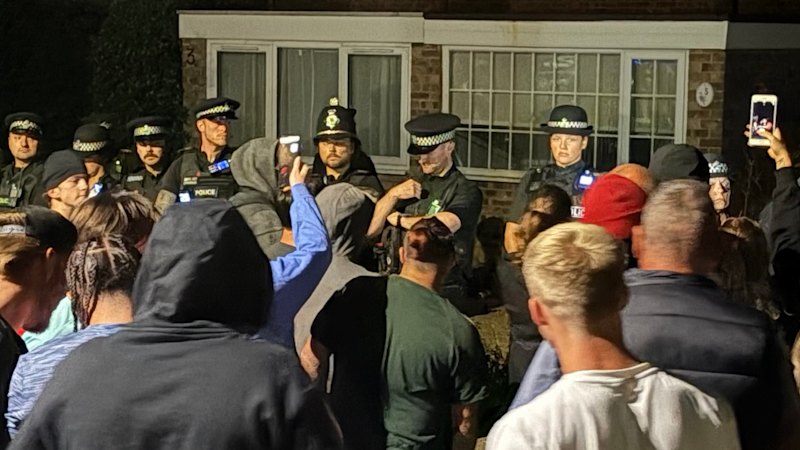
Fear has a distinct sound. It does not rumble like thunder or crash like an ocean wave. It clicks. It is the sound of heavy boots hitting pavement in unison, the ratchet of a camera phone recording a neighbor’s front door, and the hard, sharp snap of a windowpane giving way to a brick.
In the market town of Thetford, Norfolk, the air grew heavy long before the shouting started.
Quiet streets do not become battlegrounds overnight. They are primed. Weeks of anxious murmurs online, shared screenshots of government contractor housing lists, and the slow-burning resentment of communities already stretched thin create a dry tinderbox. Then, a match is struck.
Consider what happens next: a list circulates on local messaging channels. Addresses appear. Private homes used by providers like Serco to house individuals awaiting asylum decisions are pinned to the digital board like targets on a dartboard. To the people tapping their screens miles away, it is an abstraction, a political grievance translated into pixels. But to the men living inside those walls, and to the families next door, it is an imminent threat.
On a Tuesday night, the abstraction became flesh and blood.
A crowd swelled past the one-hundred mark. They gathered not outside a government office or a faceless bureaucratic building, but outside residential doorways. They came with a singular, volatile focus. Windows were smashed. Fences splintered. Letterboxes were torn apart. Inside one property in the west of the town, five men stood huddled in the dark as chants of exclusion echoed off the brickwork.
Police arrived because they had to. They stepped between the crowd and the doors, forming a thin, vulnerable human barrier against a tide of displaced fury.
Violence is rarely strategic; it is chaotic. An officer was struck in the face by a heavy rock. Another was bitten. A third was spat upon. These are not statistics pulled from an annual crime report. They are individual human beings wearing high-visibility vests, standing in the dark, absorbing the shockwave of a fractured national conscience. Two nights of unrest left property looted, residents dragged out, and an entire community asking how a market town became a flashpoint for a global crisis.
Local leaders stepped forward to condemn the mob rule. They pointed out what everyone secretly feared: that local frustrations, born of real economic strain and housing shortages, were being supercharged by outside agitators looking for a fight. Yet condemnation does little to repair a shattered window or calm a trembling heart.
The deeper fracture lies in how a society handles the weight of its own borders. When systems groan under the pressure of processing human lives, the friction bleeds down into ordinary neighborhoods. It transforms houses into symbols and neighbors into combatants.
Two men were eventually arrested and charged. One of them, a 68-year-old grandfather named Brian Thompson, walked into the record books carrying a wooden bat. Think about that image for a moment. An elderly man holding a weapon outside a house where terrified strangers sleep. This is what happens when systemic failures metastasize into local vigilantism.
The police boosted their powers, implementing public safety measures and ordering face masks removed so that anonymity could no longer shield accountability. But the emergency powers will fade, and the streetlights will hum back down to their normal, lonely glow.
The brick dust is swept away. The broken glass is replaced. Yet the silence that follows is heavy, hanging over the doorways of Norfolk like a held breath, waiting to see what happens when the internet loads the next target.
Tensions Erupt in Epping Over Asylum Housing
This video provides additional context on how similar anti-immigration protests and clashes outside asylum accommodation have unfolded in communities across England.
http://googleusercontent.com/youtube_content/1