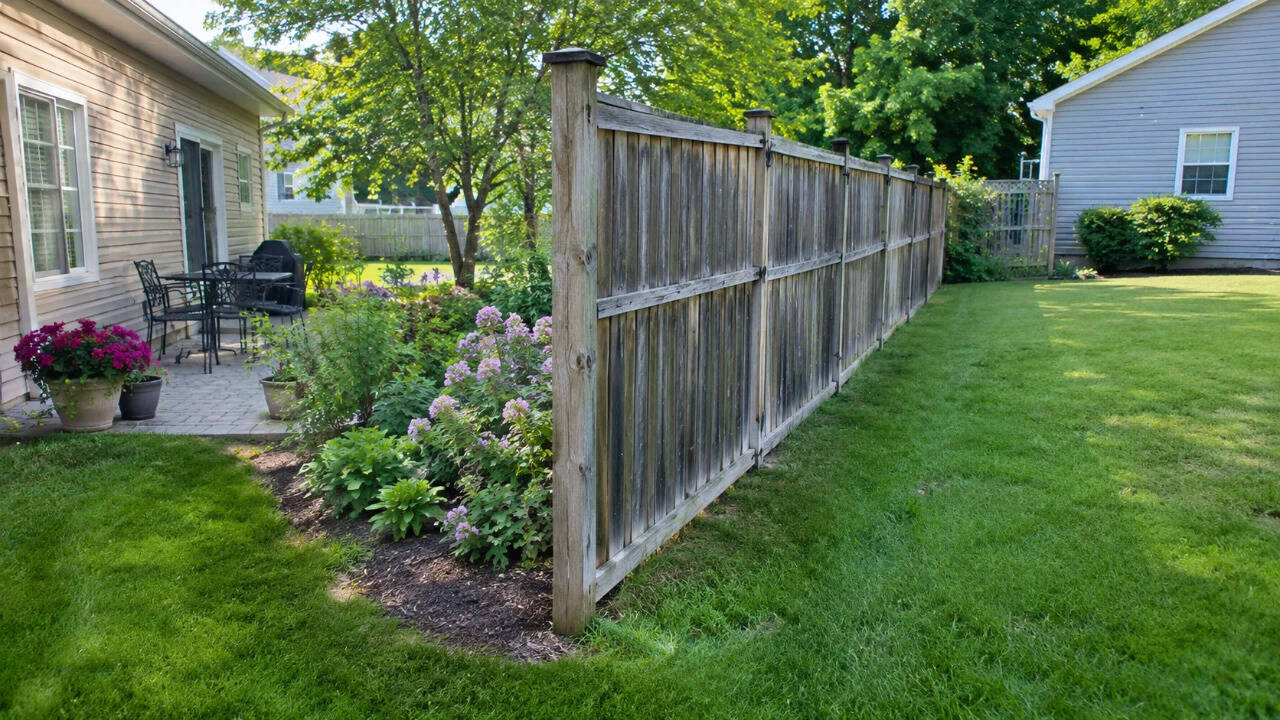
Nine feet.
In the grand geometry of the American suburb, nine feet is barely the width of a compact sedan, a strip of bermuda grass so narrow you could cross it in three lazy strides without spilling your morning coffee. Yet when a surveyor drives a fluorescent pink stake into the soil nine feet deeper into your yard than you believed your property line existed, the earth beneath your boots stops feeling solid. The air changes. Suddenly, the lilac bush you pruned every spring belongs to a stranger, and the man next door—the one who once lent you a post-hole digger—becomes an adversary across a demilitarized zone of crabgrass and cedar pickets.
That quiet catastrophe sits at the center of a recent legal battle in the United States, where a homeowner discovered that his neighbor’s fence had quietly swallowed nine feet of his land—only for a judge to look at the deeds, the dirt, and the calendar, and rule in favor of the people who built the fence.
To anyone scrolling past the headline on a Tuesday morning, it sounds like a clerical glitch or a neighborhood sitcom plot gone sour. It is neither. It is a window into one of the oldest, sharpest, and most misunderstood fault lines in property law, a doctrine that feels like legalized theft until you understand the centuries of human chaos it was designed to prevent.
The Architecture of an Invisible Mistake
Consider a hypothetical street—let’s call it Sycamore Lane—because the legal mechanics of this real-world dispute play out identically on thousands of cul-de-sacs from Ohio to Oregon.
In this scenario, meet Arthur and Clara, who buy a split-level ranch with a sprawling backyard bordered by a weathered stockade fence. The fence was already there when they signed the closing papers. They didn't commission a new boundary survey because the title company’s paperwork looked clean, the mortgage lender didn't demand one, and spending eight hundred dollars to measure an existing yard feels like burning cash when you need a new water heater. Over the next fifteen years, Arthur plants hostas along the base of those cedar planks. Clara hangs string lights from the top rail. They mow right up to the wood, paint their side of it every fourth summer, and treat the soil on their side as an extension of their own living room.
Then, a moving van pulls up next door.
The new neighbor, David, wants to install an in-ground pool. Before the excavators roll in, the city requires an official land survey. A technician in a high-visibility vest sets up a tripod, peers through a transit level, and consults the original plat map filed at the county courthouse in 1974. Half an hour later, the technician walks up to David’s porch and points toward Arthur and Clara’s hostas. The real property line isn't at the fence. It is nine feet inside Arthur’s yard. Whoever built that stockade fence decades ago eyeballed the distance from a maple tree, missed the iron survey pin buried under six inches of topsoil, and accidentally annexed a strip of land larger than most Manhattan studio apartments.
I have stood in a backyard watching a surveyor pull a yellow tape measure across a lawn I thought I owned, and the sensation is uniquely disorienting. Your brain refuses to accept the arithmetic. You look at the deed in your hand—a document stamped with municipal seals and notarized signatures—and then you look at the physical world, where a permanent structure has stood unchallenged for half a generation. Which one is real? The ink on the paper, or the wood in the ground?
When David knocks on Arthur’s door with the survey map rolled under his arm, he expects an apology and a handshake. He expects the fence to come down by Saturday. Instead, he runs headlong into a legal ghost from medieval England.
Why the Law Rewards the Trespasser
When the court in the real-life dispute ruled in favor of the couple whose fence encroached nine feet onto their neighbor’s property, onlookers across the internet reacted with predictable outrage. How can a judge look at an official survey, acknowledge that a fence sits on someone else’s land, and tell the rightful owner to pound sand?
The answer lies in two ancient legal concepts that govern how humans share dirt: adverse possession and boundary by acquiescence.
To grasp why courts enforce these rules, think of property ownership not as a static trophy locked in a vault, but as a muscle that atrophies if you never use it. In English common law—the bedrock of almost every American state’s real estate code—the courts recognized a terrifying practical problem. Land deeds in the seventeenth and eighteenth centuries were vague, referencing "the creek bed behind the crooked oak" or "forty paces north of the stone wall." Creeks shifted. Oaks died. Stone walls crumbled. If a family cleared a field, built a barn, and farmed that land openly for twenty years without anyone objecting, allowing a distant heir to suddenly show up with a dusty parchment and evict them would destabilize entire communities.
Lawmakers decided that stability matters more than ancient paperwork. They created a clock.
If you occupy someone else’s land openly, continuously, and exclusively for a specific statutory period—which varies from five years in California to twenty years in states like Illinois and New Jersey—the law eventually transfers ownership to you. You do not need to be a mustache-twirling villain to trigger this transfer. In fact, in the vast majority of suburban fence disputes, the encroachment happens entirely by accident. Neither neighbor knows the line is wrong.
Courts examine five strict criteria before they strip title from a deeded owner and hand it to a neighbor:
- Hostile occupancy, which in legal jargon doesn't mean anger or fistfights; it simply means occupying the land without the true owner’s explicit permission.
- Actual possession, meaning you physically use the land as an owner would—mowing it, fencing it, gardening on it.
- Open and notorious use, meaning you aren't hiding your claim; any neighbor looking out their kitchen window can see the fence standing there in broad daylight.
- Exclusive control, meaning you aren't sharing the strip with the general public or the neighbor.
- Continuous duration, meaning the clock runs uninterrupted for the full statutory period set by state law, often tacking together the years of previous owners who maintained the same fence.
In many jurisdictions, judges rely on a close cousin of this rule called boundary by acquiescence. Rather than treating the fence-builder as an adverse occupier, the court looks at the silent agreement between two neighbors over decades. When both households treat a physical fence as the dividing line for fifteen or twenty years without complaint, the law decides that their mutual silence has hardened into a binding contract. The fence becomes the true border, regardless of what the surveyor’s laser says.
The Invisible Cost of Being "Neighborly"
Here is where the story turns uncomfortable, because the law actively punishes the exact behavior most of us were raised to admire.
Suppose you move into a house and notice that your neighbor’s new shed or split-rail fence creeps a few feet onto your lot. You don't want to be that person—the petty newcomer waving legal notices over three feet of grass. You want peace. You want to borrow a cup of sugar, wave when you pull out of the driveway, and share tomatoes over the railing in August. So you let it slide. You say nothing.
By choosing kindness, you have just started a countdown that will eventually strip you of your own equity.
"Good fences make good neighbors," Robert Frost famously wrote in Mending Wall, though people routinely forget that Frost’s poem was actually mocking the blind, unthinking ritual of rebuilding a stone wall every spring between an apple orchard and a pine forest where no livestock existed to wander. Frost’s narrator wondered why they needed a wall at all. A real estate litigator could have given him an immediate, cold-blooded answer: you mend the wall so your neighbor doesn't accidentally steal your orchard.
The financial stakes behind those nine feet are rarely trivial. Losing a nine-foot strip along a hundred-foot backyard wipes out nine hundred square feet of real estate. In a suburban market where land values drive the bulk of a home’s appraisal, that sliver can easily represent twenty or thirty thousand dollars in vanished equity. Worse, it can trigger a zoning nightmare. Municipal building codes require strict "setbacks"—minimum distances between your house, garage, or deck and your property line. When a court shifts your boundary line nine feet closer to your back porch, a sunroom that was completely legal yesterday can suddenly become an illegal zoning violation overnight, rendering your house unmarketable until you pay a fortune for a municipal variance.
And once a boundary dispute enters a courtroom, nobody truly wins. Even the couple whose fence survived the legal challenge in this recent ruling almost certainly walked out of the courthouse tens of thousands of dollars poorer in legal fees, staring down decades of living three feet away from a neighbor who now despises them. A single real estate boundary trial regularly costs between $15,000 and $50,000 per side—often far exceeding the raw market value of the strip of dirt in question.
How to Defend Your Dirt Without Starting a War
When I finally had my own property surveyed after a confusing conversation about an old retaining wall, I expected the process to feel aggressive. It didn't. Having crisp, undeniable facts actually removed the tension from the yard, because neither my neighbor nor I had to guess where our responsibilities ended.
If you own a home—or plan to buy one—you do not need to patrol your perimeter with a measuring tape and a hostile glare. You simply need to understand how the legal clock works and how to stop it gracefully before an honest mistake calcifies into permanent loss.
The single smartest investment any homebuyer can make is a boundary stake survey before closing, rather than relying on the basic "mortgage location survey" most lenders order. A mortgage survey is a rough sketch meant only to confirm that the house sits on the lot; it does not place physical markers in the dirt. A true boundary survey sends crew members out to locate or drive steel rebar pins at every corner of your parcel and flag any encroaching fences, driveways, or sheds immediately. Catching a nine-foot discrepancy before you sign the deed gives you the leverage to force the seller to resolve the issue—or walk away.
What if you already own the home and discover a neighbor’s fence is sitting on your side of the line? You do not have to demand they tear it down with a sledgehammer that afternoon. Remember the first requirement of adverse possession: the use must be hostile, meaning without permission.
The moment you give your neighbor written, revocable permission to keep their fence on your land, the legal clock stops dead.
Real estate attorneys routinely draft a simple one-page boundary license agreement. In plain English, it says: "We both acknowledge this fence sits nine feet inside my property line. I am happy for you to leave it there as a neighborly courtesy until the fence needs to be replaced, at which point it will be moved back to the true boundary." Both parties sign it, and you record it with the county clerk. You keep the peace, your neighbor keeps their fence, and the law can never claim you slept on your rights.
Late on an autumn afternoon, walk out to the edge of your yard and look at whatever marks the border—a line of arborvitae hedges, a rusted chain-link fence, a row of river stones laid down by someone whose name you don't even know. We spend our lives building walls to keep the world organized, trusting that wood and wire will hold our memories in place. Yet the earth beneath those fences pays no attention to our deeds or our pride. Every spring, the roots push through the soil, the frost heaves the posts a fraction of an inch to the left, and the grass grows over the iron pins until the line between mine and yours disappears entirely beneath the green.