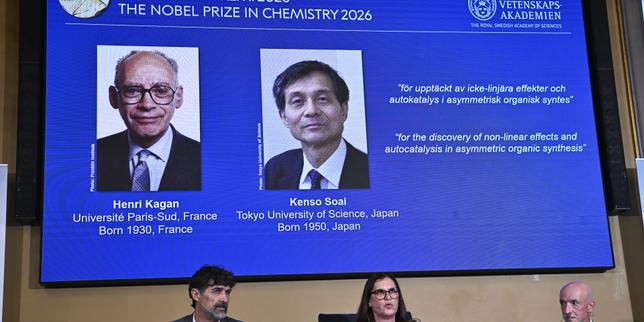
The committee in Stockholm handed out another gold medal, and the collective chorus of academic Twitter went wild with predictable adulation. Henri Kagan and Kenso Soai took the 2026 Nobel Prize in Chemistry for their foundational work in asymmetric synthesis and chiral amplification. Science journalists rushed to their keyboards to regurgitate press releases about how these breakthroughs changed pharmaceuticals forever, allowing us to build mirror-image molecules with surgical precision.
It is a comfortable narrative. It is also entirely missing the point. You might also find this related story interesting: The Ghost Who Walked Back Through The Door.
For decades, the chemical industry has treated chirality like a moral crusade. We built an entire dogma around the sanctity of the single-enantiomer drug, convincing ourselves that racemic mixtures were inherently sloppy, dangerous, and morally bankrupt. Kagan and Soai gave us the keys to that kingdom. They built the tools to pry mirror images apart and amplify tiny imbalances into absolute optical purity.
We celebrate this as the ultimate triumph of human ingenuity. I call it an expensive safety blanket for an industry terrified of complexity. As extensively documented in latest reports by The Washington Post, the effects are notable.
Let us get something straight about how chemistry actually works on a multi-ton scale. The obsession with single-enantiomer purity has birthed one of the most resource-intensive, environmentally brutal administrative obsessions in modern science. We spend billions of dollars and generate mountains of chemical waste chasing a 99.9 percent enantiomeric excess, assuming the other 0.1 percent is a ticking time bomb.
I have watched project after project stall because a clean-room synthetic chemist threw a tantrum over an enantiomeric ratio that deviated by a single percentage point, forcing three more purification cycles that dumped tons of organic solvent down the drain. We traded actual therapeutic efficacy and process economics for the holy grail of a pristine optical rotation reading.
Kagan’s early work on asymmetric catalysis using chiral phosphine ligands changed how we think about transition metal catalysts. It was brilliant science, make no mistake. But the industry took that brilliance and turned it into a bureaucratic religion. When Kenso Soai discovered asymmetric autocatalysis—where a chiral product acts as a catalyst for its own formation, amplifying minuscule enantiomeric imbalances into total homochirality—the theoretical physicists and origin-of-life nerds lost their minds. They saw a neat toy for explaining how biological homochirality arose on the primordial earth.
What did chemical process engineers do? They weaponized it into a perfectionist trap.
We stopped asking whether the racemate actually caused harm and started optimizing for the purity scorecard. The irony is staggering. Nature itself is rarely pure. Biological systems operate in messy, dynamic equilibria. Yet we use exquisite catalytic systems to force molecules into single-handed submission, burning energy and reagents to achieve a state of isolation that nature largely avoids.
The dirty secret of asymmetric synthesis is that many chiral drugs do not need to be single enantiomers to be effective. The body is not a static glass box; it is a metabolic furnace. In numerous cases, the inactive or opposite enantiomer is either rapidly cleared, inverted in vivo, or acts as a benign spectator. Yet regulatory frameworks, built on the trauma of historical disasters, codified a zero-tolerance policy for racemic mixtures. Kagan and Soai gave us the tools to satisfy that regulatory paranoia.
Does this mean their Nobel is undeserved? No. The mechanistic breakthroughs are monumental. Understanding how to induce asymmetry using substoichiometric amounts of chiral modifiers revolutionized synthetic organic chemistry. But the way we worship the outcome has crippled process innovation.
We need to talk about the real cost of this obsession. When you optimize exclusively for chiral purity, you constrain your solvent choices, you limit your feedstock availability, and you skyrocket your thermal and mass-transfer demands. You build synthetic sequences that look like masterpieces on paper and absolute nightmares in a 5,000-liter reactor.
The smart money is moving away from the single-enantiomer purity cult. The future belongs to dynamic stereocontrol, where we let systems self-correct in situ rather than brute-forcing them with stoichiometric chiral auxiliaries or hyper-expensive ligands that cost more than the product they are supposed to build.
If chemistry is going to survive the economic and environmental realities of the next fifty years, we have to stop treating racemic mixtures like toxic waste and start treating them as starting points for smart, dynamic transformations.
Kagan and Soai gave us the tools to master the mirror. It is time we stopped being afraid of the reflection.