We have been staring at the wrong smoke screen for three decades.
Every year, the same baffled headlines make the rounds in legacy media: "Smoking rates are plummeting, so why are more Asian women getting lung cancer?" Journalists interview doctors who look solemnly at statistics, shrug their shoulders, and point vaguely toward genetics or secondhand smoke. They treat it like a medical paradox, a cruel twist of genetic fate that defies explanation. For a more detailed analysis into this area, we suggest: this related article.
It is not a paradox. It is a failure of baseline data interpretation.
The obsession with tracking cigarette consumption has blinded public health authorities to the actual environment where people live, breathe, and cook. By framing lung cancer primarily as a "smoker’s disease" that mysteriously spilled over into non-smoking female populations, the medical establishment missed the shift in urban topography, domestic habits, and occupational exposure. To get more context on this issue, comprehensive reporting can be read at WebMD.
We do not have a mysterious epidemic of lung cancer among non-smoking Hong Kong women. We have a completely predictable surge in adenocarcinoma caused by non-tobacco carcinogens that we actively ignore because fixing them requires massive economic disruption, whereas telling people to stop smoking is cheap.
The Genotype Scapegoat
The lazy consensus relies heavily on the EGFR mutation.
Epidemiologists love to point out that roughly 50 percent of lung adenocarcinoma patients in East Asia carry a mutation in the epidermal growth factor receptor (EGFR) gene, compared to only 10 to 15 percent of Western patients. The narrative goes like this: East Asian women are genetically predisposed to this specific mutation, making them uniquely vulnerable to developing lung cancer even if they never touch a cigarette.
This is a classic case of confusing a mechanism with a root cause.
An EGFR mutation is not an inevitable hereditary death sentence passed down through generations. It is a somatic mutation. That means it is acquired during a person's lifetime. Something in the environment triggers that genetic mutation.
[Image of EGFR mutation pathway in lung cancer]
Citing the EGFR mutation as the reason why non-smoking women get cancer is like saying a building collapsed because the steel beams bent. Yes, the beams bent, but what was the magnitude of the earthquake that caused it?
By blaming genetics, public health officials shift the responsibility away from structural environmental failures and onto the biological bad luck of the victims. It stops people from asking harder questions about what is actually mutating those genes in the first place.
The Ventilation Lie and the Wok Carcinogen
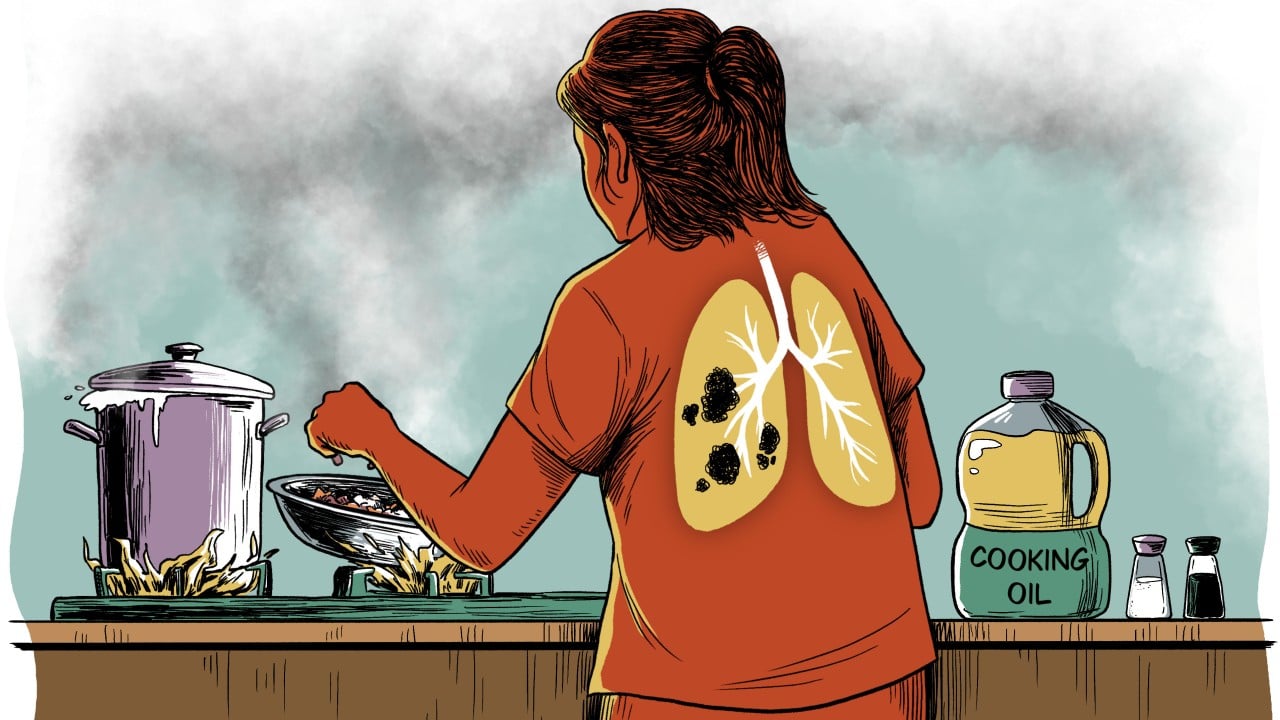
Let’s talk about the domestic kitchen. For years, public health pamphlets have warned about cooking oil fumes. They tell women to turn on their range hoods. They treat it as a personal hygiene issue.
They miss the engineering reality of modern Hong Kong housing.
I have spent years analyzing urban living conditions and working alongside indoor air quality metrics. The average Hong Kong apartment does not feature a commercial-grade restaurant ventilation system. It features a tiny kitchen, often less than 40 square feet, equipped with a domestic extractor fan that recirculates air or vents it into a narrow, stagnant lightwell shared by twenty other apartments.
When you heat unrefined peanut oil, corn oil, or lard to high temperatures in a wok—the foundational technique of traditional Cantonese cooking—you are not just creating a nice aroma. You are generating high concentrations of volatile organic compounds, polycyclic aromatic hydrocarbons (PAHs), and fine particulate matter ($PM_{2.5}$).
A landmark study by the Chinese University of Hong Kong (CUHK) confirmed that exposure to these cooking oil fumes significantly increases lung cancer risk among non-smoking women. But the nuance missed by the mainstream press is the compounding effect of architectural design.
We built micro-apartments with abysmal cross-ventilation, sealed them with airtight aluminum window frames for air conditioning efficiency, and then wondered why the women cooking inside them developed the respiratory profiles of heavy smokers. It isn't just the wok; it's the box we put the wok in.
The Inversion of the Air Pollution Debate
Whenever outdoor air quality dips in Hong Kong, the finger-pointing begins. We blame regional smog from the Pearl River Delta. We look at the horizon and grumble about coal-fired power plants across the border.
This is an easy political scapegoat, but the actual data from organizations like the Clean Air Network reveals a much more intimate killer: roadside pollution and urban canyon effects.
Hong Kong’s topography is defined by high-rise density. Tall buildings line narrow streets, creating "urban canyons" that trap vehicular emissions at street level. The primary culprit here is diesel exhaust from commercial vehicles and buses, which the World Health Organization classifies as a Group 1 carcinogen.
+-------------------------------------------------------------+
|                     THE URBAN CANYON EFFECT                 |
|                                                             |
|    [ High-Rise ]                       [ High-Rise ]        |
|    [  Building ]                       [  Building ]        |
|    [           ]                       [           ]        |
|    [           ]                       [           ]        |
|    [           ]   <-- Trapped Air --  [           ]        |
|    [           ]      Pollutants       [           ]        |
|    [           ]     (Diesel, PM2.5)   [           ]        |
|====[___________]=======================[___________]========|
|                       [ Vehicle ]                           |
+-------------------------------------------------------------+
Think about who populates these urban canyons during peak hours. It isn't the corporate executives sitting in upper-floor offices in Central. It is the women running daily domestic errands, walking children to school, and shopping at open-air wet markets situated directly adjacent to major arterial roads.
They are breathing in concentrated, non-dispersed diesel particulate matter at ground level for hours every single day. Outdoor air pollution isn't a uniform blanket over the territory; it is highly localized, aggressive, and socio-economically stratified.
The Radium in the Concrete
There is a silent, odorless carcinogen built directly into the infrastructure of Hong Kong that almost never makes it into mainstream lifestyle articles: radon gas.
According to data from the Hong Kong Environmental Protection Department, radon exposure is estimated to be the second leading cause of lung cancer in the territory, trailing only cigarette smoke. Radon is a naturally occurring radioactive gas formed by the decay of uranium in soil and rock.
Because Hong Kong is built on granite bedrock, the local stone is naturally rich in uranium. That granite is crushed and used to create the concrete aggregates that form virtually every residential tower block in the city.
The walls of your apartment are actively off-gassing radon.
In a well-ventilated house, radon disperses harmlessly. But in an airtight, high-rise apartment building where windows are kept shut for nine months of the year to preserve air conditioning, radon accumulates to dangerous levels. The gas decays into radioactive particles that lodge in the lung lining, emitting alpha radiation that directly damages DNA and induces—you guessed it—somatic mutations.
If you want to understand why lung adenocarcinoma is rising among non-smokers, stop looking at their habits and start looking at their building materials.
Dismantling the Screener Fallacy
The final piece of the puzzle is purely statistical, and it is where the media’s narrative completely falls apart. They look at the rising raw numbers of non-smoking female lung cancer cases and panic, assuming the risk is exponentially growing right now.
They fail to account for diagnostic bias and changing screening paradigms.
Historically, lung cancer was caught late. Because it was heavily associated with smoking, a non-smoking woman presenting with a persistent cough was often misdiagnosed with asthma, bronchitis, or a chronic infection. They only discovered the tumor when it was far too late to treat.
Today, high-resolution low-dose computed tomography (LDCT) scans are increasingly common in private health check packages marketed directly to affluent middle-aged women in Hong Kong.
We are looking for it more than we ever have before.
When you introduce widespread, highly sensitive screening into a specific demographic, you create an artificial spike in incidence numbers. You are catching indolent, slow-growing adenocarcinomas that might have taken twenty years to cause symptoms, or might never have killed the patient at all.
The "epidemic" is, in part, an artifact of better surveillance. We are finally counting the bodies that we used to ignore, but we are misinterpreting the new data as a brand-new threat rather than a long-standing environmental tax we’ve been paying for decades.
The Cost of the Wrong Narrative
This isn't an academic debate about epidemiology. The insistence on treating lung cancer as a tobacco-centric disease with a weird genetic footnote has real-world, deadly consequences for public policy.
As long as the government can claim that non-smoking lung cancer is largely a genetic quirk of East Asian women, they do not have to overhaul building ventilation codes. They do not have to ban diesel vehicles from urban centers entirely. They do not have to mandate radon-resistant construction techniques or fund expensive indoor air filtration retrofits for low-income public housing.
They can just tell you to eat more antioxidants, turn on your kitchen fan, and go get an expensive genetic screening.
Stop asking why smoking is down but lung cancer is up. Smoking was just the loudest killer in the room. Now that the smoke has cleared, we are finally seeing the toxic architecture we built around ourselves.