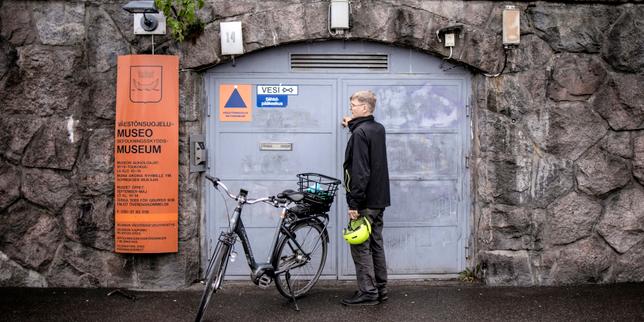
Walk into the Itäkeskus swimming pool complex in Helsinki on any given afternoon, and you'll hear the echoes of splashing water and children laughing. It looks like a standard piece of Nordic municipal infrastructure. But look closer at the walls. Notice the massive steel seals and the deep bedrock positioning. Within 72 hours, this exact swimming pool can be drained, sealed off from the outside world, and transformed into a blast-proof fortress capable of protecting 3,800 people from a nuclear detonation or chemical attack.
For decades, Western Europe treated civil defense like an embarrassing relic of the Cold War. Bunkers were welded shut, emergency stockpiles were sold off, and the idea of a land invasion by Russia was laughed out of parliamentary debates.
The Nordics never bought into that illusion.
Finland, Sweden, and Norway share a collective, multi-generational memory of what happens when the Russian military decides to push westward. Now that geopolitical tensions have hit a boiling point, the massive subterranean defense network across Scandinavia isn't just a historical curiosity. It's an active, multi-billion-dollar shield that forms the frontline of NATO's northern flank.
While the rest of the world scrambles to figure out civilian resilience, these three nations are already sitting inside the most sophisticated bunker systems on Earth.
The Fortress Under the Bedrock
Finland doesn't wait around for things to go wrong. The country shares a brutal 830-mile border with Russia, and history taught the Finns that sovereignty requires concrete. The Winter War of 1939 proved that they could inflict devastating casualties on invading Soviet forces, but it also proved that the civilian population would always be targets.
Today, Finland boasts roughly 50,500 civil defense shelters. Let that number sink in. That is enough underground bunker space to house 4.8 million people—roughly 85% of the entire population. In the capital city of Helsinki, the coverage is over 100%. The city has carved an entire parallel metropolis into the solid granite beneath its streets.
The Finnish strategy relies on a strict legal mandate. According to the national Rescue Act, any permanent residential or commercial building with a floor area of 1,200 square metres or more must build its own reinforced concrete shelter. The construction costs are factored directly into the property development.
These aren't damp, moldy cellars either. The largest rock shelters, built to S6-class standards deep in the granite bedrock, feature massive ventilation systems designed to filter out radioactive fallout and weaponized gas. They can withstand the blast wave of a 100-kiloton nuclear explosion. In peacetime, the Finns use them as indoor hockey rinks, parking garages, and storage hubs. By law, property owners must be able to completely clear out these commercial operations and make the bunkers fully functional for human survival within three days.
Sweden's Cold War Relics Face a Harsh Reality Check
Across the border, Sweden is playing catch-up, and the process is exposing the cost of complacency. During the height of the Cold War, Stockholm built the legendary Klara shelter (Klara skyddsrum), a massive two-story underground oval spanning over 6,600 square meters right beneath the city center. Designed to protect 8,000 citizens along with the core elements of the Swedish parliament, it features 35-ton blast doors and heavy-duty diesel generators.
Sweden has roughly 64,000 shelters meant to house seven million people. On paper, it looks impressive. In reality, Sweden let its guard down after the fall of the Berlin Wall.
Many Swedish bunkers were handed over to private businesses, turned into trendy nightlife venues, or simply neglected for thirty years. Equipment rotted, air filters expired, and structural integrity degraded. Now, the government faces the monumental logistical nightmare of inspecting, upgrading, and repairing tens of thousands of older facilities.
Stockholm is now forcing a massive nationwide scramble. Private property owners who inherited these shelters are realizing that the state's 48-hour reclamation rule is no longer a theoretical exercise. The country is frantically auditing its civilian defense framework, knowing that a network is only as strong as its weakest door seal.
Norway's Mountain Vaults and the Arctic Corridor
Norway's tactical challenge is different. Its rugged, mountainous topography offers natural protection, but its immense coastline and proximity to Russia's Northern Fleet in the Arctic make it a prime target. During the Cold War, Norway focused heavily on military bunkers—hidden submarine pens carved into fjords and subterranean command centers buried deep inside mountains.
Oslo is currently pouring millions into restoring these secret mountain vaults. The focus isn't just on protecting the local populace, but on securing the strategic military assets that NATO would need to deploy in a conflict.
The recent creation of a joint military corridor crossing northern Norway, Sweden, and Finland highlights how these bunkers tie into a broader strategy. The Arctic holds immense untapped natural gas and oil reserves, and as polar ice melts, new shipping routes open up. Norway's mountain bunkers are the literal anchors holding down the northernmost line of Western defense.
The Total Defense Blueprint
What most outsiders get wrong about the Nordic bunker system is the assumption that it's just about concrete and steel. It isn't. The physical infrastructure works only because it is backed by a cultural concept known as "Total Defense."
In Finland and Sweden, emergency preparedness is integrated into basic citizenship. Governments regularly distribute updated crisis survival guides to every single household, detailing exactly how much canned food, bottled water, and iodine tablets to keep on hand.
People don't panic when they receive these guides because the threat has been normalized for generations. The bunkers aren't viewed as a sign of imminent doom; they're viewed as a structural asset, much like an insurance policy or a seatbelt.
If you want to understand how civilian resilience actually works, stop looking at theoretical government white papers and look at how the Nordics manage their underground space. They don't treat national security as something handled exclusively by the military. They treat it as an architectural requirement, an urban planning priority, and a civic duty.
If you own commercial property in a Nordic country, check your local municipal regulations immediately to ensure your shelter spaces comply with current readiness standards. If you are looking to audit your own household preparedness, start by building a 72-hour emergency kit modeled on the official Nordic civil defense checklists—focusing on water purification, shelf-stable proteins, and independent communication devices.
Scandinavia: The New Cold War provides an eye-opening look at how the shifting geopolitical landscape in the Arctic is forcing Norway, Sweden, and Finland to revitalize their defensive infrastructure.