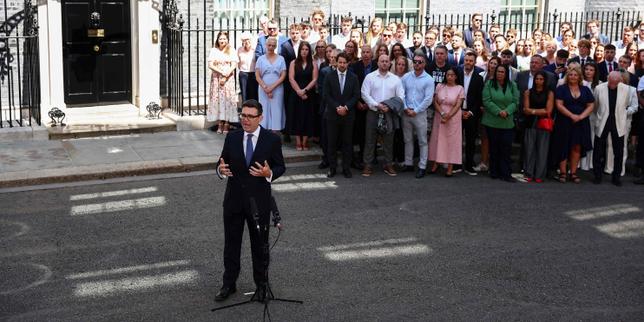
The black iron gates of Downing Street are designed to keep the world out. For decades, they have served as a physical boundary between the administrative pulse of London and the rest of the United Kingdom. But this week, the gates didn't just open; they felt more like a bridge.
When Andy Burnham walked through those doors as Prime Minister, he brought the North of England with him. It wasn’t a symbolic gesture. It was a hostile takeover of the status quo.
To understand why this shift feels tectonic, you have to stand on a platform at Manchester Piccadilly during the morning rush. The air is cold. The frustration is palpable. For years, commuters in Leeds, Sheffield, and Manchester have watched the capital absorb the national budget like a sponge, while their own infrastructure crumbled into a relic of the industrial age. They have heard the promises of "levelling up" echoed by successive administrations, only to see those promises evaporate before they could hit the ledger.
Burnham represents a different cadence. He is a politician who built his brand on the pavement, not in the members' club. By installing John Healey—the pragmatic, steely-eyed former Defence Secretary—as his Chancellor of the Exchequer, Burnham has signaled that his government will treat economic regionalism not as a social policy, but as a national security imperative.
Consider the choice of Healey. This is not the appointment of a flamboyant ideologue. It is the tactical placement of a man who knows how to manage a massive, complex machine. The Treasury has long functioned as the high priest of fiscal orthodoxy, often allergic to the kind of radical investment that regions outside the M25 desperately require. Healey knows the codes to that building. He knows that if you want to change the country, you don't just burn the rulebook; you rewrite it from the inside.
The Geography of Power
In political science, we talk about the "metropolitan bias." It is the invisible gravity that pulls talent, capital, and decision-making power toward London. This concentration creates a feedback loop: because the money is there, the experts are there; because the experts are there, the policy is designed for them.
Imagine a hypothetical software engineer named Sarah living in Wigan. She has the skills to compete globally but faces a commute that bleeds hours from her day and public transport that fails with predictable regularity. When she looks at her tax bill, she sees money funneling toward a capital city that views her home as a picturesque but neglected hinterland.
Burnham’s administration is betting that Sarah is the key to Britain’s future growth. By moving the fiscal engine room into the hands of a team that views the UK as a polycentric network rather than a hub-and-spoke model, they are attempting to break that gravity.
The move is risky. History is littered with the carcasses of leaders who tried to decentralize power. The Treasury acts like an immune system, rejecting anything that threatens its centralized control. To succeed, Healey must balance the books while simultaneously pouring billions into regional transport, green energy hubs in the North Sea, and digital connectivity that doesn't drop off the map past Birmingham. It is a tightrope walk over a canyon.
The Defence Mindset
Why would a Prime Minister appoint a former Defence Secretary to the most powerful economic post in the country?
The answer lies in the nature of modern crisis. Economics is no longer just about interest rates and inflation targets. It is about supply chains, energy independence, and the resilience of domestic manufacturing. Healey spent his time in the Ministry of Defence looking at the world through the lens of vulnerability. He understands that a nation is only as strong as its weakest industrial link.
He brings a "wartime footing" to the economy. This implies a shift away from the passive, market-led growth models of the last thirty years toward an active, state-steered industrial strategy. It means that when the government spends, it will demand a return on investment that includes local job creation, not just abstract GDP growth figures.
This will rattle the City of London. The financiers who have enjoyed a frictionless relationship with the Treasury for generations are waking up to a new reality: the person holding the purse strings now views the North not as a charity case, but as the primary engine for national survival.
The Cost of Stagnation
We have lived through the consequences of the alternative. We have seen the "brain drain," where the brightest minds in the North feel compelled to migrate south to find career fulfillment. We have seen the social fraying that occurs when towns are left behind, leading to a profound sense of political alienation.
This alienation fueled the populist fires of the last decade. It created a divide where citizens stopped believing that the government was listening, let alone acting in their interest.
Burnham’s arrival on Downing Street is an attempt to close that fracture. It is an acknowledgment that if the United Kingdom does not become a country that works for everyone, it will eventually cease to be a country that works for anyone. The stakes are not just economic; they are existential. If this partnership—the orator from the North and the strategist from the Ministry—fails, the disillusionment will be deeper and more dangerous than anything we have seen before.
The Long Game
The transition will not be visible on the stock market tomorrow morning. It will not be solved by a single budget speech. This is a multi-year project of re-engineering the British state.
We should expect friction. We should expect the defenders of the old guard to label these investments as wasteful or inflationary. We should expect the bureaucracy to slow-walk the directives coming out of Number 11. But for the first time in a generation, the people who actually build the country—the engineers in Sheffield, the port workers in Hull, the tech founders in Manchester—have a direct line to the heart of power.
The gates are open. The challenge now is to ensure that the wealth, the talent, and the future of the nation actually start flowing through them, outward to the places that have spent too long waiting in the cold. The North has finally moved into the center, and for the first time in a long time, the center might actually have to listen.