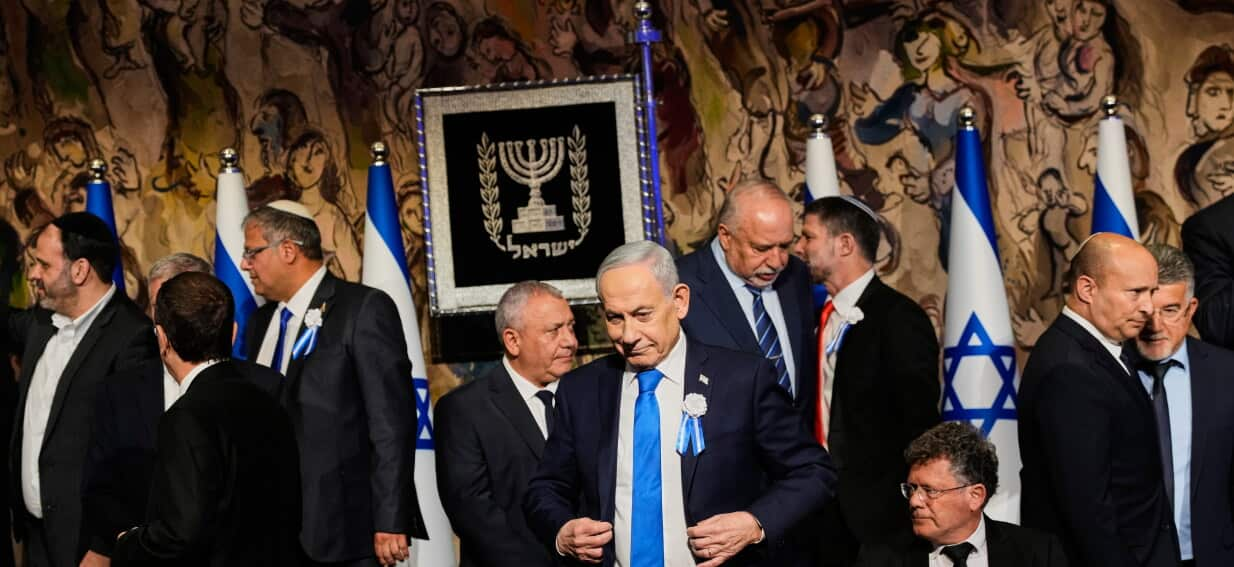
Political commentators in Jerusalem and Washington are reading the opening of the new Israeli parliament entirely backward.
According to conventional reporting—such as coverage highlighting how allies of former IDF Chief of Staff Gadi Eisenkot are moving against Benjamin Netanyahu's political legacy as the new Knesset convenes—the central drama of Israeli politics remains a personal referendum on Netanyahu. That framing treats legislative maneuvers by centrist figures as a decisive ideological reckoning. You might also find this connected story interesting: Why the Narrow 211-204 Hegseth Impeachment Vote Proves Washington Still Misunderstands Congressional Oversight.
It is a misreading of how Israeli coalition arithmetic and institutional power actually function. Treating Eisenkot's parliamentary positioning as a clean break from the Netanyahu era mistakes tactical legislative housekeeping for structural transformation.
To understand what is actually happening inside the Knesset, you have to strip away the personality-driven narratives that dominate cable news and look at the mechanics of Israeli governance. As highlighted in recent articles by TIME, the implications are notable.
The Illusion of the "Legacy Dismantling" Narrative
Political analysts often default to binary storytelling: the incumbent architect versus the reformist challenger. When Gadi Eisenkot and his parliamentary allies introduce bills or committee challenges aimed at reversing policies associated with Benjamin Netanyahu—whether involving judicial appointments, ministerial authority, or coalition-building rules—observers frame it as an existential purge of Netanyahu's political footprint.
That interpretation rests on three flawed assumptions:
- Netanyahu’s legacy is purely legislative. In reality, Netanyahu's deepest impact on Israeli politics is demographic and structural, not statutory. Repealing specific Basic Law amendments or altering parliamentary procedures does not undo two decades of realignment among religious, traditional, and right-leaning voters.
- The center-left bloc shares a unified governing vision. According to Israeli political scientists and parliamentary historians, opposition and centrist factions frequently unite around procedural anti-Netanyahu measures precisely because they cannot agree on substantive policy regarding the West Bank, Haredi conscription, or state-religion boundaries.
- Opening-session bills reflect final outcomes. Veteran Knesset watchers know that private member bills and early-term legislative offensives at the opening of a parliament serve primarily as signaling tools to party bases and coalition partners, rather than finished legal architecture.
When allies of Eisenkot target specific mechanisms built during Netanyahu's tenures—such as laws restricting the conditions under which a prime minister can be declared incapacitated, or rules governing ministerial portfolios—they are engaging in standard institutional stabilization. Calling it a dismantling of a legacy inflates routine post-transition calibration into a historical rupture.
What Gadi Eisenkot Is Actually Doing
Gadi Eisenkot is not a theatrical populist; his political instincts were forged over decades in the Israel Defense Forces general staff, where institutional predictability and chain-of-command clarity are treated as survival imperatives.
Analysts who follow Eisenkot’s parliamentary work point out that his primary objective has consistently been restoring procedural guardrails rather than pursuing ideological vengeance. Specifically, his allies' early parliamentary initiatives focus on three concrete areas:
- Reversing Hyper-Personalized Legislation: During recent Knesset terms, several Basic Laws were amended on accelerated timelines to solve immediate coalition disputes or protect specific officeholders. Reversing these changes is an effort to return Israel's quasi-constitutional framework to a baseline where rules apply uniformly regardless of who holds the premiership.
- Reasserting Ministerial Accountability: Expanding the number of ministers and creating overlapping ministries fragmented executive responsibility. Rollbacks in this area aim to consolidate operational authority back into traditional cabinet ministries.
- Constraining Coalition Extortion: By targeting the procedural levers that allow small sectarian parties to extract disproportionate budget allocations or statutory exemptions, centrist lawmakers attempt to lower the price of governing.
None of this requires inventing a new political philosophy. In fact, much of what Eisenkot’s camp advocates mirrors the institutional norms that governed Israel during the 1990s and early 2000s—eras in which Netanyahu himself operated as Finance Minister and Prime Minister under stricter parliamentary constraints.
The Structural Trap Nobody Wants to Admit
Here is the nuance that standard political coverage routinely misses: the very tools Eisenkot’s allies want to dismantle are the same tools any future Israeli prime minister will be tempted to use.
Israel’s proportional representation system, with its low electoral threshold (3.25%), virtually guarantees fragmented parliaments. No single party has ever won an outright majority in the 120-seat Knesset. Every government is a coalition of convenience assembled under intense time pressure.
Consider the mechanics of forming a 61-seat majority in modern Israel:
- A prime minister must simultaneously satisfy secular centrists, national-religious factions, ultra-Orthodox (Haredi) parties, or Arab parties—groups with mutually exclusive red lines.
- Without the ability to create custom ministries, alter coalition agreements mid-term, or pass rapid procedural adjustments, a prime minister cannot keep a fragile majority intact through a single budget cycle.
- Previous anti-Netanyahu coalitions—most notably the 2021–2022 Bennett-Lapid government—relied heavily on creative institutional workarounds, such as the "Norwegian Law" (allowing ministers to resign from the Knesset so lower-ranked party members can enter) and alternating premiership structures, simply to survive.
If Eisenkot’s allies succeed in tightening parliamentary rules and stripping away executive flexibility, they will not just constrain Netanyahu’s political heirs. They will constrain themselves the moment they have to hold together a fractious coalition of their own.
The Wrong Questions Voters and Pundits Are Asking
When a new Israeli parliament opens, public debate almost always collapses into predictable, misleading questions. Dismantling those premises clarifies what actually matters.
"Does this mark the end of the Netanyahu era?"
Asking whether a set of Knesset bills ends a political era misunderstands how political eras end in parliamentary democracies. Eras end when a competing coalition builds a durable, repeatable electoral majority capable of passing multiple consecutive budgets. Until the Israeli center demonstrates it can govern for four full years without collapsing over internal contradictions, Netanyahu’s political model remains the default template of Israeli power.
"Will rolling back Netanyahu-era laws restore public trust in Israeli institutions?"
Polling from organizations such as the Israel Democracy Institute consistently shows that public trust in the Knesset, the government, and the judiciary divides sharply along ideological lines. When centrist lawmakers repeal laws passed by a right-wing majority, center-left voters view it as institutional restoration, while right-wing voters view it as partisan erasure. Legislative reversals alone do not generate consensus; they merely shift which half of the electorate feels alienated.
"Is Eisenkot positioning himself to lead the opposition or the next government?"
In Israeli politics, those two roles require opposite skill sets. Leading an opposition rewards sharp legislative confrontation and ideological purity. Building a government requires quiet accommodation with the very ultra-Orthodox and right-leaning factions that opposition voters want sidelined. Eisenkot’s challenge is that every aggressive move against the previous government’s architecture makes future coalition negotiations with right-of-center partners harder to execute.
How to Read the New Knesset Without Getting Played by Headlines
If you want an accurate signal of where Israeli politics is heading over the next 12 months, ignore the opening-week bill introductions and watch three hard indicators instead:
- The State Budget Passage: Under Israeli law, failure to pass a state budget by the statutory deadline automatically dissolves the Knesset and triggers new elections. Watch how coalition and opposition factions negotiate budget compromises—not how they vote on symbolic legacy bills.
- Haredi Conscription Legislation: The military draft exemption dispute is the true fault line of Israeli politics. It pits demographic reality and military manpower needs directly against the survival requirements of religious parties. Any legislative move that avoids resolving conscription quotas is window dressing.
- Key Committee Chairmanships: Power in the Knesset lives in the Finance Committee, the Foreign Affairs and Defense Committee, and the Constitution, Law and Justice Committee. Who controls the gavel in those rooms determines which bills actually reach the plenum and which die quietly in committee.
The Real Stakes
The story of the new Israeli parliament is not a morality play about erasing one leader's name from the statute books. It is a stress test of whether Israel's parliamentary system can function without constant constitutional improvisation.
Centrist lawmakers can spend the opening months of the Knesset tearing down the specific legal guardrails and workarounds built over the past decade. Doing so may satisfy immediate political demands and restore a cleaner procedural baseline on paper.
Until someone solves the underlying math of a fractured 120-seat parliament, however, every government in Jerusalem will eventually reach for the exact same levers of power—regardless of whose name is attached to them.