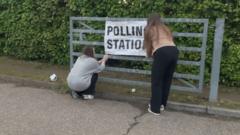
The integrity of a democratic election rests not on the casting of the ballot, but on the verification of the environment in which that ballot is cast. Most public discourse focuses on voter turnout and exit polling, yet the most critical phase of the electoral process occurs in the sixty to ninety minutes before the doors unlock. This window represents a high-stakes logistical sprint where a temporary site is converted into a secure, forensic environment. The success of this transition depends on a rigid adherence to a three-pillar framework: Chain of Custody Verification, Technical Spatial Configuration, and Procedural Synchronization.
The Taxonomy of Pre-Opening Procedures
The arrival of the Presiding Officer (PO) marks the commencement of the operational cycle. Unlike a standard retail or service opening, a polling station operates under a strict legal mandate where any deviation from statutory requirements can invalidate the results of the entire precinct. The first priority is the establishment of a secure perimeter and the validation of the materials delivered by the local returning officer.
The Inventory Audit and Chain of Custody
The "Ballot Box Audit" is the primary mechanism of trust. Before a single voter enters, the PO and Poll Clerks must verify the physical integrity of the ballot boxes. This is not a casual inspection; it involves a systematic check for tampering or structural failure.
- The Seal Verification Protocol: Every ballot box arrives empty. The PO must demonstrate this emptiness to any present polling agents—representatives of candidates who serve as independent auditors. Once verified, the box is sealed with high-tenacity, numbered security seals. The unique serial numbers are recorded in the official log. This creates a forensic "zero-point" for the election.
- The Register of Electors Validation: The paper or digital registers are checked against the specific precinct codes. A mismatch here is a catastrophic failure; if a clerk uses the register for District A in a District B station, the legal basis for the vote is erased.
- The Ballot Paper Serial Sequence: Ballot papers are issued in stitched books. The staff must verify that the serial numbers on the reverse of the papers are consecutive and match the numbers listed on the Ballot Paper Accounts. This ensures that "ghost ballots" cannot be injected into the system later in the day.
Spatial Engineering and Voter Flow Dynamics
The physical layout of the room is a strategic exercise in behavioral psychology and legal compliance. The objective is to maximize throughput while guaranteeing the absolute secrecy of the vote. Failure in spatial design leads to "bottlenecking," which directly correlates with voter attrition.
The Privacy Mandate
The placement of voting booths is governed by the "Line of Sight Rule." No booth can be positioned such that a person standing in a common area, or even another voter in a different booth, can observe the marking of a ballot. This requires an analysis of window placement (to prevent external observation) and the elimination of reflective surfaces.
The Throughput Equation
A polling station functions as a linear processing plant. The efficiency of the station ($E$) can be modeled by the relationship between the number of processing stations ($S$), the average time taken to verify a voter’s ID and issue a ballot ($T_v$), and the average time spent in the booth ($T_b$).
$$E = \frac{S}{T_v + T_b}$$
To optimize this, the pre-opening setup phase focuses on:
- The Check-In Junction: Placing the clerks’ table at the primary ingress point to prevent unverified individuals from entering the secure zone.
- The Directional Pivot: Using signage to dictate a one-way flow, ensuring that voters exiting the booths move toward the ballot box and then the exit, rather than backtracking through the queue.
The Legal Threshold and Statutory Signage
The final thirty minutes of the pre-opening phase are dedicated to the "Public Information Layer." In many jurisdictions, the law dictates exactly which notices must be displayed and where. This is not merely informative; it is a legal requirement for a fair election.
Mandatory Postings
- The Guidance for Voters: A large-print version of the instructions on how to mark the ballot. This must be visible both outside the station (to prepare the voter) and inside each booth.
- The Corrupt Practices Act: Notices outlining the penalties for personation (voting as someone else), bribery, and undue influence. These serve as a legal deterrent and a boundary for the station’s authority.
- The Ballot Sample: A clearly marked "SPECIMEN" ballot to prevent confusion, especially in complex multi-choice or ranked-choice elections.
The Synchronization of Personnel
The human element of the pre-opening phase is managed through a "Read-and-Verify" checklist system, similar to aviation pre-flight protocols. The PO conducts a final briefing to synchronize the team on two critical variables: Challenge Procedures and Voter Assistance Limits.
Challenge Procedures
Staff are trained on the specific legal triggers required to challenge a voter’s eligibility. This includes the "Statutory Questions"—the only questions a clerk is legally permitted to ask a voter to verify their identity. If a voter is suspected of personation, the clerks must know the precise sequence of the challenge before it happens, as hesitation can lead to a breach of the peace or a legal challenge by observers.
The Neutrality Constraint
The most difficult aspect of personnel synchronization is the enforcement of "Affective Neutrality." Staff must remove any item of clothing or accessory that could be perceived as political. This extends to the environment; the PO must ensure no posters, leaflets, or even colors associated with specific parties are visible within the "exclusion zone" surrounding the building.
The Zero-Hour Verification
At five minutes to opening, the PO performs the "Final Walkthrough." This is a redundant check designed to catch "low-probability, high-impact" errors.
- Stationery Readiness: Ensuring every booth has a functional marking implement (usually a pencil tethered to the desk). While a trivial detail, a broken lead in a booth creates an immediate stoppage in the $T_b$ variable of the throughput equation.
- Lighting and Accessibility: Verifying that the path from the street to the ballot box is unobstructed for voters with mobility impairments. This includes the deployment of ramps and the testing of low-level voting compartments.
- The Official Clock: Synchronizing the station clock with a reliable time source (usually GPS or atomic time). The station must open at the exact second mandated by law. Opening early is as legally precarious as opening late, as it provides an argument that the station was not operating under the uniform rules of the election.
The Strategic Buffer and Crisis Mitigation
Experienced election officials build a "contingency buffer" into the pre-opening hour. This time is reserved for the inevitable failure of non-critical infrastructure, such as a malfunctioning printer or a locked gate.
The primary risk during this phase is the "Observer Conflict." Polling agents may arrive with an adversarial mindset, questioning the placement of the ballot box or the lighting in the booths. The PO’s strategy is one of "Radical Transparency"—allowing agents to see the empty box and the intact seals early, thereby co-opting them into the verification process. By making the agents witnesses to the security protocols, the PO reduces the likelihood of disruptive challenges once the voting begins.
The transition from a silent room to an active polling station is the most volatile moment of the day. The moment the clock strikes the hour, the PO declares the station open. This declaration is a formal legal act. From this point forward, the station is no longer a building; it is a "Constitutional Space" where the state’s power is temporarily delegated to the citizen.
The operational success of the day is determined by the silence of the pre-opening hour. If the logistics are executed with clinical precision, the voter experience remains unremarkable. In the context of election administration, "unremarkable" is the gold standard. Every minute spent troubleshooting a missing sign or a misplaced seal during voting hours is a minute that threatens the franchise.
The strategic imperative for any election authority is to move beyond "checklist-based" training and toward "systems-based" simulation. Ensuring that the PO understands not just what to do, but the causal impact of a failed seal or a blocked aisle, transforms the pre-opening phase from a chore into a rigorous exercise in risk management. The final act is the unlocking of the door, a movement that must be backed by a sixty-minute foundation of documented, verifiable integrity.


