The survival of a stranded cetacean is not a function of sentiment; it is a battle against the physics of gravity and the thermodynamics of heat dissipation. When a juvenile whale—identified in public records as "Timmy"—became grounded, the biological clock began ticking toward systemic organ failure. To understand the successful extraction and release of this specimen, one must look past the narrative of "rescue" and analyze the mechanical interventions required to counteract the rapid physiological decline that occurs when a marine mammal enters a terrestrial environment.
The Biomechanics of Stranding Induced Pathology
Marine mammals are evolved for a neutrally buoyant environment. Once removed from the support of water, their skeletal structure and soft tissues collapse under the force of gravity. This creates a sequence of cascading failures that rescue teams must manage simultaneously.
The Compression Gradient
For a whale of this mass, the primary threat is crush syndrome. In the water, the weight is distributed evenly across the body surface. On land, the downward force of gravity compresses the internal organs against the ribcage and the ground. This leads to:
- Myoglobinuria: Muscle tissue breaks down (rhabdomyolysis) due to restricted blood flow and physical pressure. The resulting release of myoglobin into the bloodstream creates a toxic load that often results in acute renal failure.
- Pulmonary Restriction: The weight of the thoracic cavity prevents full lung expansion, leading to hypoxia and hypercapnia (the buildup of carbon dioxide in the blood).
Thermal Dysregulation
Whales are insulated by thick layers of blubber designed to retain heat in cold currents. On a beach, this insulation becomes a liability. Without the convective cooling provided by seawater, the specimen’s core temperature rises rapidly. This hyperthermia can lead to neurological damage and cardiac arrest if the skin is not kept saturated with cool water and protected from UV radiation, which causes rapid desiccation and skin sloughing.
The Three Pillars of Extraction Logistics
The "Timmy" rescue operation succeeded because it adhered to a strict logistical framework categorized by stabilization, transport mechanics, and re-entry protocols.
1. Stabilization and Hydration Management
Before any physical movement occurs, the biological baseline must be stabilized. This involves the application of wet blankets and zinc oxide creams to prevent dermal breakdown. In this specific case, the intervention window was tight. Rescuers utilized a perimeter of sand berms to create a makeshift "tide pool" around the whale, partially restoring buoyancy and reducing the pressure on the ventral surface before the tide returned.
2. The Mechanics of Displacement
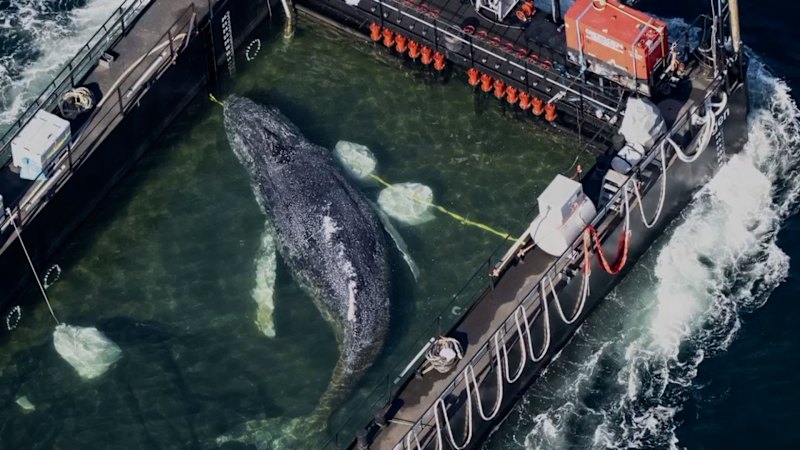
Moving a multi-ton biological entity requires specialized rigging to avoid further injury. Using standard ropes or nets causes focal pressure points that can snap bones or lacerate skin. The rescue utilized wide-mesh slings designed to distribute weight across the largest possible surface area.
The transport phase involves a "Cost Function of Time vs. Trauma." Every minute the whale is in the air or on a transport vessel, the risk of shock increases. The logistics chain must be synchronized so that the transition from the beach to the transport cradle, and then to the release site, happens without a "dead stop" in the workflow.
3. Re-entry and Post-Release Equilibrium
Release is not as simple as dropping the animal back into deep water. A whale that has been stranded often suffers from disorientation and "swim bladder" issues—metaphorically speaking—as its equilibrium and buoyancy control are skewed by hours of terrestrial pressure. Rescuers must support the animal in the water (the "acclimation phase") until it regains enough muscle tone and orientation to surface for air autonomously.
Variables Influencing Post-Release Viability
The success of the "Timmy" operation is measured not by the moment the whale swam away, but by its long-term survival in the wild. Several hidden variables dictate this outcome:
- Lactic Acid Thresholds: If the whale's blood pH dropped too low during the stranding due to anaerobic metabolism, late-stage cardiac failure can occur days after release.
- Acoustic Environment: High levels of anthropogenic noise (shipping, sonar) can interfere with the whale's navigation, potentially leading to a "re-stranding" event.
- Social Integration: For a juvenile, the proximity of its pod or a surrogate group is vital. A solitary release in an unfamiliar territory significantly lowers the probability of long-term caloric intake and predator defense.
The Economic and Scientific Utility of Rescue Operations
Critiques of these operations often focus on the high financial cost per specimen. However, from a data-driven perspective, these rescues serve as critical data acquisition events.
Biological Data Harvesting
Every stranding provides a rare opportunity to collect blood samples, skin biopsies, and respiratory exudate. This data offers a snapshot of the health of the broader population and the presence of pathogens or pollutants in the local ecosystem. The "Timmy" case allowed for the attachment of a satellite tag, which converts the rescued animal into a mobile sensor for oceanographic data, tracking temperature gradients and migration patterns that are otherwise difficult to monitor.
Testing Modular Response Systems
The rescue serves as a stress test for rapid-response infrastructure. The coordination between local authorities, non-profits, and federal agencies provides a blueprint for managing larger environmental disasters, such as oil spills or mass strandings caused by naval exercises.
Structural Bottlenecks in Current Rescue Models
Despite the success of this specific event, the global capacity for megafauna rescue remains constrained by two primary bottlenecks.
The Geographic Gap: Most strandings occur in remote areas where the transit time for specialized equipment (slings, heavy-lift cranes, and veterinary teams) exceeds the animal's survival window. Unless modular rescue kits are decentralized and cached in high-risk zones, the survival rate will remain tied to the proximity of major urban centers.
The Knowledge Asymmetry: There is a lack of standardized protocols for different species. A technique that works for a juvenile whale may be lethal for a different species with different skeletal densities or metabolic rates. The "Timmy" rescue utilized a specific "sling-and-float" method that is currently the gold standard but requires further refinement for larger, adult specimens.
Strategic Action for Marine Resource Management
To move beyond reactive, one-off rescues, maritime agencies must pivot toward a predictive model. This involves:
- Deployment of Real-time Hydrophone Arrays: By monitoring the acoustic signatures of pods near shallow-water "traps," authorities can deploy acoustic deterrents (pingers) to steer whales away from danger before a stranding occurs.
- Investment in Amphibious Transport Tech: Current reliance on cranes and flatbed trucks limits rescue efforts to accessible beaches. Developing air-cushion vehicles or heavy-lift drone swarms could allow for extraction from rocky or marshy terrain where vehicles cannot tread.
- Mandatory Satellite Integration: Every rescued and released animal should be fitted with standardized, high-frequency telemetry tags. The resulting dataset will allow for the creation of a "Survival Probability Matrix," helping rescuers determine when an intervention is a viable use of resources and when it is a prolonging of inevitable mortality.
The path forward lies in treating these events as high-stakes engineering problems. The successful release of this whale was a triumph of applied physics over biological collapse, proving that with the right mechanical leverage and physiological monitoring, the "gravity trap" of the coastline can be overcome.