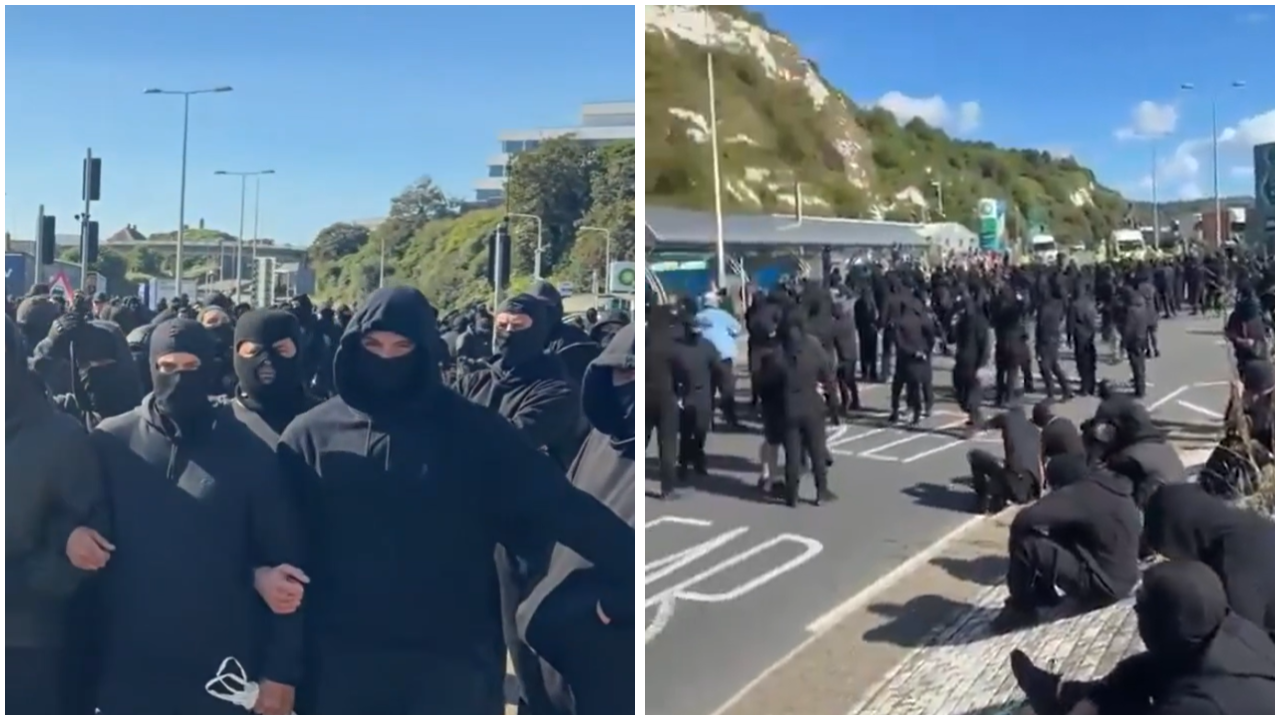
The Port of Dover handles a disproportionate volume of frictionless trade and passenger movement between the United Kingdom and continental Europe, functioning as a critical node in a hyper-optimized supply chain. When physical blockages disrupt this threshold, the economic toll is not linear; it compounds exponentially through logistics networks. The recent incident involving masked demonstrators blocking access roads while local law enforcement exhibited delayed intervention exposes fundamental flaws in infrastructure resilience, response coordination, and border security architecture.
Understanding this event requires moving past superficial political framing to examine the structural mechanics of port logistics, the operational constraints governing police deployment, and the cascading failure modes that occur when regional choke points face targeted civil disruption. Recently making waves lately: Inside the Pacific Airpower Pivot That is Rewriting the Rules of Modern Combat.
The Structural Fragility of Linear Trade Corridors
Ports like Dover operate on strict temporal efficiencies. Unlike decentralized manufacturing hubs that can absorb localized delays through buffer stock, roll-on/roll-off ferry operations depend on continuous vehicle velocity. Every minute a truck spends idling on the approach road to the Eastern Docks reduces terminal throughput capacity, creating a localized supply shock that travels upstream into manufacturing schedules and retail distribution centers across the United Kingdom.
The geography of Dover compounds this vulnerability. Hemmed in by chalk cliffs and constrained by legacy road infrastructure, the port lacks alternative arterial bypasses. When access routes are compromised by external actors, the system possesses zero spatial redundancy. Additional information on this are covered by Associated Press.
[Targeted Blockade] ---> [Arterial Choke Point] ---> [Idling Fleet Capacity] ---> [Upstream Supply Chain Lag]
This structural dependency means that small-scale disruptions—such as a coordinated group blocking a primary roundabout—can achieve disproportionate tactical impact. The vulnerability is not merely physical; it is architectural. A logistics network reliant on a single point of failure without dynamic rerouting options will inevitably experience systemic paralysis when confronted with determined disruption.
The Cost Function of Delayed Law Enforcement Interventions
In public order management, response latency is the primary variable determining whether an event remains a localized nuisance or escalates into a systemic crisis. The delayed police reaction during the Dover port blockade highlights an operational disconnect between risk assessment and field execution.
Standard operating procedures for managing civil disobedience near critical national infrastructure typically mandate rapid dispersal to preserve economic continuity. When law enforcement agencies exhibit hesitation, tactical actors exploit the operational vacuum. The cost function of this delay can be modeled across three dimensions:
- Temporal Expansion: Every incremental minute of police inaction increases the time required to clear the roadway, as backed-up vehicles lock the physical space and prevent response units from physically reaching the friction point.
- Economic Burn Rate: Commercial freight operators incur quantifiable losses per vehicle hour, encompassing driver wage regulations, refrigeration fuel consumption for perishable goods, and contractual penalties for missed ferry slots.
- Deterrence Decay: Delayed interventions signal vulnerability to potential imitators, lowering the perceived threshold and risk associated with launching secondary blockades at alternative transport nodes such as Holyhead, Felixstowe, or the Channel Tunnel terminal at Folkestone.
The root cause of slow response times in these scenarios is rarely a lack of tactical capability; rather, it stems from bureaucratic friction between local constabulary jurisdictions, port police entities, and national strategic oversight committees. When lines of command blur, tactical initiative stalls.
Border Security and the Friction of Ideological Mobilization
Anti-immigration protests targeting transit hubs represent a tactical shift from traditional static demonstrations toward dynamic infrastructure interference. By leveraging the symbolic weight of the border, organizers utilize the port as a high-visibility stage to project political grievances onto national commerce.
This creates a complex operational matrix for security planners. Border zones are heavily regulated spaces governed by statutory powers distinct from municipal highways. However, the immediate access roads leading to port perimeters often fall under the jurisdiction of regional police forces who must balance public assembly rights with economic protection mandates.
- Jurisdictional Boundaries: Division of labor between port authorities, local police forces, and national security agencies creates communication lag during rapid-onset disruptions.
- Intelligence Deficits: Intelligence collection on ad-hoc, digitally coordinated protest groups frequently lags behind their physical mobilization capacity, leading to reactive deployments rather than preemptive containment.
- Proportionality Dilemmas: Tactical commanders face legal thresholds regarding the use of force and rapid dispersal tactics against domestic civilian groups, complicating high-speed clearance operations.
These factors combine to form a defensive posture that is structurally ill-equipped to handle agile, single-issue agitators who prioritize symbolic disruption over traditional negotiation.
Upstream and Downstream Systemic Repercussions
The ripple effects of a blocked transport corridor extend far beyond the immediate vicinity of the white cliffs. Just-in-time manufacturing models utilized by automotive and pharmaceutical sectors depend on predictable transit windows across the English Channel. When these windows close unpredictably, the economic shock transmits through inventory management systems.
Warehousing facilities near Dover experience immediate congestion as diverted trucks attempt to park safely, overflowing local laybys and residential streets. Simultaneously, ferry operators face scheduling deregulation. Vessels must either depart half-empty to maintain timetable integrity or wait for delayed freight, disrupting the return leg capacity from Calais and Dunkirk.
This feedback loop demonstrates that border blockades are not merely localized public order issues; they are macroeconomic disruptions that test the stress limits of international trade agreements and national supply chain integrity.
Strategic Realignment for Critical Infrastructure Defense
Securing critical transport arteries against targeted disruption requires an operational overhaul that transcends traditional public order policing. Border access management must be treated with the same strategic gravity as digital cybersecurity or physical utility protection.
Law enforcement agencies must establish pre-designated exclusion zones around all primary trade corridors, backed by pre-authorized rapid clearance mandates that bypass traditional bureaucratic escalation chains. Furthermore, intelligence-sharing frameworks between local forces and national border intelligence units must be automated to detect digital mobilization patterns before physical blockades materialize on tarmac.
The primary objective must be the reduction of response latency to near zero. Until transport authorities eliminate the tactical window that allows outside actors to paralyze critical trade nodes, the United Kingdom’s supply chains will remain structurally vulnerable to low-cost, high-impact blockades.