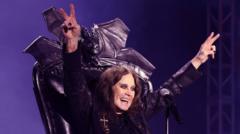
The rock and roll museum circuit loves a good relic. When news broke that Ozzy Osbourne’s famous concert throne—the velvet-draped, gothic seat he used to command the stage during his 2011 tour while recovering from a broken hand—was heading to a public exhibition, the music press reacted with the usual Pavlovian nostalgia. They treated it like a sacred piece of heavy metal history. A symbol of resilience. The Prince of Darkness refusing to back down.
They got it entirely wrong. Recently making waves lately: The End of the Carter Era on EastEnders Proves Long Running Soaps Are Out of Road.
Putting Ozzy's throne in a glass case isn't a celebration of rock's enduring power. It is an accidental autopsy of its greatest illusion.
For forty years, the music industry has sold a specific myth: that rock stardom is an unscripted, chaotic explosion of pure rebellion. We are trained to look at a prop like Ozzy’s throne and see a warrior’s stool. But if you have spent any time working behind the scenes in live entertainment touring logistics, or managing the brutal physical realities of heritage acts, you know the truth is far colder. More insights regarding the matter are covered by Variety.
That throne isn't a symbol of rebellion. It is a highly optimized piece of workplace accommodation designed to protect a massive financial asset.
The Industrial Reality of the "Rebel"
Live music is no longer an chaotic, drug-fueled road trip. It is a high-stakes corporate operation. When a legacy artist goes on the road, tens of millions of dollars are riding on their ability to stand under a spotlight for 90 minutes.
Consider the mechanics of a modern arena tour. Insurance underwriters evaluate the artist's health with the scrutiny of an actuary looking at a cargo ship. Promoters lock in millions in non-refundable venue deposits. Merchandise companies print millions of dollars in inventory that becomes worthless the second a date is canceled.
When Ozzy broke his hand and required surgery in 2011, the "rock" response would have been to cancel the tour, stay home, and flip off the cameras. The corporate reality was that a cancellation would have triggered a catastrophic domino effect of financial liabilities across multiple international promoters.
Enter the throne.
The throne was a brilliant piece of staging misdirection. It took a genuine medical necessity—the fact that an aging, injured performer physically could not pace a 100-foot stage for a full set—and packaged it as a theatrical choice. It allowed the audience to believe they were seeing something dark and regal, while the production crew breathed a sigh of relief because the insurance policy remained valid.
The Fragility of Heritage Touring
We refuse to look at the math behind our musical icons. The entire multi-billion-dollar nostalgia touring market relies on a collective agreement between fans and artists to ignore gravity, biology, and time.
Look at the heavy hitters of the live industry over the last decade:
- The Rolling Stones traveling with an integrated medical team and a custom-built, climate-controlled backstage environment.
- Axl Rose borrowing Dave Grohl's custom-built guitar throne in 2016 after fracturing his foot right at the start of the Guns N' Roses reunion tour.
- Phil Collins performing his final Genesis shows entirely from a chair, turning a stadium rock show into an intimate, if heartbreaking, living room session.
Every single one of these instances is framed by the media as "the show must go on" heroism. But let's look at the downside of this contrarian truth: when we demand that these artists perform through severe physical decay, we are transforming live music from an art form into a high-end curiosity show. We are no longer paying to see a performance; we are paying to witness survival.
The industry hides this under layers of gothic velvet and laser shows. Dave Grohl’s throne had flashing lights and moving guitar necks. Ozzy’s throne looked like it was ripped from a Dracula set. The flashier the chair, the bigger the distraction from the underlying vulnerability.
Dismantling the Fan Premise
Go to any online forum and look at what people ask about these objects. The questions are always identical.
Did Ozzy use the throne because he wanted to look cool?
No. He used it because his body was breaking down after decades of unmatched physical punishment and an acute injury. The aesthetic was built around the limitation, not the other way around.
Does displaying the throne preserve rock history?
It preserves the marketing of rock history. If museums wanted to show the reality of modern touring, they wouldn't just display the throne. They would display the spreadsheets, the cortisone injections, the physical therapy schedules, and the ironclad cancellation clauses in the Live Nation contracts.
When we isolate these props and treat them as holy relics, we reinforce a false narrative that these artists are superhuman. They aren't. They are workers inside an incredibly demanding industry that does not allow them to retire because their catalog value is too high to let sit idle.
The Actionable Truth for Music Fans
Stop buying into the myth of the unbreakable icon. The next time you buy a $300 ticket to see a legacy act perform from a piece of custom furniture, change your perspective.
Do not look at the chair as a sign of power. Look at it as a testament to the sheer scale of the economic machine behind the artist. Demand honesty from the performances you consume. The most rock-and-roll thing an aging artist can do isn't to build a shinier throne to hide their frailties; it is to let the lights go down, walk away from the arena circuit, and let the music exist on the records where time can't touch it.
Everything else is just expensive upholstery.