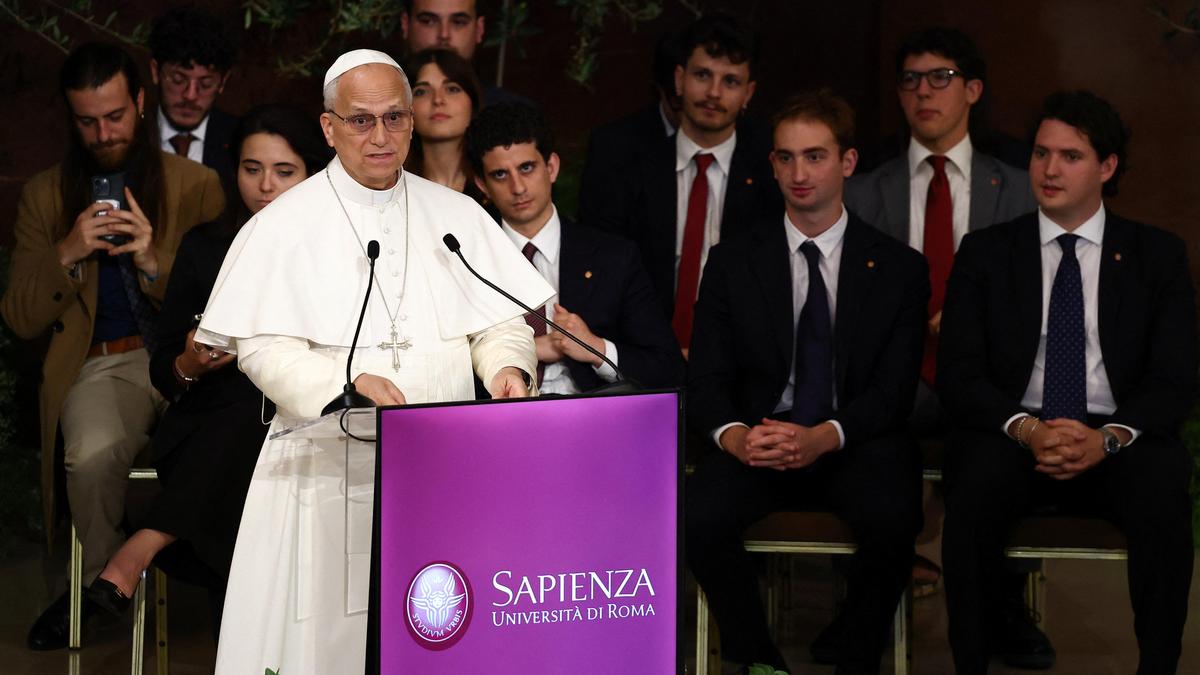
Pope Leo calls it a "betrayal." The critics call it a "waste." I call it the price of being able to speak your mind without a foreign tank parked in your driveway.
The latest outcry against European military spending relies on a comfortable, post-Cold War delusion: that diplomacy is a standalone engine. It isn't. Diplomacy is the chrome trim on a heavy-duty chassis of hard power. When the Pope or the ivory-tower pacifists decry the shift toward a 2% GDP minimum for NATO members, they aren't advocating for peace; they are advocating for a vacuum. And in geopolitics, vacuums are filled by the most violent actors in the room.
If you think a strongly worded letter from Brussels can stop a hypersonic missile, you haven't been paying attention to the last three years of continental history.
The Diplomacy Fallacy
The "lazy consensus" argues that every Euro spent on a Leopard 2 tank is a Euro stolen from a diplomat's briefcase. This is fundamentally backwards.
Diplomacy without a credible military threat is just "asking nicely." History is littered with the corpses of nations that tried to substitute moral high ground for a fortified border. To suggest that military investment "betrays" diplomacy is to misunderstand the very nature of statecraft.
Look at the Budapest Memorandum. Ukraine was promised security in exchange for giving up its nuclear arsenal. The diplomacy was impeccable. The signatures were authentic. The paper was high-quality. But because there was no military teeth behind the Western guarantees, the paper became scrap the moment a neighbor decided to ignore it.
Why the "Bread vs. Bullets" Argument is Poison
Critics love to pivot to the opportunity cost. They say we could fund schools, hospitals, and green energy with the billions flowing into defense contractors.
It’s an emotional trap.
- Safety is the Precondition: You cannot run a hospital in a war zone. You cannot educate children in a state that has ceased to exist. Defense spending is the insurance premium on the entire social contract.
- Economic Stimulus: Unlike foreign aid that often vanishes into the ether, defense spending is an industrial policy. It drives R&D in materials science, aerospace, and cybersecurity.
- The Deterrence Discount: The cost of a war is roughly $1,000$ to $10,000$ times higher than the cost of the hardware required to prevent it. Spending €300 billion now to avoid a €30 trillion total war is the only fiscally responsible move a leader can make.
The Mythology of European Neutrality
For decades, Europe outsourced its security to the United States. We lived in a protected bubble where we could afford to lecture the world on "soft power" because American carrier strike groups were doing the heavy lifting.
That era is over.
The U.S. is pivoting to the Indo-Pacific. The "Security Umbrella" is folding. If Europe doesn't build its own "Iron Dome" of integrated defense, it becomes a playground for regional hegemons.
The Industry Insider’s View
I’ve seen how these procurement cycles work. I’ve sat in rooms where officials try to balance "ethical investing" with the reality of an aging fleet of fighter jets. The biggest mistake isn't spending the money—it's spending it inefficiently.
The real betrayal isn't the budget size; it's the fragmentation.
- Europe currently operates over 20 different types of fighter jets.
- The U.S. operates about 6.
- Europe uses nearly 30 different types of tanks.
The inefficiency is staggering. If the Pope wanted to be useful, he wouldn't attack the spending; he would attack the protectionism that keeps European nations from standardizing their equipment. We are spending more to get less because every country wants their own domestic factory to build a specific bolt for a specific wing.
Hard Power is the Only Language Aggressors Speak
Let’s address the "People Also Ask" obsession with "de-escalation."
The premise that "buying weapons causes war" is a classic causal inversion. People buy umbrellas because it’s raining; the umbrella doesn't cause the storm.
When a revisionist power looks across the border, they don't look for the most "diplomatic" neighbor. They look for the softest target.
The Logic of the Thucydides Trap
$Power = (Economic Capacity + Military Capability) \times Political Will$
If you have the economic capacity but zero military capability, your power is effectively zero in a crisis. You become a resource to be harvested by those who have the guns.
By increasing military spending, Europe is finally signaling Political Will. This is the most "pro-peace" move possible. It tells potential invaders that the cost of an incursion is higher than any possible benefit. That is how you maintain a long-term peace. You make war an "unprofitable" venture.
The Moral High Ground is a Graveyard
There is a specific type of arrogance in the pacifist position. It assumes that our values—human rights, democracy, free speech—are self-evident and self-sustaining.
They are not. They are anomalies.
The vast majority of human history has been defined by the "strong do what they can, and the weak suffer what they must." The last 80 years of European peace were a historical fluke maintained by massive military overmatch.
To decry the return to military readiness as a "betrayal" is to spit on the graves of those who built the very walls we live behind. It is a luxury belief held by those who have never had to defend anything more significant than a Twitter handle.
Stop Asking for Peace. Start Building Strength.
If you want to prevent the next great European conflict, you don't do it by cutting the defense budget. You do it by:
- Mass-producing ammunition: Strategic depth is measured in shells, not speeches.
- Integrating Command: A unified European defense force is the only way to achieve the scale necessary to deter a superpower.
- Investing in "Unsexy" Tech: Electronic warfare, logistics, and drone swarms matter more than ceremonial units.
The "Peace Dividend" was spent long ago. We are now in the era of the "Security Debt." And like any debt, if you don't pay the interest now, the collectors will eventually come for the principal.
Don't listen to the moralists who haven't updated their worldview since the 1990s. They are peddling a fantasy that will get people killed.
Strength isn't a betrayal of diplomacy. It is the only thing that makes diplomacy possible.
Build the tanks. Buy the jets. Secure the border.
Anything else is just a suicide note written in Latin.