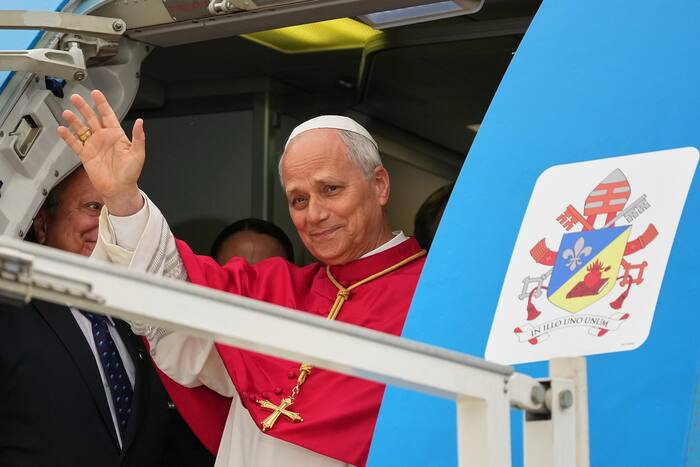
When Pope Leo XIV stepped off his plane in Lima on November 11, 2026, the official narrative wrote itself before the wheels even stopped turning. Cable networks and wire services immediately framed the six-day tour as an emotional triumph: the first U.S.-born pontiff, Chicago native Robert Francis Prevost, returning to the South American nation where he spent decades as an Augustinian missionary and bishop, obtained dual citizenship in 2015, and became Peru's adopted son. By the time he departed on November 16, Peru's Ministry of Foreign Trade and Tourism reported that nearly 1.1 million people had turned out across Lima, Chiclayo, Cusco, Pucallpa, and Santa Cruz, generating an estimated 680.2 million soles (roughly 181 million euros) in economic activity.
Look past the cheering crowds and commemorative ice-cream banners in Chiclayo, however, and a far sharper reality comes into focus. This was never just a sentimental reunion. Behind the brass bands and stadium vigils, Pope Leo's return to Peru functioned as a high-stakes stress test for both a deeply fractured republic and a Catholic hierarchy still struggling to settle its own moral debts. While mainstream coverage treated the trip as a monolithic celebration, three underlying tensions defined what actually happened on the ground: an awkward political handshake with a dynasty Prevost once opposed, an unresolved reckoning over clergy abuse and stalled financial reparations, and a Vatican strategy using Peru to project Latin American authenticity after the death of Pope Francis.
The Dusty-Boots Bishop Versus the Presidential Palace
To understand why Peruvians reacted to Leo XIV with a fervor that Pope Francis never experienced even in his native Argentina, you have to look at the mechanics of Prevost's actual career. Francis never returned to Buenos Aires after his 2013 election, wary of becoming a partisan football in Argentine politics. Prevost had no such hesitation about Peru, largely because his reputation there was forged outside the capital's salons.
Arriving as a young missionary in 1985 and later serving as Bishop of Chiclayo from 2015 to 2023, Prevost built institutional trust through logistics rather than rhetoric. During the COVID-19 pandemic—which killed more than 219,000 people in Peru, giving the nation one of the highest per-capita death rates in the world—hospitals ran out of breathable air. While state procurement stalled, Prevost worked through Caritas to raise $380,000, purchasing two oxygen plants and personally flying in helicopters to deliver supplies to isolated northern communities. When hyperinflation drove roughly 1.6 million Venezuelan migrants into Peru, he established a diocesan commission in Chiclayo that absorbed thousands of destitute families.
That street-level credibility collided head-on with Lima's political reality the moment Leo arrived at the Government Palace. Waiting to greet him with state honors was President Keiko Fujimori.
The optics were thick with historical irony. During the 1990s, when Keiko's father, Alberto Fujimori, ruled Peru with an iron fist—and was later convicted of murder, kidnapping, and corruption—then-Father Robert Prevost was an outspoken critic of both the Shining Path insurgents and the Fujimori government's human rights abuses, publicly calling on the elder Fujimori to ask for forgiveness. By November 2026, Keiko Fujimori had won the presidency despite her own past legal battles, presiding over a country suffering from what sociologists describe as a total collapse of political representation. Even as public budgets expanded over the previous decade, Peru's educational infrastructure gap widened by 40 percent, while extortion and violent crime surged across urban neighborhoods.
At the palace, Fujimori urged the pope to help the country pursue "national reconciliation"—a phrase that carries heavy political baggage in Lima, often deployed by conservative factions to close the book on past state crimes. Leo refused to play prop. Rather than endorsing the administration's framing, he used his address at the Gran Teatro Nacional to warn authorities that Peru's young people were being denied a future, and later told Peru's clergy that reconciliation requires institutions to humble themselves and accept responsibility for the wounds they have inflicted. In a country where citizens view Congress and the executive branch with overwhelming distrust, the pope's refusal to validate the political establishment was precisely what kept his moral authority intact.
The Unfinished Business of Sodalitium
If the mainstream press missed the political subtext in Lima, it nearly buried the sharpest conflict of the entire visit: the lingering fury of survivors abused by Sodalitium Christianae Vitae.
Before his election to the papacy in May 2025, Prevost played a central role in dismantling Sodalitium, an ultra-conservative Peruvian lay society founded in 1971 that became notorious for systemic psychological, physical, and sexual abuse. Because Sodalitium drew heavily from Lima's interconnected upper class, Prevost's push to hold the group accountable earned him fierce enemies among traditionalist Peruvian clerics and wealthy donors, who mounted smear campaigns against him before and after his move to Rome. Pope Francis formally suppressed the group in 2025.
Suppression on paper, however, is not justice in bank accounts. On November 12, behind the closed doors of the Apostolic Nunciature in Lima, Leo spent more than an hour meeting individually with six abuse survivors, several of them former Sodalitium members. Inside the room, participants like Chilean journalist and survivor Camila Bustamante described a pontiff who listened with visible pain and promised to examine complaints involving other religious congregations that had never been investigated.
Outside the nunciature, patience had already run out. Prominent survivor Pedro Salinas and other victims pointed out that since meeting with Prevost in 2025 when he was still a cardinal, the Vatican's liquidation and reparations process—overseen by Spanish investigator Jordi Bertomeu—had been shrouded in silence. While Sodalitium's vast real estate and cemetery holdings remained entangled in legal structures, victims were still waiting for finalized compensation.
- Institutional accountability: Survivors warned that emotional apologies during a papal tour mean nothing without binding timelines for financial reparations.
- Episcopal resistance: Many Peruvian bishops remain deeply reluctant to confront wealthy Catholic networks, forcing Leo to publicly lecture the hierarchy in Lima's cathedral to stop judging people by rank or social status and to accompany victims directly.
- The credibility gap: By choosing to meet survivors on his very first full day in Lima, Leo signaled that the issue would not be swept under the rug, yet his pontificate now faces a measurable deadline in Peru. If reparations remain stalled six months from now, the goodwill generated by his homecoming will evaporate among the very people who once saw him as their fiercest Vatican ally.
Why Rome Needed Peru More Than Chicago
Zoom out from Lima and Chiclayo, and the strategic logic of this 12-day South American swing—which also included stops in Uruguay and Argentina—becomes unmistakable.
When cardinals elected an American pope in May 2025, skeptics across the Global South worried that the Vatican was pivoting back toward North Atlantic wealth and institutional caution. Leo XIV has spent the first eighteen months of his papacy dismantling that assumption, and Peru is his primary Exhibit A. Despite being born on Chicago's South Side and graduating from Villanova, Leo did not choose the United States for his flagship 2026 homecoming. He chose the dusty roads of northern Peru, the Andean heights of Cusco, and the Amazonian river city of Pucallpa.
The itinerary was calibrated to establish his bona fides as a pastor of the global periphery. In Zaña, a historically Afro-Peruvian town an hour outside Chiclayo, he walked through modest streets where he had baptized children years earlier. In Cusco's Saqsaywaman archaeological park, he met with Indigenous communities. In Pucallpa, he highlighted Amazonian ecological and missionary struggles. Throughout the journey, he tied local pastoral work to broader encyclical themes, warning against unbridled economic extraction and arguing that artificial intelligence and modern technology must never reduce human beings to mere data points.
At the same time, the economic windfall of the trip exposed a stark contrast between Vatican symbolism and Peruvian reality. Tourism officials celebrated the $181 million injection into hotels, restaurants, and transport operators, noting that more than 231,000 international visitors traveled to Peru for the events. Yet for the day-trippers and working-class families who slept on sidewalks in Lima and Chiclayo just to catch a glimpse of the popemobile, the celebration was an act of spiritual survival in a state that consistently fails to deliver basic security or healthcare.
The Real Measure of a Homecoming
A papal visit always leaves behind two competing records. One is preserved in official photography: Leo crowning the image of the Immaculate Virgin in Chiclayo Cathedral, wiping away tears as Peruvians sang their national anthem, and telling a crowd in St. Peter's Square days later that in northern Peru he truly felt at home.
The other record is written in slow, unglamorous institutional follow-through. Peruvians turned out by the million not because they are naive about the Catholic Church's flaws, but because Robert Prevost spent decades proving he would show up when oxygen ran out and migrants arrived on foot. Now that the popemobile has returned to Rome, nostalgia will no longer be enough. Whether Leo XIV's return to his second homeland is remembered as a genuine turning point or merely a well-choreographed pause from national dysfunction depends entirely on what happens next in the diocesan offices of Lima—when the cameras are gone, the streets are quiet, and the survivors of Sodalitium are still waiting for the Church to pay its debts.