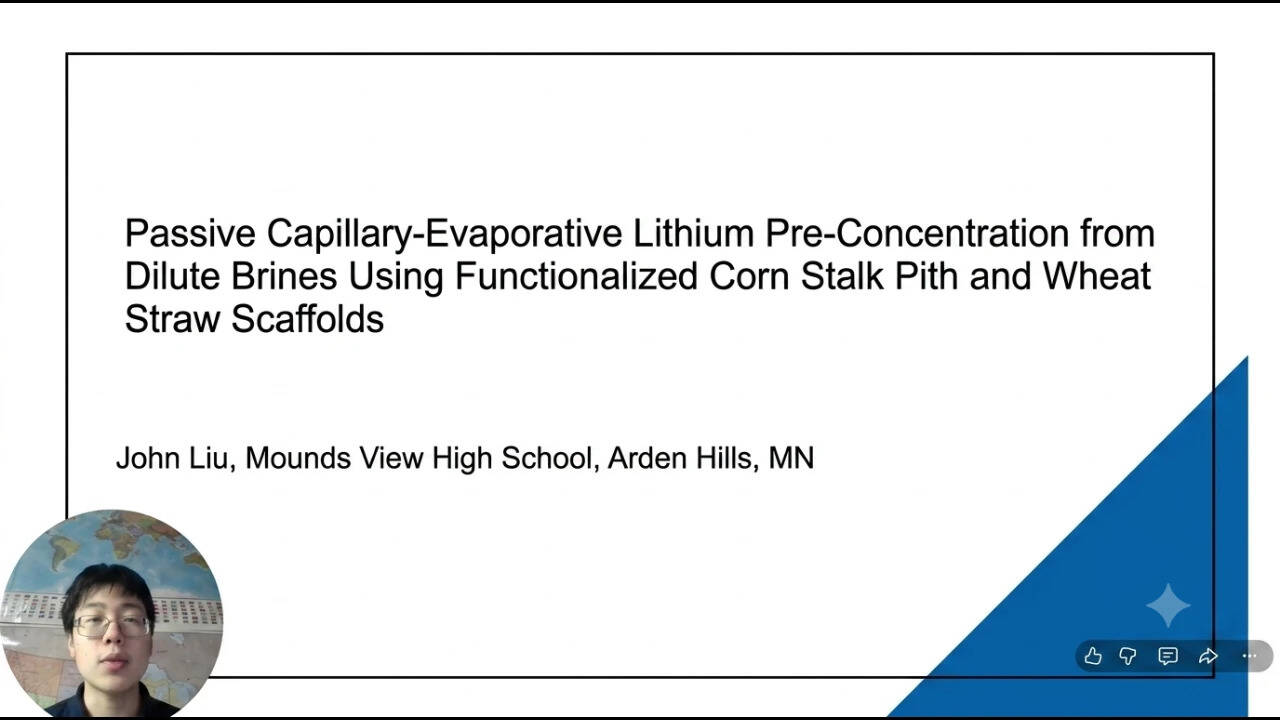
The bottleneck of global lithium supply chains is not absolute resource scarcity, but thermodynamic dilution. Extracting lithium from low-concentration aqueous matrices—such as geothermal brines, oilfield produced water, and continental salars—requires mobilizing massive volumes of liquid, leading to heavy thermal or chemical expenditures. Conventional evaporation ponds demand vast acreage and multi-month residence times, whereas direct lithium extraction methods face severe capital cost constraints and scaling barriers.
Addressing this kinetic and thermodynamic bottleneck demands an evaluation of decentralized preconcentration architectures. Recent investigative work into agricultural waste utilization, specifically focusing on functionalized corn stalk pith and wheat straw scaffolds for passive capillary-evaporative extraction, shifts the focus from high-energy chemical processing to material-driven fluid transport.
The Thermodynamics of Dilute Brine Extraction
Raw aqueous lithium sources often present concentrations ranging from tens to a few hundred parts per million. Direct chemical precipitation or adsorption at these low concentrations exhibits poor mass-transfer efficiencies because the chemical activity of lithium ions is minimal relative to competing background ions like sodium, magnesium, and calcium.
To make downstream sorbents or membranes economically viable, the feed solution must undergo preconcentration. Active preconcentration via reverse osmosis or multi-effect distillation imposes severe energy penalties, neutralizing the environmental utility of the extracted lithium. The operational objective, therefore, is to decouple concentration gain from external power inputs by maximizing passive interfacial evaporation coupled with directional mass transport.
Structural Mechanics of Plant-Derived Scaffolds
Agricultural residues, notably corn stalk pith and wheat straw, possess hierarchical porous networks optimized by nature for fluid distribution. Corn stalk pith consists of a low-density cellular parenchyma tissue characterized by high porosity and interconnected micro-channels. These biological structures exhibit natural capillary action, defined by the Young-Laplace equation, which drives liquid upward against gravity through microscopic lumens without mechanical pumping.
[Dilute Brine Source]
       │
       ▼ (Capillary Action via Micro-Channels)
[Functionalized Plant Scaffold (Corn Pith / Wheat Straw)]
       │
       ▼ (Interfacial Solar/Ambient Evaporation)
[Pre-Concentrated Lithium Eluent Matrix]
When deployed as structural scaffolds, these materials are chemically functionalized to modify surface energy and ion-binding affinities. The functionalization process alters the native lignocellulosic matrix, introducing active sites that selectively retard or guide ionic migration while maintaining high evaporation rates across the solid-liquid-vapor interface.
Fluid Transport and Evaporative Flux
The efficacy of a plant-based scaffold rests on two coupled transport phenomena:
- Capillary Rise Velocity: The rate at which the aqueous matrix moves through the cellular architecture, governed by the fluid's surface tension, contact angle, and effective capillary radius.
- Vaporization Kinetics: The rate of solvent departure from the scaffold surface, which determines the accumulation rate of target lithium ions within the residual liquid phase.
By engineering the tortuosity and porosity of the corn stalk pith, the system prevents salt-crust accumulation—a primary failure mode in traditional solar evaporation ponds that blocks light and arrests evaporation. The continuous wicking mechanism ensures a dynamic equilibrium where moisture is constantly supplied to the evaporation front, concentrating the brine locally within the scaffold matrix.
Economic and Operational Constraints
While repurposing agricultural byproducts introduces an elegant circular economy vector, translating biomaterial scaffolds from bench-scale assays to industrial throughput exposes distinct operational limits:
- Scaffold Degradation: Lignocellulosic materials undergo biological and chemical breakdown over extended exposure to saline and alkaline solutions, limiting operational lifespans before structural collapse occurs.
- Selectivity Ratios: While preconcentration increases lithium concentration, competing divalent ions such as magnesium ($Mg^{2+}$) frequently co-concentrate unless the scaffold's functionalized groups feature strict ionic exclusion thresholds.
- Geographic and Climatic Dependency: Passive evaporative systems remain constrained by ambient relative humidity, temperature, and solar irradiance, making them unviable in high-humidity or sun-deficient operating theaters.
Scaling this architecture requires shifting the material preparation from batch-level functionalization to continuous extrusion and chemical modification lines capable of producing uniform scaffold sheets. Integration into existing mining operations hinges on pairing these passive preconcentration modules directly ahead of standard sorbent columns, thereby reducing the volume of water processed by downstream infrastructure by an estimated order of magnitude.
Future deployment vectors must focus on enhancing the wet-state mechanical strength of the lignocellulosic matrix through cross-linking agents, alongside optimizing the surface charge density to maximize lithium-to-impurity separation factors during the initial wicking phase.
WSU Researchers on Corn Protein for Batteries
This video provides additional context regarding how agricultural byproducts and plant proteins are engineered to improve the performance and structural stability of lithium-based energy technologies.
http://googleusercontent.com/youtube_content/1


