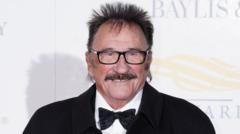
Every entertainment desk in Britain just published the exact same press release dressed up as journalism. They saw the headline—Paul Chuckle making his stage debut at the National Theatre—and immediately reached for the dusty box of nostalgic clichés. Heartwarming. Unlikely. A beloved national treasure trading slapstick ladders for high-brow prestige.
They got the entire story backward.
The lazy consensus paints this casting as a charity gig for a retired children's entertainer or a quirky stunt by a subsidised arts institution trying to look accessible. Both takes miss the brutal economics and mechanical realities of live theatre. Paul Elliott—the man behind the moustache—is not stepping into the National Theatre to learn how to act. He is walking onto the South Bank because modern prestige theatre has forgotten how to command a room, and the people running it desperately need someone who spent fifty years surviving the hardest classrooms in show business.
The Lie of the "Low-Brow" Clown
Drama school graduates love to talk about subtext. They spend three years in black-box studios dissecting Chekhov and agonising over internal motivation. Meanwhile, a working-class variety comic spends four decades playing twice-nightly summer seasons in Great Yarmouth, dodging beer glasses in northern working men's clubs, and keeping 2,000 screaming kids from tearing the seats out during a December pantomime matinee.
Ask any veteran stage director which performer is more technically proficient. The answer is never the kid fresh out of RADA.
Physical comedy—specifically the rhythmic, call-and-response slapstick that powered ChuckleVision for twenty-one series—is governed by mathematical precision. There is no fourth wall to hide behind. There is no moody lighting to manufacture gravitas. If your timing is off by a quarter of a second, the gag dies in silence. If your spatial awareness fails, someone gets hit in the face with a plank of wood for real.
I have sat in West End production meetings where producers burned through millions trying to fix a sagging second act with expensive set automation and ambient sound design. The problem was never the scenery. The problem was actors who could not project intent past the third row without a body mic.
The Mechanics of Earned Authority
When you watch archival footage of the Chuckle Brothers—Paul and his late brother Barry—strip away the colourful waistcoats and the catchphrases. Look at the footwork. Look at the eye-lines. What you are watching is pure commedia dell'arte filtered through British music hall tradition.
- Rhythmic Pacing: Slapstick relies on tempo rubato—speeding up and slowing down the physical action to manipulate the audience's anticipation before a fall or a collision.
- Status Play: Classic double acts survive on rigid status dynamics. Barry played the perpetually flustered instigator; Paul played the compliant, literal-minded foil whose blank obedience caused the catastrophe.
- Silence Control: A seasoned panto comic knows how to hold a pause while an audience laughs, riding the wave down to the exact decibel where the next line lands cleanly.
Drama schools teach actors to ignore the audience. Variety halls teach performers to conduct them like an orchestra. Calling Paul Chuckle's National Theatre debut a "leap into serious acting" insults the hardest technical discipline in live entertainment.
Why the National Theatre Actually Made This Call
Let us look at the institution itself. Britain's subsidised theatre sector is currently fighting a quiet war for survival. Ticket prices in central London have pushed working-class families out of the stalls. Arts Council England has slashed funding across London while demanding broader demographic reach. At the same time, younger audiences raised on short-form video find traditional three-hour straight plays unbearable.
The National Theatre does not hire a 78-year-old comedy icon out of sheer whimsy. They hire him because he solves three existential problems before the curtain even rises.
First, built-in multi-generational trust. Millions of adults in their thirties and forties grew up watching ChuckleVision after school. They do not view Paul Chuckle as a celebrity; they view him as a family member. When his name appears on a cast list at the South Bank, people who would never normally cross the threshold of a subsidised theatre suddenly buy tickets. That is not dumbing down the repertoire. That is basic audience acquisition that marketing departments spend fortunes failing to replicate.
Second, unmatched stamina. Eight shows a week in a major London house breaks performers half Paul's age. Vocal strain, physical exhaustion, and repetition fatigue routinely derail long runs. A performer who built his career doing two shows a day, six days a week, across provincial touring circuits treats an eight-show week like a holiday.
Third, the death of ironical distance. Modern prestige drama often suffers from a terminal case of self-consciousness. Actors wink at the material. Directors bury simple human emotions under layers of conceptual staging. A music hall veteran does not know how to be ironic about commitment. When Paul Chuckle steps onto a stage, he commits 100 percent to the reality of the scene, whether he is carrying a phantom piano or delivering a dramatic monologue.
The History the Pundits Forgot
Anyone acting shocked by a slapstick comedian crossing into prestige theatre has zero grasp of British stage history. This is not an anomaly. It is the standard career trajectory for our greatest stage actors.
Consider the pedigree. Max Wall spent decades as a eccentric music hall dancer and trouser-dropping comic before delivering a legendary, career-defining performance in Samuel Beckett's Krapp's Last Tape and stealing scenes in John Osborne's The Entertainer. Ken Dodd—a man most critics dismissed as a feather-duster-wielding stand-up—played Malvolio in Twelfth Night at the Liverpool Playhouse to rave reviews because he understood Shakespearean clowns better than any academic. Eric Morecambe and Tommy Cooper were worshipped by Laurence Olivier precisely because Olivier knew he could never replicate their effortless command of a live crowd.
Look at Mark Rylance, widely considered the finest stage actor of his generation. Watch his Tony-winning turn in Jerusalem or his physical work in Twelfth Night. His entire toolkit—the sudden shifts in weight, the weaponised hesitation, the ability to turn a room full of strangers into co-conspirators—is pure clowning.
Theatre purists love to build a brick wall between "art" and "entertainment." The people actually doing the work at the highest level know that wall is imaginary. Beckett wrote Waiting for Godot directly out of the rhythms of Laurel and Hardy. Harold Pinter's famous pauses were lifted straight from the cross-talk acts he watched in Hackney variety theatres as a boy.
The Real Risk Nobody Wants to Mention
Contrarian takes are useless if they ignore the obvious pitfalls. Putting a legendary variety performer inside a heavily scripted, director-driven National Theatre production is not a guaranteed triumph. The collision of two radically different working cultures creates real friction.
In variety and pantomime, the comic is the undisputed boss of the room. If a line is not working on Tuesday night, the comic changes it on Wednesday. If an audience is sluggish, the performer improvises until the energy shifts. The script is a loose framework, nothing more.
At the National Theatre, the text is sacred. Blocking is taped to the floor down to the millimetre. Lighting cues are programmed into computers months in advance. A stage manager watches every entrance on a monitor. If a performer decides to riff for forty-five seconds because the house feels quiet, they throw off the sound cues, ruin the scene transitions, and leave their scene partners stranded in the dark.
There is also the recognition trap. When an audience loves a performer for a specific persona, that goodwill can become a cage. The moment Paul Chuckle walks onto the stage, a portion of the room will expect him to say "To me, to you." If the play is a serious drama or a sharp contemporary satire, the director has to work twice as hard in the first five minutes to break that expectation without alienating the crowd. If they fail, every dramatic beat risks getting swallowed by affectionate giggles from the balcony.
What Casting Directors Need to Learn From This
If you run a theatre company, produce live events, or cast talent for major productions, stop looking at this headline as a novelty piece and start treating it as a blueprint.
- Audit your cast for live-room mileage. Stop hiring exclusively from the same narrow pipeline of drama schools and television procedurals. Look for performers who have survived hostile or distracted rooms—stand-ups, panto veterans, cabaret artists, street performers. They possess spatial instincts that cannot be taught in a rehearsal room.
- Value rhythm over realism. Television acting has infected the stage with mumbled, microscopic naturalism. Theatre is an architectural medium. Hire actors who understand tempo, physical silhouette, and vocal projection.
- Bridge the class divide through casting, not panel discussions. Institutions spend millions on outreach initiatives while keeping their stages stocked with the exact same upper-middle-class voices. Putting working-class entertainment icons into flagship productions does more for genuine cultural inclusion in one night than a decade of strategy documents.
- Respect the craft of the foil. Every creative team is obsessed with hiring loud, dominant leads. Paul Chuckle spent his entire life proving that the person who listens, reacts, and absorbs the chaos is the real engine of any scene.
Stop Patronising the Professionals
The next time a legacy entertainer steps into a prestige venue, spare us the patronising narratives about "unlikely second acts" and "brave leaps out of the comfort zone."
Paul Chuckle spent half a century mastering the physics of human attention in front of the most unforgiving audiences in Britain. He survived the collapse of the variety circuit, dominated children's television for over two decades, and kept working on live stages long after his peers retired to golf courses in Spain.
He does not need the National Theatre to validate his career. The National Theatre needs him to remind their building what an actual showman looks like.


