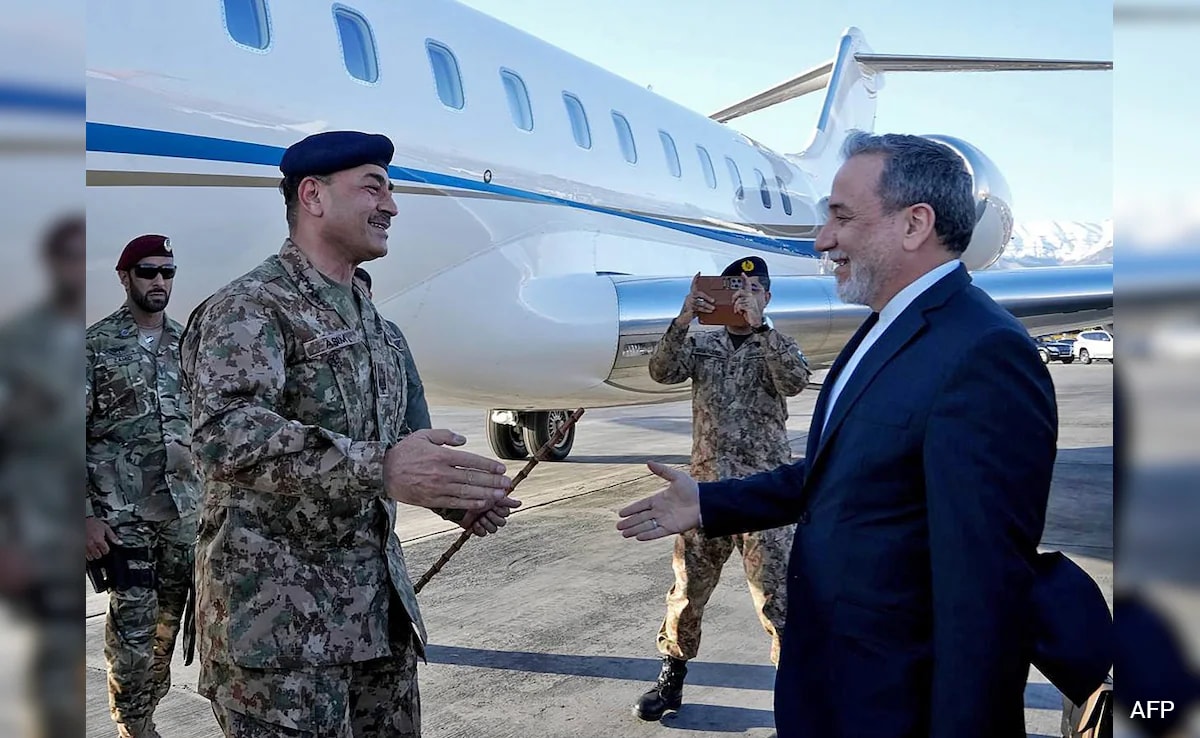
The mainstream media is currently obsessed with a fairytale. They want you to believe that General Asim Munir is trekking to Tehran as a humble messenger for Donald Trump, carrying a "peace offer" like a diplomatic olive branch. It makes for a great headline. It fits the neat, linear narrative of regional de-escalation. It is also fundamentally wrong.
If you think a Pakistani Army Chief travels to Iran to play postman for a U.S. President-elect, you don't understand the brutal mechanics of survival in the Global South. Munir isn't there to prevent a war. He is there to price one out.
The "peace offer" narrative assumes that Islamabad is a neutral arbiter desperate for stability. That is the first lie. Stability is a luxury Pakistan cannot currently afford, and chaos is the only currency it has left to trade.
The Trump Proxy Fallacy
The press loves to link everything to the Mar-a-Lago orbit. They suggest that because Islamabad and Trump had a "reset" during his first term, Munir is now his regional enforcer. This ignores the cold reality of the "Maximum Pressure" campaign. Trump doesn’t do "peace offers" with Tehran; he does ultimatums.
Sending a Pakistani General to deliver a Trump message is like sending a cat to negotiate with a dog on behalf of a lion. It doesn’t scale. Iran knows that Pakistan is deeply beholden to Saudi Arabian capital and Chinese infrastructure projects. They aren't looking to Islamabad for a backdoor to Washington. They are looking at Islamabad to see if the eastern border is about to leak militants while they are busy with Israel.
Munir’s visit isn't about brokering a deal for the Americans. It’s about ensuring that when the regional powderkeg finally blows, Pakistan isn't the one holding the match—unless it gets paid to do so.
Why "Islamabad Talks Fail" is a Distraction
The competitor reports claim Munir left for Tehran because talks in Islamabad "failed." Failed at what? The premise is that there was a specific domestic agreement to be reached on border security or trade.
In reality, these talks never "fail." They are perpetual loops designed to keep the IMF happy and the neighbors guessing. The real friction isn't a failure of diplomacy; it’s a success of leverage. Pakistan thrives on being the "necessary headache." By appearing to struggle with internal security while simultaneously dangling the possibility of regional mediation, the military elite ensures that every major power—from DC to Beijing—remains invested in their survival.
If the talks had "succeeded," Pakistan would lose its relevance. A solved problem earns no rent. An ongoing crisis, however, requires constant funding, high-level visits, and geopolitical concessions.
The Sectarian Chessboard
You cannot discuss Iran-Pakistan relations without touching the third rail: the Sunni-Shia divide and how it’s weaponized for budget approvals.
Mainstream analysts talk about "border management" in Sistan-Baluchestan as if it’s a technical policing issue. It isn’t. It’s a pressure valve. When Pakistan needs to signal its value to the Gulf monarchies, the border gets "porous" for militant groups. When it needs to court Iranian energy or prevent Indian encirclement, the border gets "tight."
Munir is in Tehran to calibrate that valve. He is signaling to the IRGC (Islamic Revolutionary Guard Corps) that Pakistan can either be a shield or a sieve. Calling this a "peace offer" is a sanitized, westernized way of describing a protection racket.
The Economic Desperation Anchor
Let’s look at the data the "peace" peddlers ignore. Pakistan’s debt-to-GDP ratio and its dependency on the next IMF tranche dictate every flight Munir takes.
- Energy blackmail: Iran has a completed pipeline sitting on the border. Pakistan hasn't touched it because of U.S. sanctions.
- The Saudi Factor: Riyadh just signaled another massive investment. They didn't do that out of the goodness of their hearts. They did it to ensure Pakistan stays in the "Sunni Bloc" during a hot war with Iran.
- The China Pivot: Beijing wants a quiet backyard for the CPEC (China-Pakistan Economic Corridor).
Munir is balancing three conflicting masters. To suggest he is simply carrying a message for Trump simplifies a three-dimensional chess game into a game of checkers. He is actually there to tell Iran: "We won't let the Americans use our soil to strike you, provided you keep the Baloch insurgents quiet and help us bypass certain trade barriers."
It’s a transactional survival play, not a diplomatic masterclass.
The Intelligence Gap: What the "Insiders" Miss
I’ve spent years watching these military-to-military exchanges. Here is the pattern the armchair experts miss: the most important meetings don't happen with the foreign ministers. They happen with the shadowy heads of the intelligence wings.
While the cameras capture Munir shaking hands with Iranian officials, the real work is happening in the basements. They are trading coordinates on "non-state actors." This isn't about peace; it’s about managing the inevitable violence.
If war breaks out between Israel/US and Iran, Pakistan becomes the most valuable real estate on the planet. They can offer a "neutral" corridor, or they can provide the logistics for a squeeze. Munir is currently shopping for the highest bidder. To frame this as a Trump-led peace initiative is to fall for the most basic disinformation tactic in the book: the Great Man Theory of History. Trump is a factor, sure, but he is a tool for Munir, not the other way around.
The Inevitability of Conflict
The "peace offer" assumes that conflict is an accident that can be avoided with the right words. In the Middle East and South Asia, conflict is an industry.
- The Pakistani military needs a threat to justify its disproportionate share of the national budget.
- The Iranian regime needs an external "Great Satan" to suppress internal dissent.
- The U.S. defense complex needs a reason to keep the Fifth Fleet stationed in the region.
When Munir lands in Tehran, he isn't trying to break this cycle. He is making sure Pakistan's cut of the "conflict economy" remains protected.
The Myth of the "Failed" Islamabad Talks
Common wisdom says the Islamabad talks failed because they couldn't agree on counter-terrorism. I'll give you a different take: They "failed" because Pakistan refused to give Iran a guarantee that it wouldn't allow U.S. drones back into its airspace.
Why would they give that guarantee? That guarantee is worth billions. You don't give it away in a preliminary meeting in Islamabad. You hold it back. You wait until the pressure is at a breaking point. You wait until the General is on the ground in Tehran, looking them in the eye, and then you negotiate the price of your "neutrality."
How to Actually Read the Room
If you want to know what’s really happening, stop looking at the official communiqués. Watch the currency markets and the movement of heavy artillery toward the Chaman and Taftan borders.
If Munir was truly bringing a peace offer, you’d see a softening of rhetoric in the state-controlled media of both countries. Instead, we see a hardening. We see "exercises." We see "readiness drills."
This is the language of a region preparing for the worst while pretending to hope for the best.
The Trap of Optimism
The biggest mistake you can make in analyzing South Asian geopolitics is being an optimist. Optimism is for people who don't have to live with the consequences of these deals.
The "peace offer" is a ghost. It's a convenient fiction that allows everyone to keep talking while they sharpen their knives. Munir is a brilliant tactician, but he isn't a peacemaker. He is a hedge fund manager whose only asset is a nuclear-armed military in the middle of a collapsing neighborhood.
He didn't go to Tehran to save the world. He went to make sure that when the world burns, Pakistan has enough fuel to stay warm and enough water to stay relevant.
Stop waiting for a breakthrough. Start watching the price of the "neutrality" Pakistan is about to sell to both sides. The only "peace" being discussed is the quiet that comes after a successful transaction. The rest is just noise for the newspapers.
General Munir isn't Trump's messenger; he's the man making sure that no matter who wins the coming war, the Pakistani military doesn't lose.