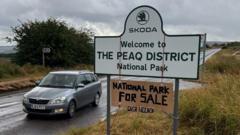
The Peak District National Park is not for sale. Except, for one week in late July, it was.
When automobile manufacturer Škoda UK struck a commercial agreement with park officials to temporarily rename Britain's oldest national park the "Peaq District" to promote a new electric SUV, the backlash was swift, predictable, and entirely justified. Temporary roadside signs reading "Peaq District" sprouted across Derbyshire, even touching the park authority headquarters in Bakewell. Free cycle hire at Parsley Hay was subsidized by the car brand. A marketing stunt designed to generate headlines for a seven-seater electric vehicle had successfully hitched its wagon to seven decades of public trust.
Critics howled. Residents protested. Environmental campaigners warned that crossing this Rubicon opens the floodgates to the industrial extraction of protected British landscapes.
Yet, listening exclusively to the chorus of moral outrage misses the dirtier, more systemic reality. This marketing stunt is not an aberration. It is the logical, desperate consequence of a quiet state-sponsored strangulation.
The Economics of Starvation
To understand why a public body charged with protecting a pristine national asset would agree to a corporate vanity project, follow the money. Or rather, follow the absence of it.
Phil Mulligan, the chief executive of the Peak District National Park Authority, did not defend the partnership with starry-eyed corporate optimism. He defended it with the flat exhaustion of a bureaucrat holding together a collapsing budget. Central government grants to England’s national parks have continued to face real-terms cuts year after year. Today, statutory funding covers roughly a quarter of the authority's operating costs.
The math is brutal. Parks must pay for footpath maintenance, visitor management, conservation, and staffing through a patchwork of parking fees, planning applications, and commercial partnerships. When the state retreats from funding public goods, public bodies are left to forage in the private market.
Škoda did not hand over cash out of pure philanthropic zeal. They paid for association, visibility, and consumer alignment. The park authority accepted the check because the alternative was cutting services vital to the management of an ecosystem buckling under millions of annual visitors.
Contradictions on the Ground
The timing of the corporate tie-in compounded the public relations disaster.
While temporary banners altered the geographic identity of the park to match a commercial product launch, the surrounding landscape faced immediate, tangible strains. In the Dark Peak, internationally significant peatlands suffered from fires that pumped stored carbon directly into the atmosphere. Local residents watched smoke billow from the hills while corporate billboards thanked motorists for choosing an adventure-ready SUV.
Furthermore, the park authority has spent years trying to disincentivize car dependency. Initiatives like the "Take the Bus" campaign and the installation of double red lines around congested honeypots like Mam Tor were explicitly designed to keep private vehicles out of fragile rural corridors. Partnering with a heavy vehicle manufacturer to promote a two-and-a-half-tonne electric automobile creates an ideological collision. It tells the public that carbon reduction is paramount, except when a corporate sponsor pays enough money to put a multi-ton SUV on a promotional pedestal.
This contradiction exposes a deeper anxiety among local communities. If a national park can alter its historic nomenclature for a marketing campaign, where does the compromise stop?
The Slippery Slope of Commercialization
Corporate sponsorship of public infrastructure is nothing new. Museums name galleries after hedge fund managers. Transit stations append multinational bank titles to their stops.
National parks, however, occupy a different psychological and cultural category. They are designated sanctuaries, legally protected landscapes held in trust for the public. When a commercial entity brands a national park, the transaction alters the nature of the space itself. It shifts the visitor from a citizen exercising a birthright to a consumer targeted by an advertising funnel.
Tom Laws of Save Our Rivers captured the existential dread of the moment when he warned that accepting such deals sets a precedent for industrial extraction. Once a landscape's identity becomes a line item on a balance sheet, the barrier against heavier, more invasive commercial exploitation begins to erode.
The park administration argues that the funds secured from Škoda enable vital access projects and active travel initiatives. This is likely true in the micro-term. A week of free bicycle hire offers an immediate, tangible benefit to holidaymakers. But trading institutional integrity for short-term operational cash creates a corrosive dependency. It normalizes the starvation of public conservation while offering corporate entities a cheap greenwashing veneer.
Beyond the Stunt
The temporary signs have come down. The "Peaq District" experiment has retreated into the archives of controversial marketing case studies, replaced once more by the traditional wooden signposts of the Peak District National Park.
Yet the underlying pressure cookers remain sealed. The government grants have not increased. The peatlands remain vulnerable. The visitor numbers continue to climb, bringing gridlock to country lanes and erosion to ancient footpaths.
The anger directed at park officials should be redirected upward toward Whitehall. Starve a public institution of its operational budget long enough, and you force its guardians to make Faustian bargains just to keep the gates open. The scandal is not merely that a car company bought a week of advertising space on a national treasure. The true scandal is that the guardians of the countryside were left with no other way to pay the bills.