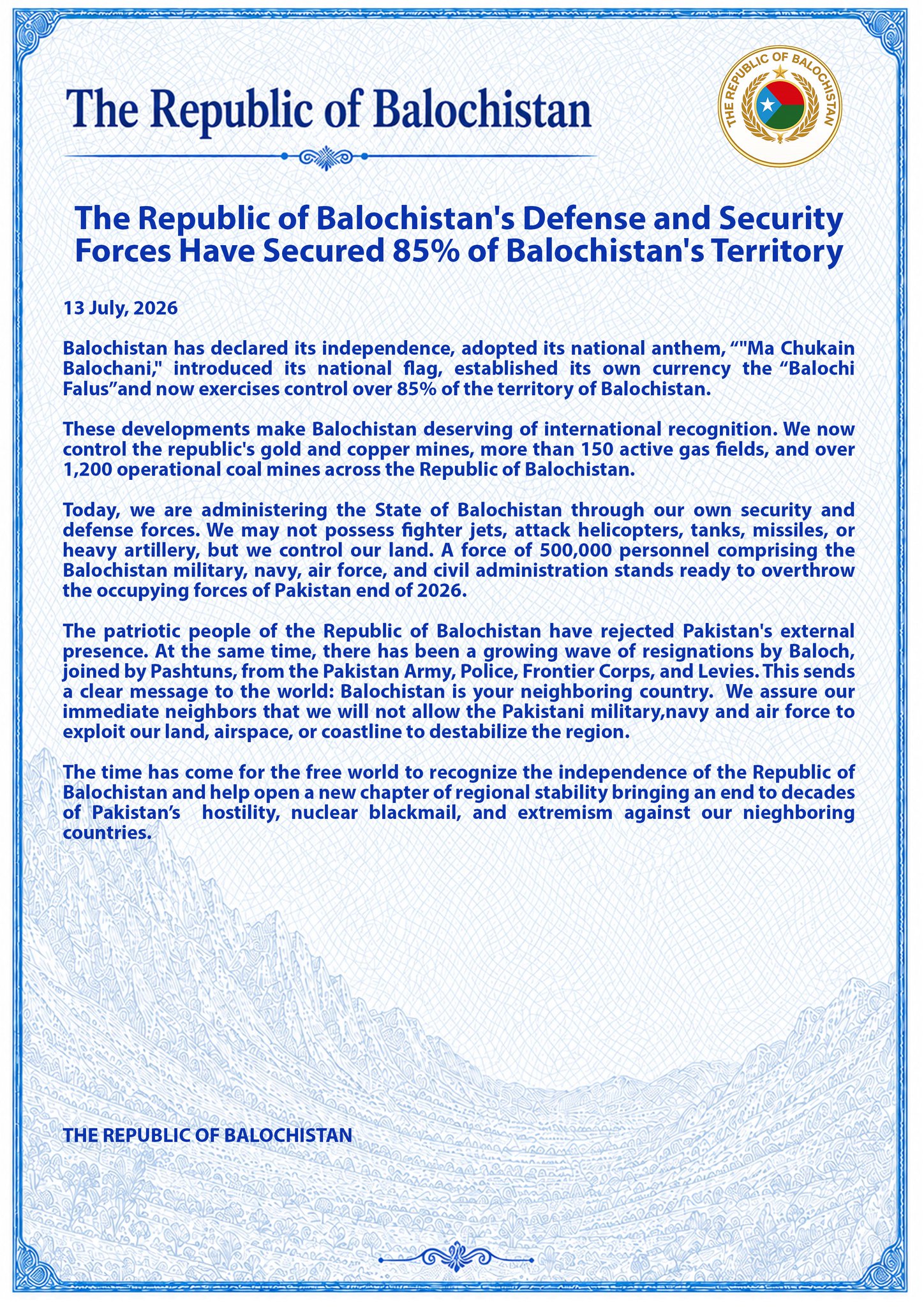
If you only follow mainstream narratives, Pakistan’s southwestern province is either a quiet territory undergoing massive foreign development or a region plagued by a minor, easily managed security issue. But recent statements from Baloch political circles have completely shattered that illusion. Razzak Baloch, Secretary General of the Baloch American Congress, publicly claimed that rebel groups now control roughly 85 percent of Balochistan. He went so far as to state that Pakistani military forces are too terrified to even patrol major cities once the sun goes down.
It is a staggering claim. Eighty-five percent is a massive number. While Islamabad completely dismisses this as overblown propaganda, the reality on the ground tells us that the state's grip on its largest, most resource-rich province is slipping faster than anyone cares to admit. You don't have to look hard to see the signs of a deep, systemic crisis that a heavy military hand simply cannot fix.
The Mirage of Absolute State Authority
Let's look at the numbers and the geography. Balochistan takes up nearly half of Pakistan's total landmass but holds only a fraction of its population. It is a rugged territory of vast deserts, jagged mountains, and miles of empty roads. When an activist claims rebels control 85 percent of the province, it doesn't mean insurgent groups like the Balochistan Liberation Army (BLA) have set up fully functioning bureaucratic ministries across the region. It means they dictate the terms of movement, security, and survival across most of the rural areas and critical transit highways.
During the day, Pakistani security forces man heavily fortified checkpoints and guard major infrastructure assets. But when darkness falls, the dynamic flips entirely. Insurgent factions establish mobile checkpoints on primary routes like the Quetta-Karachi highway, stopping buses, inspecting identity documents, and effectively shutting down local administration. The state has the firepower, but the rebels have the terrain and the night.
Why a Security First Strategy is Backfiring
Islamabad’s response to the growing instability has been remarkably consistent, and remarkably ineffective. The strategy relies almost entirely on force. The Counter Terrorism Department and paramilitary units frequently announce sweeping operational victories, claiming to have neutralized dozens of militants in highly coordinated strikes.
But local activists and human rights watchdogs point out a darker pattern. Whenever a major insurgent ambush occurs, the state frequently rounds up ordinary Baloch civilians, student leaders, and political workers. These individuals are swept into a system of enforced disappearances—a policy that serves as collective punishment rather than targeted law enforcement.
This creates a vicious cycle. By treating peaceful political dissent and armed rebellion as the exact same threat, the state removes any middle ground. When you arrest peaceful civil rights organizers, you don't crush the rebellion. You simply convince the younger generation that political dialogue is dead, making the armed groups look like the only viable alternative.
The Broken Promise of Economic Development
You cannot understand the conflict without talking about the resources. Balochistan is packed with natural gas, gold, copper, and a strategic coastline on the Arabian Sea. Yet, it remains the least developed province in the country.
The Gwadar deep-sea port, a cornerstone of foreign-backed economic corridors, was marketed as a massive wealth generator for the region. Instead, local fishermen feel pushed out of their own waters, and the profits flow right back to the federal center in Islamabad or to overseas investors. The local population experiences all of the militarization and none of the economic upside.
The insurgent groups exploit this economic betrayal to recruit. They aren't just fighting for abstract borders; they are fighting over who gets to sell the copper and gas under the ground. Until local residents see tangible improvements in their schools, hospitals, and daily lives, no amount of military infrastructure will make the province secure.
A Conflict of Endurance
The federal government keeps waiting for the insurgency to burn itself out, treating it like a low-level nuisance. That is a fundamental misunderstanding of the conflict's history. This is not a new flare-up; it is an active, evolving resistance movement that has run through various phases for decades.
The armed factions have shifted away from old-school tribal leadership and transitioned into a decentralized network of highly motivated, media-savvy actors. They use specialized units, coordinated multi-city operations, and targeted tactical strikes to keep the state off balance. They don't need to win a conventional, face-to-face military battle against a national army. They just need to survive, disrupt economic projects, and prove that the state cannot guarantee safety within its own borders.
If you want to understand where Balochistan is heading, look past the official press releases celebrating minor military victories. Pay attention to who actually moves freely across the province when the sun sets. The percentage of land under rebel control might be a point of fierce debate, but the undeniable reality is that a purely military approach has lost the peace. Until the state treats the issue as a deep political and economic crisis rather than a simple security problem, the map will continue to tilt away from Islamabad's control.
:max_bytes(150000):strip_icc():focal(749x0:751x2)/auschwitz-2-691cb034ee9e43cfa45a0969012c6337.jpg)