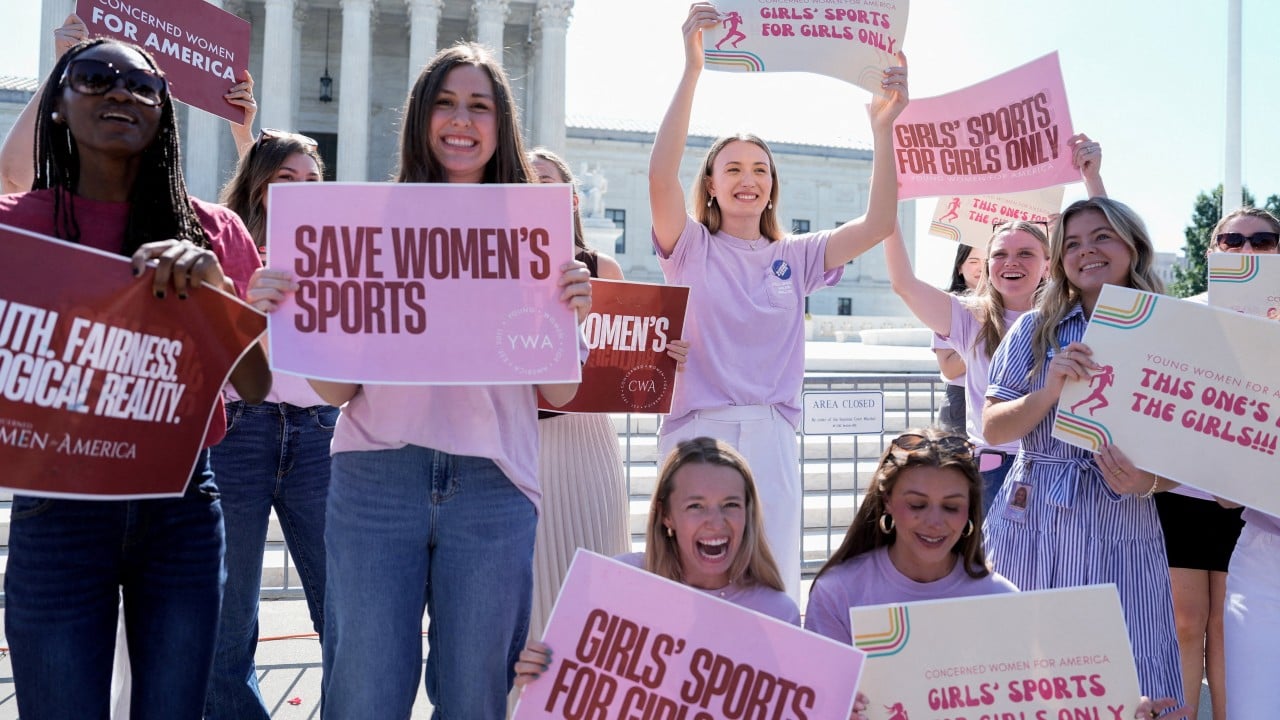
The highest court in America just dropped a bombshell ruling that fundamentally changes school athletics. On June 30, 2026, the US Supreme Court handed down a massive decision allowing states to bar transgender girls and women from competing on female school sports teams.
If you think this is just a minor footnote in the ongoing culture wars, you are dead wrong. This is the definitive legal stamp of approval that conservative-led states have been waiting for. It completely reshapes how public schools, universities, and athletic associations across the country must define sex and eligibility.
The 6-3 ruling specifically upheld restrictive laws in Idaho and West Virginia, reversing lower courts that had blocked them. Written by Justice Brett Kavanaugh, the majority opinion clears a path for more than two dozen states with similar bans to enforce them without fear of federal constitutional blocks. It is a massive victory for the Trump administration and a devastating blow to LGBTQ+ advocates who fought for years to establish that federal civil rights laws protected gender identity in sports.
But the details of this decision reveal a much more complicated reality than the loud headlines suggest.
The Two Crucial Cases That Sparked the Showdown
This did not happen in a vacuum. The Supreme Court consolidated two major legal fights that wound their way through federal courts for years.
First is West Virginia v. B.P.J., which centered on Becky Pepper-Jackson, a 15-year-old middle school track and cross-country runner. Becky has identified as a girl since she was eight years old. She took puberty-delaying medications and hormone therapy before ever entering puberty. Her legal team argued she never experienced male puberty and holds zero biological or physiological advantage over her peers. To her, running was a vital outlet, a way to fit in, and a core component of managing her gender dysphoria. West Virginia passed its Save Women’s Sports Act in 2021, drawing a hard line that barred her from the track.
Then you have Little v. Hecox out of Idaho. Lindsay Hecox was a student at Boise State University who wanted to run track and cross-country. Idaho passed the first-in-the-nation trans athlete ban back in 2020. Hecox sued, starting a massive multi-year legal battle. Interestingly, by the time the case hit the Supreme Court, Hecox had actually stepped away from competitive collegiate sports due to intense public scrutiny and fear of harassment. Her lawyers even tried to have the case dismissed as moot. The justices refused, eager to settle the legal question once and for all.
What critics and supporters often miss is how these specific backgrounds clashed in court. One plaintiff transitioned before puberty; the other did not. Yet the Supreme Court chose to look past those individual nuances, opting instead to issue a broad, sweeping standard for all student-athletes.
How the Court Split on the Fourteenth Amendment and Title IX
The legal mechanics of this decision are fascinating and a bit surprising. The justices divided sharply along ideological lines regarding the Constitution, but found an unexpected consensus on statutory law.
The main battleground was the Equal Protection Clause of the 14th Amendment. The three liberal justices, led by a fiercely critical Justice Sonia Sotomayor, dissented strongly from the majority’s view on this point. Sotomayor even took the rare step of reading her dissent aloud from the bench, showing just how deeply fractured the court felt.
Kavanaugh wrote that separating sports teams by biological sex is completely reasonable. He argued that physical differences between the sexes are real, and that limiting female teams to biological females reduces injury risks and ensures fair competition. The majority relied heavily on a previous ruling, United States v. Skrmetti, asserting that these bans classify students by their biological sex at birth rather than targeting their transgender status directly.
When it came to Title IX, the landmark 1972 law that forbids sex discrimination in education, the court reached a unanimous 9-0 agreement that the text itself does not force schools to include trans women on female teams. Even the liberal block agreed that Title IX’s original framework allows for sex-segregated sports.
Kavanaugh noted that sports are fundamentally different from normal employment or classroom settings. In a workplace, treating people regardless of sex is standard. In sports, sex segregation has been the baseline for over half a century to give women a real chance to compete and win.
The Scientific Debate the Justices Refused to Touch
One of the most intense parts of this legal war was the conflicting science. The plaintiffs brought forward extensive data showing that when a transgender girl takes puberty blockers and life-long hormone therapy early enough, she does not develop the bone density, muscle mass, or lung capacity typically associated with male development. They argued that a blanket ban ignores medical reality.
Lawyers representing Idaho and West Virginia countered with their own set of studies, asserting that biological males retain structural athletic advantages in height, heart size, and hemoglobin levels regardless of hormone treatments.
Instead of picking a scientific winner, the Supreme Court basically threw its hands up. Kavanaugh wrote that legislatures and local school boards are far better equipped than judges to weigh complex medical data and draw lines. He stated that no line drawn will satisfy everyone, meaning the court is officially stepping out of the business of micromanaging sports science.
Sotomayor blasted this approach. She argued that the majority ignored crucial factual evidence and completely dismissed the real-world harm done to vulnerable teenagers. In her view, the court chose to ignore facts because the political outcome was already decided.
What Happens to States with Inclusive Sports Policies
This ruling does not mean transgender sports participation is banned everywhere in America. It simply means states are allowed to ban it if they want to. This creates a massive, fractured map across the country.
Right now, 27 states have laws on the books restricting trans student-athletes. Those laws are now completely safe from federal constitutional challenges. Expect those states to enforce them aggressively starting immediately.
But what about blue states? States like California, Maine, and Connecticut have explicit policies protecting the rights of transgender students to play on teams matching their gender identity. Maine’s Attorney General, Aaron Frey, immediately issued a statement after the ruling confirming that the state will maintain its inclusive policies. The Supreme Court did not rule that inclusion is illegal; it ruled that exclusion is permissible.
This sets up a bizarre patchwork system. A transgender girl in California can run high school track without issue, but if her family moves to Idaho, she is legally barred from the girls' team. This fragmented reality will complicate regional tournaments, collegiate recruiting, and national governing body regulations for years to come.
The Numbers Behind the Culture War
Politicians have turned this into a massive campaign issue, but the actual number of individuals affected is incredibly small.
Consider the data. NCAA President Charlie Baker testified before Congress that out of more than 500,000 collegiate student-athletes in the United States, his organization was aware of only about 10 transgender athletes competing in women's sports. That is a minuscule fraction of a percent.
Yet, the political footprint is massive. President Donald Trump hailed the ruling on Truth Social as a monumental victory, calling the inclusion of trans women in female sports a ridiculous situation that is now off the table. The Trump administration actively backed the states during the Supreme Court arguments. His Education Secretary, Linda McMahon, praised the decision for stopping what she called a radical agenda that harmed women.
The governing bodies of sports have already started shifting. Following the lead of international federations and Olympic committees, both the NCAA and the US Olympic and Paralympic Committee have tightened their rules, largely cutting off paths for trans women to compete in female divisions. This SCOTUS ruling provides the ultimate legal shield for those organizations.
Next Steps for Schools, Athletes, and Families
If you are a school administrator, an athletic director, or a parent, you need to understand the immediate practical fallout of this decision. The legal landscape has shifted, and action is required to navigate the new rules.
First, audit your state laws immediately. If you are in one of the 27 states with a ban, any policy or individual accommodation that allowed a transgender girl to play on a female team must be rolled back to comply with state law, as federal injunctions are falling away.
Second, expect immediate athletic association updates. State high school athletic associations will be issuing new compliance guidelines over the summer. Schools must review these to ensure they do not lose funding or face state-level penalties.
Third, look out for multi-state tournament complications. If an inclusive school team from a blue state travels to a red state for a tournament, conflicts will arise if that team includes a transgender athlete. Governing bodies will need to issue specific guidelines on venue rules and tournament eligibility to avoid chaotic forfeits on the field.
Fourth, provide support for affected students. Kavanaugh closed his opinion by noting that these student-athletes are teenagers and young adults who simply want to play. He explicitly wrote that no student deserves to be ostrasized or vilified. Schools need to establish clear, respectful pathways—such as co-ed or open divisions—to ensure all students can stay physically active without violating state laws.
The Supreme Court has spoken, and the legal debate over the Constitution's role in this issue is effectively finished. The battle now moves directly to local statehouses and school board meetings, where the actual implementation of these separate sporting worlds will play out in real time.


