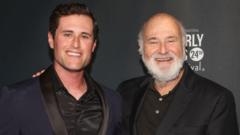
The silence of a house at night has a specific weight. It isn’t just the absence of noise; it is a heavy, expectant pressure that builds in the corners of a room when you realize the people who are supposed to be there aren't coming back. For Nick Reiner, that silence didn't arrive with a slow fade. It arrived like a gunshot.
We often treat the lives of Hollywood royalty as if they are scripted. We assume the children of legends like Rob Reiner or the grandchildren of Carl Reiner inhabit a world where the lighting is always soft and the safety nets are made of gold. But fame doesn’t insulate a family from the jagged edges of mortality. It just makes the mourning more public, more distorted, and somehow, more lonely. Meanwhile, you can explore similar stories here: The Royal PR Myth Why the Dutch Monarchy’s Double Loyalty is Bad Politics.
When the news broke that Rob Reiner’s son had "found out" his parents were dead, the internet did what it does best: it turned a visceral human tragedy into a headline. But headlines are flat. They don’t capture the smell of the air or the way the floor feels beneath your feet when the world tilts on its axis. To understand what Nick went through is to understand the universal terror of the "unspoken event"—the moment when you realize the pillars of your world have crumbled while you were looking the other way.
The Illusion of the Permanent Parent
There is a psychological contract we sign as children. It’s an unwritten agreement that our parents are the fixed points in our geography. They are the North Star. Even when we grow up, even when we struggle with them, even when we go through the cycles of addiction and recovery that have shadowed Nick’s own journey, we carry the subconscious belief that they are invincible. To see the complete picture, we recommend the recent analysis by Associated Press.
When that contract is torn up, the physical reaction is immediate. The heart rate spikes. The skin goes cold. It is a biological rejection of reality.
Nick wasn't just losing a father who directed When Harry Met Sally; he was losing the man who sat across from him at dinner. He wasn't losing a public figure; he was losing his history. The way he discovered the loss wasn't through a gentle sit-down or a prepared statement. It was the raw, unfiltered chaos of modern communication—the kind of discovery that leaves a digital footprint on the soul.
The Digital Ghost in the Room
Imagine holding a device in your hand that contains the entirety of your social world. Now imagine that device becoming a weapon.
In the age of instant information, the "grace period" of grief has vanished. In decades past, a family had hours, perhaps even a day, to gather their strength before the world hammered at the door. Today, the world often knows before the next of kin. There is a specific kind of trauma in learning about a personal catastrophe through a screen, through a notification, or through the frantic, coded messages of friends who are afraid to say the words out loud.
This is the invisible stake of being a public family. Your private nightmare is a global trending topic. You are forced to process the unthinkable while the "audience" is already providing commentary.
But the real problem lies elsewhere. It isn't just about the speed of the news; it's about the lack of a transition. The brain needs a bridge to cross from "life as it was" to "life as it is now." When you find out your parents are gone through a haphazard discovery, you are forced to leap across a chasm. Many people never quite make it to the other side. They spend years hovering in the air, waiting for the impact.
The Weight of the Name
Nick Reiner has never hidden from his shadows. He has been vocal about his battles with substance abuse, a struggle that often acts as a fog between a person and their reality. When you are fighting for your own life, the idea of losing the people who anchored you to the earth is too much to process.
Consider the dynamics of a family under the microscope. There is a pressure to be "okay," to uphold the legacy, to speak eloquently about the man the world loved. But what about the man Nick loved? What about the mundane memories—the way a room smelled after a rainy day, or the specific tone of a voice during a disagreement?
Those are the things that get buried under the "celebrity news" cycle.
The human element is found in the small, jagged details. It's the unfinished cup of coffee. it's the voicemail you haven't listened to yet. It's the realization that you can never ask them that one specific question about your childhood that only they would remember.
The Architecture of Recovery
Grief is not a room you walk through. It is a climate you learn to live in.
For someone like Nick, who has navigated the treacherous waters of recovery, this kind of loss is a test of the most brutal variety. In the world of healing, they talk about "triggers." But losing both parents in a sudden, nightmarish discovery isn't a trigger; it's a demolition.
It forces a confrontation with the self. Without the parents there to witness your progress or provide the friction that defines your growth, who are you? You become the senior representative of your own life. The safety net is gone. The spectators are watching.
But there is a quiet strength that emerges from this kind of wreckage. It is the strength of the person who has seen the worst-case scenario and is still standing.
Nick’s story isn't just about a tragic discovery. It is about the resilience of the human spirit when it is stripped of its most basic protections. It is about the courage it takes to keep breathing when the air feels like broken glass.
The Finality of the Dial Tone
We live in a culture that loves a "comeback story," but grief doesn't have a third act where everything is resolved. There is no swelling music. There is no final speech that makes sense of the pain.
There is only the morning after. And the morning after that.
When we look at the headlines about the Reiner family, or any family facing the sudden extinguishing of their lights, we shouldn't see "content." We should see a mirror. We should see the fragility of our own anchors.
The real story isn't how he found out. The real story is that he stayed. He stayed in the reality, he stayed in the pain, and he chose to keep walking forward in a world that felt fundamentally different than the one he woke up in.
The phone sits on the nightstand. It is silent now. The notifications have slowed, the headlines have moved on to the next tragedy, and the world has turned its gaze elsewhere. But in the quiet, there is a young man learning to speak a new language—a language where the words "mom" and "dad" are no longer used in the present tense, but are carved into the very foundation of who he is becoming.
The light in the hallway is still on, casting a long, thin shadow across the floorboards.