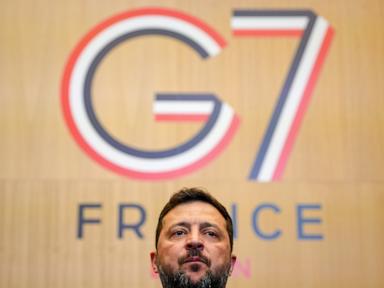
The air inside the lakeside summit halls in Evian-les-Bains, France, was thick with the scent of expensive coffee and the low, structured murmurs of global diplomacy. World leaders had gathered under crystal chandeliers, their binders filled with policy briefs, macroeconomic forecasts, and strategic talking points. But the true weight of the summit did not exist on a spreadsheet. It sat inside a small folder of glossy photographs carried by Volodymyr Zelenskyy.
Outside, the French summer sun glinted off the water. Inside, the Ukrainian president opened the folder and placed the images onto the conference table.
There were no military schematics in these photos. Instead, they captured the immediate aftermath of a midnight strike on Kyiv. One image showed the ancient, towering structures of the Kyiv Pechersk Lavra monastery framed by orange sheets of fire. Another captured a group of exhausted first responders, their faces smeared with ash and soot, dragging heavy hoses through a shower of sparks to put out the blaze. Ten civilians had died across the country during those same overnight hours.
Zelenskyy let the images do the talking first. The room went quiet.
For more than four years, the war has been discussed in the abstract languages of attrition, fiscal allocations, and supply chains. But when the leaders of the world’s wealthiest democracies looked at the raw, unedited reality of a burning cultural landmark, the political posturing faded. The photographs forced a stark realization upon the room: the violence isn't slowing down, and the strategy to stop it requires an entirely different level of urgency.
The Logic of the Unmoved
For months, global headlines have hinted at a fatigued West and a frozen front line. Speculation swirled around how a return of Donald Trump to the White House and shifts in European leadership might alter the landscape of international support. Yet, behind the closed doors in France, a surprising consensus emerged among the Group of Seven.
Consider the fundamental diplomatic problem that Zelenskyy laid bare to his counterparts. Just hours before the summit began, Ukraine had extended a formal offer for direct, face-to-face negotiations with Vladimir Putin right there in Evian. The framework was ideal—a unified table featuring Ukraine, the United States, and European powers. It was an open door to peace.
Moscow’s response arrived in the form of explosive drones and cruise missiles raining down on Kharkiv and Kyiv.
"Everyone sees that Russia does not want to end this war," Zelenskyy noted after emerging from the sessions.
The Western leaders admitted to a shared frustration. They confessed that they do not understand the internal logic driving the Kremlin's current strategy. When a state actively rejects a multilateral peace forum in favor of burning monasteries and residential blocks, standard diplomatic overtures lose their meaning. You cannot negotiate with an entity that views a ceasefire merely as an opportunity to reload.
Because of this, the collective conclusion of the summit shifted from persuasion to compulsion. If a leader cannot be convinced to stop, he must be forced to stop.
The Anatomy of Pressure
Force, in the context of the G7, does not mean marching foreign armies onto the battlefield. It means systematically dismantling the economic engine that funds the machinery of war.
The strategy hammered out in Evian focuses heavily on closing the loopholes that have allowed the Russian economy to endure. This means tightening the vice on the "shadow fleet"—the aging, uninsured oil tankers used to bypass international price caps and funnel billions in fuel revenue back to Moscow. It means tracking the complex financial networks that reroute western electronic components through third-party countries into missile guidance systems.
But economic pressure is a slow-acting medicine, and Ukraine's needs are immediate.
While financial analysts debate the long-term impact of asset seizures and banking restrictions, Ukrainian air defense crews are staring at radar screens in the dark, counting the seconds before an incoming interceptor missile meets a low-flying drone.
To bridge this gap, the discussions on the sidelines of the summit turned practical, focusing heavily on localizing defense manufacturing. Zelenskyy sat down with U.S. President Donald Trump to discuss a shift away from merely importing weapons toward securing production licenses. The goal is simple: allow Ukrainian factories to build their own anti-ballistic systems and missiles domestically. Cooperation agreements with Canada were also advanced to scale up drone production—a sector where commercial technology has completely rewritten the rules of modern reconnaissance and defense.
The Horizon of the Grid
There is another clock ticking beside the one that measures ammunition counts. It is the seasonal clock.
A major part of the strategy discussed in France revolved around the upcoming winter. For four consecutive years, the strategy against Ukraine has included a systematic attempt to freeze the population into submission by destroying power stations, transformers, and thermal plants.
Imagine a civilian apartment building in mid-December. The power grid fails. Within hours, the concrete walls retain the bitter chill of the sub-zero Eastern European winter. The water pipes freeze and burst. Without electricity, elevators stop, leaving the elderly stranded on the upper floors of dark, unheated high-rises. It is a quiet, architectural form of warfare aimed directly at human endurance.
To counter this, the G7 leaders began coordinating a massive energy package. This isn’t just about sending money; it is a logistical pipeline of physical hardware. More than 2,500 large-scale generators, alongside industrial transformers, turbines, and repair boilers, are being mobilized to reinforce the grid.
The package also includes guaranteed supplies of diesel fuel, natural gas, and gasoline to ensure that even if central plants are struck, critical infrastructure—like hospitals, water pumping stations, and civilian shelters—can keep the lights on and the heat running.
The Unbroken Line
When the summit concluded, there were no grand, sweeping declarations that promised an end to the conflict by tomorrow morning. Diplomacy at this level doesn't work in miracles. It works in commitments, incremental pressure, and the steady accumulation of material support.
But the true takeaway from Evian was the quiet collapse of the narrative of Western abandonment. Despite deep internal disagreements over other global flashpoints, the leaders of the G7 found themselves bound together by the stark imagery presented at the table.
Ukraine officially launched its European Union membership negotiations during the same week—a bureaucratic process that requires years of deep political and legal transformation, yet serves as a definitive statement of where the country's future lies.
The path forward remains volatile, dangerous, and profoundly uncertain. But as the leaders prepared to leave the lakeside resort, the folder of photographs remained a physical reminder of what is at stake. The war is not a distant geopolitical puzzle to be solved with clever phrasing. It is a human crisis happening in real-time, defended by people who are currently rebuilding their homes while the smoke is still clearing from the sky.