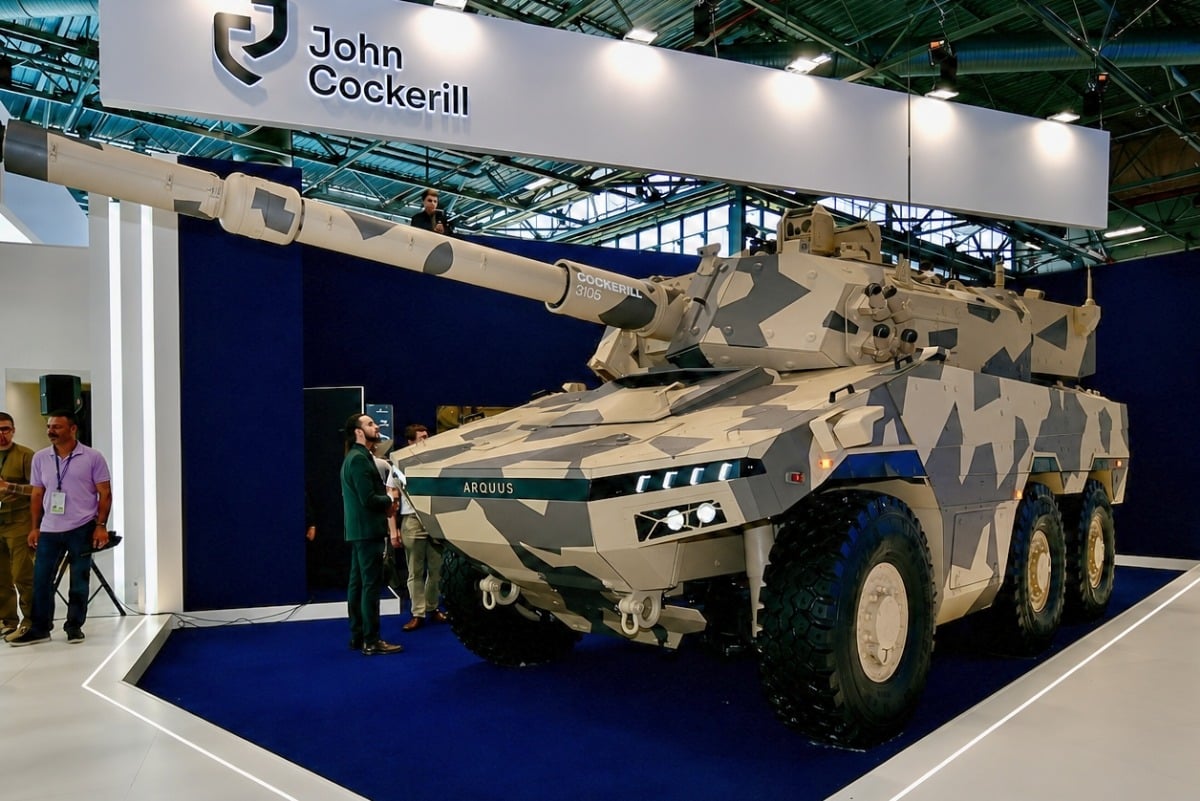
The modern peer-to-peer battlefield has exposed a critical operational vulnerability in light infantry and motorized formations: the absence of organic, rapidly deployable direct fire support capable of neutralizing fortified positions and armored threats without relying on slow-moving tracked armor. The unveiling of the Fenris armored vehicle at Eurosatory in Paris—a joint development between Arquus and John Cockerill Defense—signals a structural shift toward high-mobility, large-caliber wheeled combat systems. By integrating a 105mm NATO-standard cannon onto a 26-tonne 6x6 chassis, this platform addresses the tactical imbalance between light reconnaissance units and main battle tanks.
To evaluate the utility of this platform, defense planners must analyze the design through three technical variables: structural weight allocation for strategic airlift, recoil energy dissipation on a wheeled chassis, and the elevation mechanics dictating non-line-of-sight engagement ranges.
The Strategic Weight Dilemma and Hull Optimization
The core engineering constraint of the Fenris platform is its 26-tonne combat weight. This precise mass is dictated by the maximum payload limitations of standard Western strategic airlifters, specifically the Airbus A400M. Heavy tracked armor platforms exceeding 40 to 60 tonnes require strategic logistical corridors and heavy equipment transports, introducing deterministic delays into rapid deployment timelines.
Weight distribution across a 6x6 configuration involves a strict trade-off between ballistic protection, ammunition capacity, and drivetrain longevity. The vehicle distributes its mass across three axles to minimize ground pressure and maintain off-road mobility. The hull architecture, optimized by Arquus, yields a specific power ratio of approximately 19.2 horsepower per tonne via its 500-horsepower diesel engine and automatic transmission.
This power-to-weight optimization guarantees rapid acceleration and cross-country maneuverability, yet it imposes severe constraints on armor volume. To maintain the 26-tonne ceiling while accommodating the Cockerill 3105 turret, the hull relies on high-hardness ballistic steel supplemented by modular composite panels. This structural compromise results in asymmetrical protection levels:
- The turret assembly provides ballistic resistance rated up to 25mm sub-caliber armor-piercing rounds.
- The lower hull and drivetrain components are optimized for mine and improvised explosive device blast mitigation rather than high-caliber kinetic energy threats.
Recoil Dynamics and Mobile Fire Control Architecture
Integrating a high-pressure 105mm cannon onto a wheeled platform introduces severe physical strains that do not exist in tracked architectures. When a tracked main battle tank fires, the massive inertia of its 50-to-70-tonne chassis, combined with the broad surface area of its tracks, absorbs and transmits the recoil energy directly into the earth. On a 26-tonne wheeled vehicle, firing a high-velocity 105mm projectile generates a recoil force that threatens to destabilize the vehicle, warp the suspension, or destroy the tracking telemetry of the optical sights.
The solution implemented within the Cockerill 3105 turret relies on a long-stroke hydraulic recoil mechanism combined with a high-efficiency muzzle brake. The muzzle brake redirects expanding propellant gases rearward and outward, mechanically counteracting a percentage of the initial rearward momentum. The remaining kinetic energy is absorbed through the prolonged stroke of the hydraulic dampers, dampening the shock pulse transmitted to the chassis.
This mechanical attenuation allows the integration of a digitized fire control system capable of accurate fire-on-the-move operations. The system calculates a first-hit probability of 95 percent at a baseline range of 2,000 meters. To achieve this accuracy, the vehicle relies on an integrated stabilizer system that decouples the weapon axis from hull oscillations caused by uneven terrain. A continuous feedback loop between the panoramic digital sights, chassis gyroscopes, and the turret drive motors adjusts the barrel elevation and azimuth in real time.
High-Elevation Mechanics and Non-Line-of-Sight Range Expansion
The defining tactical evolution of the Fenris platform lies in its turret elevation envelope. Standard direct-fire vehicles typically limit main gun elevation to roughly 15 to 20 degrees, restricting their utility to direct line-of-sight engagements. The Cockerill 3105 turret expands this envelope to a 40-degree maximum elevation angle.
This geometric shift alters the vehicle’s fire function, allowing it to transition from direct fire support to an indirect, non-line-of-sight asset. By elevating the barrel to 40 degrees, the platform can project standard 105mm NATO artillery and tank munitions far beyond the traditional 2-kilometer direct-fire horizon, reaching targets at distances up to 11 kilometers.
This dual-role capability serves as an operational buffer against high-density artillery deficits. The vehicle utilizes a 12-round automated ammunition loader housed within the turret bustle, supplemented by two additional internal ammunition storage racks to hold up to 36 total rounds. This automated system achieves two critical outcomes: it reduces the vehicle's crew requirement to three personnel (commander, gunner, driver) and maintains a consistent rate of fire uninterrupted by the physical fatigue of a human loader under sustained high-elevation operations.
Target Acquisition Performance and Sensor Integration
The vehicle functions as a data-gathering node within networked combat architectures, satisfying the reconnaissance mandate alongside its destructive capacity. The sensor suite consists of a 360-degree external camera network and advanced day/night thermal optics integrated directly into the commander's independent panoramic sight.
The optical array delivers target detection metrics that extend well past the physical range of the main armament:
- Daytime detection range: Up to 18 kilometers using high-resolution optical magnification and digital stabilization.
- Nighttime/Thermal detection range: Up to 15 kilometers, utilizing long-wave thermal imaging to identify heat signatures through atmospheric obscuration, dust, and smoke.
This sensor-to-shooter overmatch allows the crew to identify hostile columns and coordinate precision strikes before entering the threat envelope of opposing light forces. The system's digital architecture integrates external target data via software-defined combat net radios, allowing the platform to act as an organic indirect fire asset for forward light infantry units that lack heavy organic artillery attachments.
Strategic Allocation Framework
The deployment of the 105mm wheeled platform represents a deliberate tactical compromise between absolute survivability and rapid operational deployment. It is not designed to breach heavily fortified lines anchored by heavy main battle tanks; rather, its role is to act as a highly mobile destroyer within light, motorized, or airborne task forces.
The primary limitation of this framework is the logistical footprint of the ammunition supply chain. While the platform itself can be airlifted directly into theater via an A400M, its sustained high-angle firing operations will deplete its 36-round complement rapidly. To mitigate this vulnerability, deployment doctrines must pair these wheeled fire support vehicles with dedicated armored replenishment platforms sharing an identical 6x6 chassis profile, ensuring parts commonality and preventing supply bottlenecks in high-intensity environments.