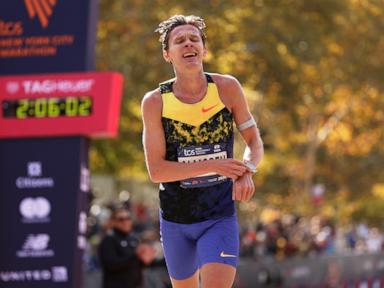
Winning the New York City Marathon on a debut attempt is a statistical anomaly that violates traditional distance-running dogma. Most elite track athletes require two to three marathon cycles to adapt their musculoskeletal systems to eccentric muscle damage and calibrate carbohydrate oxidation rates over 42.195 kilometers. Andreas Almgren bypassed this multi-year learning curve, translating track-derived aerobic capacity directly onto one of the most technically punishing championship courses in the world.
This outcome is not a fluke of raw talent; it is the result of specific physiological transfers, metabolic efficiency, and tactical discipline executed on an unpaced, rolling terrain. To understand how a track specialist conquered the five boroughs without prior marathon race experience, we must deconstruct the biomechanical, metabolic, and strategic variables that govern debut marathon success. Read more on a connected issue: this related article.
The Track-to-Road Conversion Engine
Historically, athletes transitioning from the 5,000-meter and 10,000-meter track events to the marathon suffer from a predictable failure mode: neuromuscular breakdown after the 30-kilometer mark. While their central cardiovascular systems—cardiac output and maximal oxygen uptake ($\text{VO}_2\text{max}$)—are fully developed, their peripheral tissues lack the structural durability to absorb tens of thousands of repetitive ground-reaction forces on asphalt.
Almgren’s trajectory from a middle-distance 800-meter runner to a European record holder over 5,000 meters and 10,000 meters created a unique physiological profile. Unlike pure aerobic grinders who build volume slowly over a decade, athletes who descend from middle-distance speeds possess superior neuromuscular economy and elastic energy return. Further reporting by The Athletic highlights related perspectives on this issue.
The Three Pillars of Track-Derived Marathon Readiness
- Speed Reserve Compression: An athlete capable of running sub-13:00 for 5,000 meters and sub-27:00 for 10,000 meters operates at a substantially lower percentage of their maximal aerobic speed during a 2:07 or 2:08 marathon pace. For a 27:30 10K runner, marathon pace feels moderately hard; for a sub-27:00 runner, that exact same velocity sits comfortably below the second lactate threshold ($\text{LT}_2$).
- Lactate Clearance Architecture: Years of high-intensity interval training at or above $\text{VO}_2\text{max}$ upregulate monocarboxylate transporters (MCT1 and MCT4) within skeletal muscle. During a tactical marathon marked by erratic surges—a defining feature of the New York City Marathon—this elevated clearance capacity allows the runner to metabolize lactate spikes during uphill climbs without accumulating systemic acidosis.
- Tendon Stiffness and Ground Contact Time: Middle-distance conditioning builds high Achilles tendon stiffness. Stiffer tendons store and return elastic energy more efficiently during the stance phase of running, reducing the metabolic cost of transport. Over 30,000+ strides, a 2% improvement in running economy translates into significant glycogen preservation.
The primary risk for a debutant with this background is not cardiovascular exhaustion, but eccentric muscle fiber tearing. Track surfaces provide uniform energy return and zero camber. New York City’s bridges and avenues impose severe mechanical stress, particularly on the quadriceps during downhill descents like the drop off the Queensboro Bridge into First Avenue. Surviving this requires specific pre-race structural conditioning—high-volume eccentric loading and extended threshold blocks on undulating asphalt—to harden the connective tissue prior to race day.
Why New York City Favors Tactical Debutants Over Time-Trial Specialists
The New York City Marathon is structurally distinct from flat, pacemaker-assisted courses like Berlin, Chicago, or Valencia. Without pacemakers (rabbits) to dictate an even metronomic split, and without pancake-flat elevation profiles to reward purely steady-state metabolic efficiency, New York operates as a tactical chess match governed by course topography and wind resistance.
For a debutant, the absence of pacemakers is an advantage rather than a liability. In a fast, paced race, a novice marathoner is forced to commit to an aggressive, predetermined pace from the gun—a gamble that frequently ends in catastrophic glycogen depletion at 35 kilometers if their fuel calculations are off by even 3%.
In New York, the opening miles across the Verrazzano-Narrows Bridge and through Brooklyn are typically conservative. This early restraint shifts the race dynamic from a pure physiological time trial to an elimination tournament.
The Course Topography Cost Function
Every marathon course imposes a specific energetic penalty based on elevation change and surface geometry. In New York, the cost function is heavily back-loaded:
- Miles 1–15 (The Conservation Phase): Flat to gently rolling terrain through Brooklyn and Queens. Drafting within a large lead pack reduces aerodynamic drag by up to 6–8% at marathon velocities, conserving crucial muscle glycogen.
- Mile 15–16 (The Queensboro Bridge): A sustained, steep climb devoid of crowd noise, followed by a sharp descent onto First Avenue. This transition acts as the primary physiological filter. Athletes who attack the climb prematurely spike their heart rates above their aerobic threshold, burning through finite hepatic and muscular glycogen stores. Those who absorb the climb evenly and relax into the descent preserve neuromuscular function for the final 16 kilometers.
- Miles 16–23 (The Manhattan Straightaway and Bronx Loop): A long, exposed north-south corridor up First Avenue, across the Willis Avenue Bridge, and back down Fifth Avenue. Headwinds off the East River frequently penalize solo front-runners here.
- Miles 23–26.2 (Central Park): Rolling hills on fatigued legs. By this stage, muscle glycogen is critically low, and stride mechanics degrade. Success here depends entirely on fatigue resistance—the ability to maintain stride length and cadence when central nervous system drive is compromised.
Almgren’s track background directly solves the Central Park problem. When a marathon slows down through the middle miles due to tactical cat-and-mouse dynamics, the race is decided by who retains the highest absolute anaerobic and high-end aerobic capacity over the final 5 kilometers. A 10,000-meter specialist possesses a finishing gear that pure marathoners cannot match when the pace transitions from steady-state grinding to a long, sustained kick.
Metabolic Pacing and the Fueling Equation
Even with superior running economy and tactical patience, a marathon debutant cannot outrun human biochemistry. The human body stores roughly 400 to 500 grams of glycogen in skeletal muscle and another 80 to 100 grams in the liver—equating to roughly 2,000 to 2,400 kilocalories of high-octane fuel. Running a marathon at elite speeds requires approximately 2,600 to 3,000 kilocalories.
This mathematical deficit guarantees that an athlete relying solely on endogenous glycogen stores will hit the physiological "wall" (acute hypoglycemia and severe muscle glycogen depletion) between 30 and 35 kilometers.
Exogenous Carbohydrate Delivery
Modern elite marathon performance has been transformed by high-carbohydrate fueling protocols, shifting the race from a pure endurance test to an ingestion-and-absorption contest. To prevent glycogen depletion, elite athletes now target 90 to 120 grams of carbohydrates per hour during competition, utilizing dual-transportable carbohydrate blends (typically a 2:1 or 1:0.8 ratio of maltodextrin/glucose to fructose) to maximize intestinal uptake via SGLT1 and GLUT5 transporters without triggering gastrointestinal distress.
For a debutant, executing this fueling strategy under race-day adrenaline is often harder than the running itself. At sub-2:08 marathon pace, splanchnic blood flow—blood directed to the stomach and intestines—is reduced by up to 80% as the cardiovascular system prioritizes working muscles and thermoregulation.
Successful debutants treat gut training with the same rigor as interval training. By repeatedly ingesting concentrated hydrogel formulations during marathon-pace long runs, the gastrointestinal tract upregulates transporter proteins, allowing the athlete to oxidize exogenous carbohydrates at rates exceeding 1.5 grams per minute. This exogenous fuel spares endogenous muscle glycogen, ensuring that when the race breaks open in Central Park, the athlete still has the metabolic substrate required to surge.
The Psychological Advantage of Zero Marathon Trauma
Experienced marathoners carry a distinct cognitive burden: they know precisely how much the final 10 kilometers hurt. Having previously experienced severe glycogen depletion, cramping, or late-race fading, veteran runners often subconsciously hold back during critical mid-race moves to protect themselves from late-stage collapse.
A debutant possesses cognitive insulation. Without prior somatic memory of marathon-specific failure, an athlete like Almgren approaches the 32-kilometer mark with the psychological framework of a 10,000-meter track racer. To a track athlete, 10 kilometers remaining is not an endless expanse of suffering; it is a familiar, quantifiable distance they have raced dozens of times at much higher intensities.
This perceptual reframing alters risk tolerance. When the lead pack hesitates entering Central Park, a track-calibrated mind recognizes a familiar closing window. Instead of racing defensively to survive the distance, the debutant attacks the final 5 to 8 kilometers using the exact pacing intuition honed on the 400-meter oval.
Limitations and Structural Risks of the Track-First Model
While Almgren’s victory validates the high-speed, track-first pathway to marathon dominance, treating this blueprint as a universal formula carries severe operational risks. Several limiting factors govern whether this model succeeds or fails:
- Thermoregulatory Vulnerability: Track athletes spend minimal time racing in sustained heat and humidity for over two hours. On an unseasonably warm November morning in New York, high metabolic heat production combined with inadequate sweat-rate adaptation can cause core body temperature to rise rapidly, forcing premature cardiovascular drift regardless of $\text{VO}_2\text{max}$.
- Biomechanics Under Extreme Fatigue: High-stride-length, high-vertical-oscillation mechanics that generate blistering speed on the track can become an injury liability on concrete and asphalt. If an athlete lacks sufficient hip stability and eccentric quadriceps endurance, form breakdown after 30 kilometers leads to acute mechanical failure—such as hamstring strains or severe cramping—even when fuel stores remain adequate.
- Sample Size Bias: For every track star who wins a major marathon on debut, dozens of sub-27:00 10K runners flame out violently in their first attempt due to misjudged hydration, shoe-induced calf trauma from carbon-plated super shoes, or early pacing errors. The strategy only works when supported by a disciplined, multi-month transition block that respects the mechanical demands of road running.
Strategic Execution for Athlete Development Programs
Distance running coaches and performance directors should stop treating the marathon as a retirement home for aging track athletes. The physiological data confirms that peak marathon performance occurs when an athlete's speed reserve is at its absolute highest—typically between ages 25 and 30, immediately following peak 5,000m and 10,000m track cycles.
To replicate this debut success model, performance programs must execute three specific operational shifts:
- Transition at Peak Track Velocity: Move elite 10,000-meter specialists to the marathon while their sub-27:00 speed is still intact, rather than waiting until their top-end velocity declines in their mid-thirties.
- Replace Junk Mileage with Specific Eccentric Conditioning: Keep total weekly volume controlled during the initial marathon build to prevent overuse injuries, but introduce dedicated downhill running sessions and high-volume marathon-pace blocks on rolling asphalt to build structural durability in the quadriceps and Achilles complex.
- Target Tactical Championship Courses for Debuts: Place high-speed debutants on unpaced, undulating championship courses like New York or Boston rather than flat time-trial courses. Use the tactical nature of the race to protect the athlete from early metabolic overreach, allowing their superior track finishing speed to decide the outcome in the final 5 kilometers.