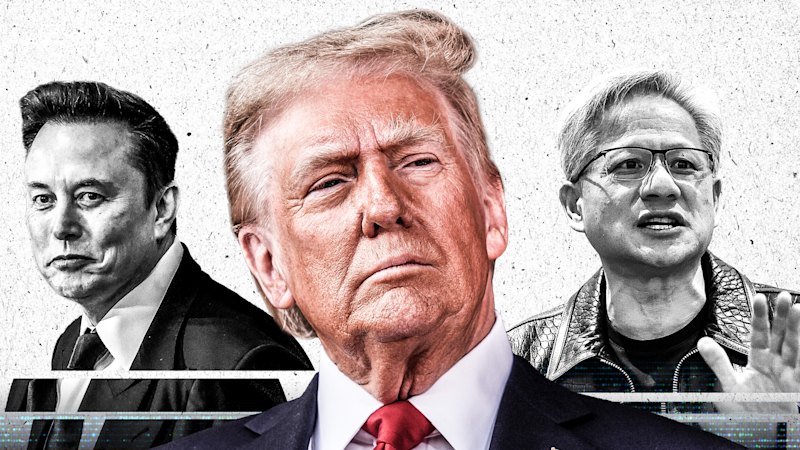
The convergence of accelerating computational infrastructure demands and federal regulatory gridlock has transformed artificial intelligence from a speculative Silicon Valley narrative into a core electoral friction point. Following the shift in congressional power, the structural posture of the Democratic party toward technological governance has transitioned from passive observation to an aggressive legislative mandate. Donald Trump’s administrative dismissals of existential risk narratives—characterized by the dismissal of catastrophic safety concerns as political posturing—have created an ideological fault line between executive deregulation and state-level intervention.
Potential 2028 Democratic presidential contenders are navigating this divergence through distinct operational strategies. Evaluating how figures such as California Governor Gavin Newsom, Pennsylvania Governor Josh Shapiro, and former Vice President Kamala Harris position themselves reveals the structural mechanics of contemporary tech policy.
The Sub-Federal Regulatory Arbitrage
With federal legislative movement constrained by divided governance and executive resistance, statehouses have become the primary laboratories for technological containment. State-level actors face a collective action problem: imposing strict liability or operational moratoria on domestic labs risks capital flight to jurisdictions with permissive compliance regimes.
California has leveraged its unique market gravity to establish de facto national standards. Governor Gavin Newsom’s executive actions—introducing whistleblower protections, mandatory algorithmic transparency guidelines, and emergency shut-down protocols for frontier models—operate as a direct counter-weight to federal laissez-faire stances. This approach exploits the California Effect, wherein compliance costs inside a dominant state market compel nationwide corporations to standardize their entire pipeline to match that single jurisdiction's thresholds.
Conversely, industrial swing states face a different economic equation. Pennsylvania Governor Josh Shapiro has pursued a calibrated middle-tier framework, separating existential risk rhetoric from the immediate externalities of physical infrastructure. Power grid strain, localized water table depletion from cooling systems, and municipal energy rate spikes caused by high-density data centers represent quantifiable variables that impact local constituencies immediately. Shapiro’s executive mandates target the physical footprint of the buildout rather than algorithmic weights, requiring developers to internalize environmental and electrical upgrade costs before receiving municipal zoning approval.
The Divergence in Risk Frameworks
The political debate is underpinned by a fundamental classification error: conflating probabilistic national security risks with deterministic economic externalities.
The administration’s dismissals rely on an international competitiveness argument. The core premise asserts that decelerating domestic frontier training cycles to satisfy precautionary safety protocols hands a structural advantage to foreign competitors, specifically state-backed entities in jurisdictions lacking regulatory oversight. Under this economic model, computational speed is treated as a zero-sum geopolitical asset where second-place status equals systemic strategic failure.
The opposing faction, championed by progressive legislators and safety-focused state executives, models frontier systems through a hazard-mitigation lens akin to civil aviation or pharmaceutical deployment. This framework assumes that unconstrained scaling of autonomous optimization engines introduces tail risks that cannot be patched post-deployment. However, this approach struggles with operational enforcement. Because model weights can be distributed across global server clusters, geographical containment policies face high evasion probabilities.
Electoral Positioning and the Labor Vector
As the 2028 cycle approaches, the political viability of technological governance rests on labor market impacts rather than abstract philosophical debates about superintelligence.
The integration of agentic workflows into white-collar administrative sectors alters the historical dynamics of automation. Previous industrial shifts primarily displaced manual labor through robotics, creating political coalitions centered around manufacturing decline. The current wave targets cognitive labor—legal analysis, software engineering maintenance, financial auditing, and bureaucratic processing—shifting the demographic of affected voters toward middle-class professional classes.
Democratic candidates are attempting to synthesize a coherent response that avoids outright technological Luddism while insulating workforce segments from rapid devaluation. Kamala Harris’s historical portfolio of balancing innovation promotion with consumer privacy guardrails serves as a template for moderate positioning. The strategic objective is to shift the tax and regulatory burden away from foundational research and toward corporate deployment velocity, funding retraining initiatives via operational levies on automated displacement.
Structural Outlook for Infrastructure Capital
The collision between administrative deregulation and state-level resistance creates acute market uncertainty for institutional investors allocating capital toward compute infrastructure.
[Federal Deregulation Mandate]
       │
       ▼
[Unconstrained Compute Buildout] ──> [Grid Strain & Resource Depletion]
                                            │
                                            ▼
                               [State-Level Moratoria & Mandates]
When federal executive orders seek to preempt municipal restrictions on data centers, they collide directly with gubernatorial and legislative powers over local zoning, environmental standards, and public utility commission rate structures. This friction guarantees protracted litigation, shifting compliance risk from statutory law to administrative agency rule-making and judicial injunctions.
To insulate portfolios against regulatory shocks, capital allocators must price in the probability of regional fragmentation. Infrastructure deployment will increasingly favor jurisdictions with secure, off-grid energy sources—such as dedicated nuclear or localized renewable microgrids—to bypass public utility commission battles over electrical rate inflation passed down to residential consumers. The political survival of any candidate attempting to navigate this space will depend on their ability to decouple the macro-economic gains of technological supremacy from the micro-economic pain of localized resource scarcity.